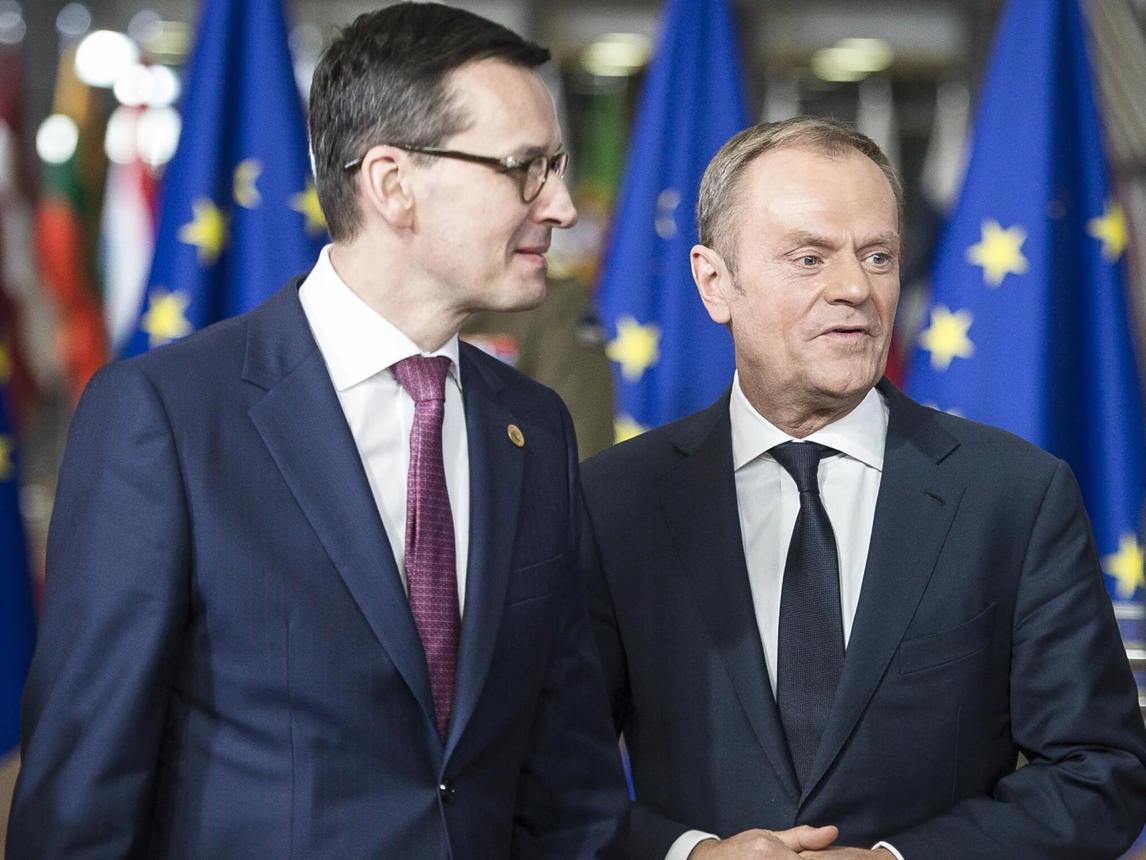
In Poland, on 31 October 2026, former Prime Minister Mateusz Morawiecki announced a motion of no confidence in Donald Tusk’s government against the backdrop of a constitutional crisis. The politician proposed forming an interim government led by former Sejm Speaker Marek Jurek, which would remain in office until the next parliamentary elections. This was prompted by events surrounding the Constitutional Tribunal, where the removal of the institution’s leadership was announced on 30 October. This was reported by Euronews and Suspilne.
Morawiecki proposes reshuffling the Polish government ahead of the 2027 elections
Mateusz Morawiecki, who heads the «Rozwój Plus» political alliance, has announced his intention to seek the resignation of the cabinet Donald Tusk through the mechanism of a constructive vote of no confidence.
The politician published a statement to this effect on the social media platform X on 31 October. According to him, the current political situation calls for a change of government and a resolution to the conflict surrounding the Constitutional Tribunal.
For the post of the new Prime Minister Moravetsky suggested Marek Jurek, who served as Speaker of the Polish Sejm from 2005 to 2007. The proposal is to form a caretaker government, whose main task will be to stabilise the situation and prepare for the parliamentary elections in 2027.
Moravetskyy believes that the Constitutional Tribunal needs to be reformed; however, in his view, the current government cannot be involved in this process due to recent events surrounding the institution.
The former prime minister accused Tusk’s government in an attempt to unlawfully seize control of the Constitutional Tribunal. This is Morawecki’s political assessment, not a fact established by the court.
What caused the political crisis in Poland?
The situation came to a head on 30 October, when a judge of the Constitutional Tribunal, AAnna Korwin-Piotrowska announced the suspension of the head of the organisation from his duties Bogdan Svienchkovsky and his deputy Bartłomiej Sohanski.
She explained her decision by stating that the management had allegedly obstructed the holding of the general meeting of judges and the tribunal’s proper functioning.
The opposition party «Law and Justice» regarded these actions as unlawful interference in the work of a constitutional body. Outside the tribunal building Protests took place in Warsaw, and the police arrived at the scene.
President of Poland Karol Navrotskyi convened urgent consultations with representatives of the political groups in parliament. He himself Svienchkovsky did not accept the decision to suspend him.
Tusk responded to the opposition’s accusations
Prime Minister Donald Tusk takes the opposite view. He described the events surrounding the Constitutional Tribunal as part of the process of restoring the rule of law in Poland.
«Restoring the rule of law is a long and, at times, painful process», said Tusk, emphasising the need for decisive action.
Minister of Foreign Affairs of Poland Radoslav Sikorsky He also supported the changes. He accused the tribunal’s previous leadership of obstructing the work of the newly appointed judges.
According to Sikorsky, the actions of the law enforcement agencies were aimed at ensuring that lawfully elected judges could carry out their duties.
Consequently, representatives of the current government describe the events as a restoration of the rule of law, whilst the opposition and the president’s inner circle question the legitimacy of the change in the tribunal’s leadership.
Two Polish ambassadors have announced their resignation
The political crisis has also affected Poland’s diplomatic service. Against the backdrop of the conflict, the Ambassador to Romania, Paweł Solokh, and the Ambassador to China, Jakub Kumoch, have announced the conclusion of their missions.
Solokh stated that he did not see any possibility of continuing to carry out his diplomatic duties following the events surrounding the Constitutional Tribunal. He informed the Ministry of Foreign Affairs and the Office of the President of Poland of his decision.
Kumoch also announced the completion of the work in China, assuring that the Polish embassy would continue to operate as normal.
Foreign Minister Radosław Sikorski criticised Kumoh’s decision, describing this way of bringing the diplomatic mission to a close as unprofessional.
Could Tusk’s government be forced to resign?
Under Article 158 of the Polish Constitution, a constructive vote of no confidence requires a written motion signed by at least 46 members of the Sejm. The document must include the name of a candidate for the post of Prime Minister.
To bring down the government, the motion must secure at least 231 votes out of 460 MPs. The vote may be held no earlier than seven days after the motion has been formally tabled.
If. Sejm If a motion of no confidence is passed, the President accepts the resignation of the current government and appoints the new Prime Minister elected by Parliament.
As of 31 October, Morawiecki had publicly announced his intention to seek the resignation of Tusk’s government; however, there has as yet been no official confirmation that the relevant document has been tabled in the Sejm. It is also unclear whether his initiative will be able to secure the support of the necessary number of MPs. The next step should be the formal tabling of the motion and the setting of a date for parliamentary debate.