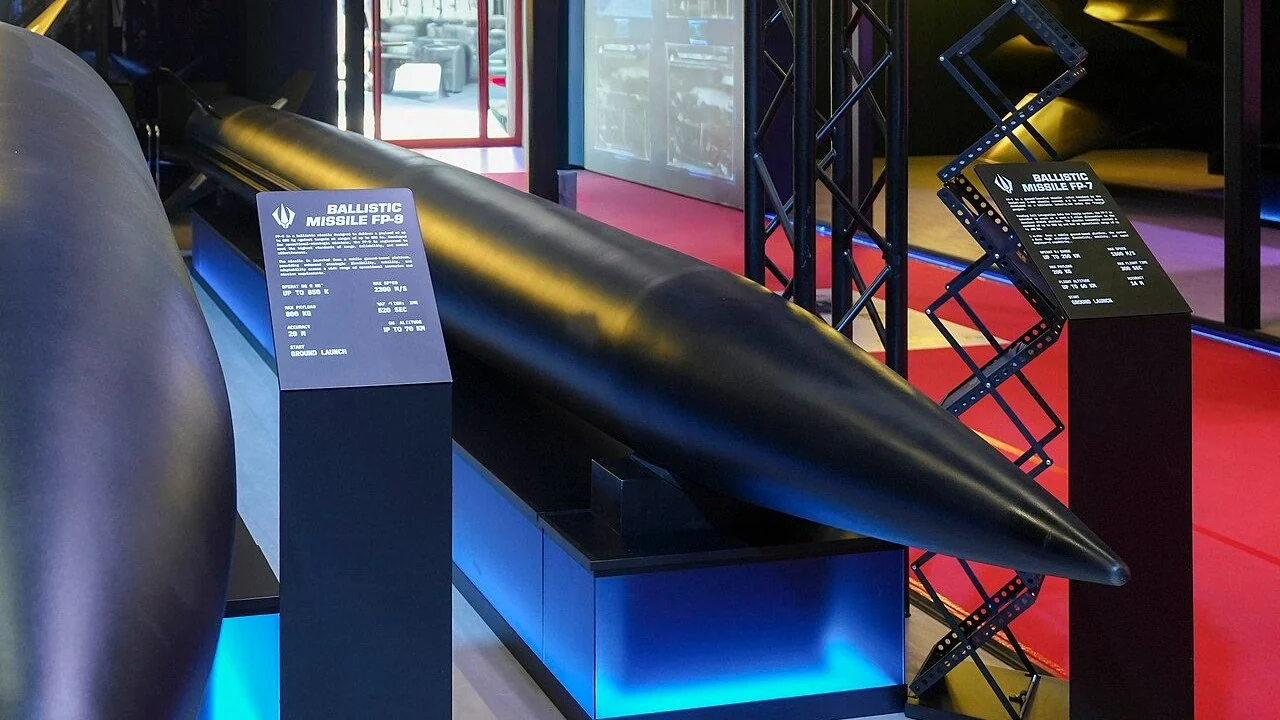
The Ukrainian FP-7 ballistic missile, manufactured by Fire Point, was presented as a more affordable alternative to the American ATACMS, capable of enhancing the Defence Forces’ long-range capabilities. After months of anticipation, President Volodymyr Zelenskyy announced its first combat deployment; however, the company’s chief designer, Denys Shtilerman, now admits that using the missile with a conventional warhead is not economically viable. The cost of a single such strike could be around $600 thousand, whilst a mission with a payload of similar mass, he says, can be carried out by a drone for $50 thousand.
From a «cheap alternative to the ATACMS» to a missile that is not cost-effective to launch
As far back as the spring of 2026, Fire Point was actively discussing the future of Ukrainian ballistics.
In March Denis Stielerman stated that FP-7 It is set to become the equivalent of the American ATACMS, whilst costing at least half as much. The main advantage of the design was said to be the possibility of establishing mass production.
The plans sounded promising. Ukraine was to acquire its own missile, the use of which would not be subject to authorisation from foreign partners.
On 1 October, the President Volodymyr Zelenskyy announced the first combat use FP-7. He posted a video of the launch and expressed his gratitude for the result, stating that the next stage would be production.
It seemed as though the months-long saga of announcements was finally moving into the practical stage. But now an important detail has come to light: The manufacturer itself does not see any economic justification for the widespread use of the rocket in its standard configuration.
According to Stilerman, delivering a 200 kg warhead over a distance of around 300 km using a ballistic missile costs approximately $600 thousand. A payload of similar mass can be delivered by a strike drone FP-2 around $50 thousand.
The difference is a factor of 12. This naturally raises the question: if the manufacturer is aware of such a difference in cost, for what specific purposes are they planning to mass-produce the FP-7?
The most interesting thing is that they were already aware of the high price back in the summer
This latest statement might seem like an unexpected revelation following the combat trials. However, Stilerman put forward similar arguments as far back as 27 June. At the time, he stated that, under certain conditions, the FP-7 is significantly inferior to drones in terms of the price-to-payload ratio.
So, this is not a problem that was suddenly discovered following the October launch. At least publicly, the developer had acknowledged it long before the missile’s first announced combat deployment.
This makes it all the more important to consider how the system’s cost-effectiveness was assessed when its capabilities and plans for mass production were presented. After all, for a country that spends vast resources on defence every day, the cost of armaments is by no means a secondary consideration.
However, there is an important caveat here. It is not correct to compare a ballistic missile and a drone solely on the basis of the cost of delivering 200 kg.
Ballistics has different velocity characteristics and may be necessary to engage targets that require an immediate response. A slower drone is not always capable of carrying out the same combat mission.
Stilman himself had previously cited the need to attack an enemy launcher quickly as an example.
Therefore, the FP-7 cannot automatically be dismissed as unnecessary. However, if the missile is intended primarily for specialised missions, then this is precisely what needs to be explained to the public, rather than giving the impression that it is a versatile, cheap weapon for mass strikes.
Hopes are now pinned on the cassette version of the FP-7
According to the designer, the use of The FP-7, with its conventional high-explosive warhead, is not currently cost-effective.
The situation may change following the introduction of the variant with a cassette warhead, which the company considers to be more promising. And, of course, this will entail a whole host of additional costs.
Meanwhile, Fire Point is continuing to develop a more powerful ballistic missile FP-9. According to the company’s latest statements, it is in the final stages of testing.
The manufacturer also assures that it is not discontinuing production of the «Flamingo» cruise missiles and the FP-1 and FP-2 attack drones.
In other words, the Fire Point missile programme is continuing as a whole. However, according to the developer’s own assessment, the feasibility of the widespread use of the specific FP-7 model, equipped with a conventional warhead, remains in doubt.
Grand promises and real results: who should be held accountable for the outcome?
Ukrainian society has good reason to demand an explanation when, following high-profile announcements, a manufacturer acknowledges significant economic constraints on its development programme. This is not a demand to disclose military secrets or the exact number of missiles produced. Such information could have a direct impact on national security.
However, questions regarding the justification of costs, test results and plans for mass production are entirely legitimate.
How much did the development of the FP-7 cost? Did it receive separate government funding? What performance targets were set before production began? Do the actual results meet the military’s initial expectations?
There is not enough publicly available information to provide comprehensive answers.
Fire Point had previously stated that it had funded part of its missile development programme from its own profits. At the same time, the company is a major contractor for government defence contracts, so questions regarding the proper oversight of the use of public funds remain relevant.
In themselves, a change in priorities, the high cost of a rocket or even a failed development project do not constitute evidence of embezzlement. It would be unfounded to claim the opposite without any supporting documents or the findings of an investigation.
However, the lack of evidence of a crime does not negate the need to explain why such a vital defence programme faced economic constraints that were known even before it was deployed in combat.
Ukraine needs its own ballistic missiles. And the successful development of such weapons could indeed prove to be a significant achievement for the defence industry.
But there is a world of difference between a promising prototype and a mass-produced combat system. Neither flashy presentations nor yet another promise of a swift start to production can bridge that gap.
For the time being, the key question regarding the FP-7 remains unanswered: will this missile prove to be an effective asset for the Defence Forces at a cost that Ukraine can afford?