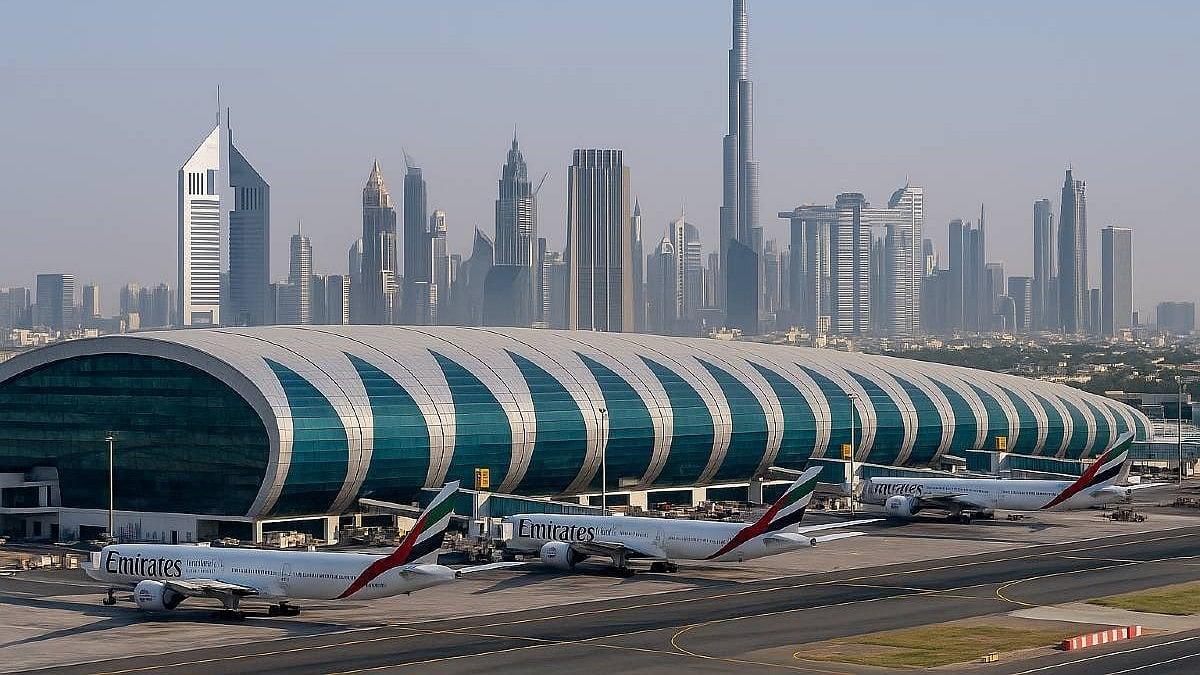
Dubai International Airport (DXB) handled 50.4 million passengers in January–September 2026, a decrease of 28.1 per cent compared with the same period last year. The decline was attributed to hostilities in the Middle East, airspace closures and the suspension of flights. This was reported on 17 November by Dubai Airports, the company that operates the airport, according to Reuters. At the same time, Paul Griffiths, Chief Executive of Dubai Airports, stated that passenger traffic is gradually recovering and that international airlines are returning.
Key points at a glance:
- Passenger numbers at Dubai Airport fell by 28.1 per cent in the first nine months of 2026, to 50.4 million people.
- In the third quarter, the airport handled 18.8 million passengers, which is 22.1 per cent fewer than last year.
- The main reasons for the decline were the war in the Middle East and restrictions on air travel.
- Dubai Airports forecasts over 70 million passengers by the end of 2026, but this is significantly lower than the record 95.2 million in 2025.
By how much has passenger traffic at Dubai Airport fallen?
According to the official report by Dubai Airports, in the first nine months of 2026, 50.4 million passengers passed through Dubai International Airport.
By way of comparison, during the same period in 2025, the airport handled approximately 70.1 million passengers. It therefore lost nearly 19.7 million passengers over the course of the year.
The situation improved slightly in the third quarter. Between July and September, the airport handled 18.8 million passengers, although this is still 22.1 per cent fewer than in the corresponding period last year.
August was the busiest month of the quarter, with 6.6 million passengers passing through the airport. This indicates a gradual recovery in demand following the most severe disruptions in the spring.
How has the war in the Middle East affected air travel?
The fall in passenger numbers is linked to a war between the US, Israel and Iran, which began on 28 February 2026.
Due to the hostilities, a number of countries in the region temporarily closed their airspace. Airlines were forced to cancel flights, alter routes and restrict flights to major transport hubs Persian Gulf.
Dubai has been particularly hard hit by the consequences of these decisions, as a significant proportion of its passengers use the airport as a transit point between Europe, Asia, Africa and other regions of the world.
Following the ceasefire on 8 April, air services began to resume. However, some international airlines have not yet returned to their previous timetables.
According to the aviation publication Skift, 108 airlines operated at the airport in 2025, whereas there are now only 57.
Which airlines are resuming flights to Dubai?
In November 2026, the British airline British Airways resumed flights to Dubai International Airport.
Royal Air Maroc, SunExpress and Cebu Pacific have already resumed flights on these routes. Dubai Airports management expects other international carriers to resume flights in the coming weeks.
DXB currently offers flights to 235 destinations in 101 countries around the world.
Paul Griffiths, Chief Executive of Dubai Airports, told Reuters that advance bookings for the next two weeks indicate steady demand. He said that the gradual return of airlines is paving the way for a further recovery in air travel.
At the same time, not all carriers are planning to resume flights to Dubai this year. Some airlines have postponed the resumption of flights until early 2027 due to security risks and flight restrictions over certain countries in the Middle East.
Which countries account for the highest number of passengers?
India remains the largest international market for Dubai Airport.
In the third quarter of 2026, passenger traffic by major country was distributed as follows:
| Country. | Passengers |
|---|---|
| India | 2.6 million |
| Saudi Arabia | 1.4 million |
| United Kingdom | 1.3 million |
| Pakistan | 800,000. |
| USA | 640,000. |
| Germany | 480,000. |
Among individual cities, London had the highest number of passengers — 784,000. It was followed by Mumbai with 528,000, New Delhi with 525,000 and Riyadh with 500,000.
In September, transit passengers accounted for 51 per cent of the total passenger flow, whilst passengers arriving in or departing from Dubai directly accounted for 49 per cent.
Will Dubai Airport be able to resume flights by the end of the year?
Dubai Airports’ management expects the airport to handle over 70 million passengers by the end of 2026. In an interview with Reuters Paul Griffiths cited a figure of 71 million people.
This would represent a significant reduction compared with 2025, when DXB set a record of 95.2 million passengers.
The consequences of the regional war have affected more than just passenger transport. Over the course of nine months, the number of take-offs and landings fell by 27.6 per cent to 243,000, whilst the volume of freight transport decreased by 23.2 per cent to 1.215 million tonnes.
At the same time, the airport continues to invest in automation, biometric technologies and passenger flow forecasting systems in order to make more efficient use of its existing infrastructure.
As of 17 November, Dubai International Airport is gradually resuming operations, but has not yet returned to pre-war levels. Future developments will depend on the security situation in the Middle East and the pace at which international airlines resume their flights.