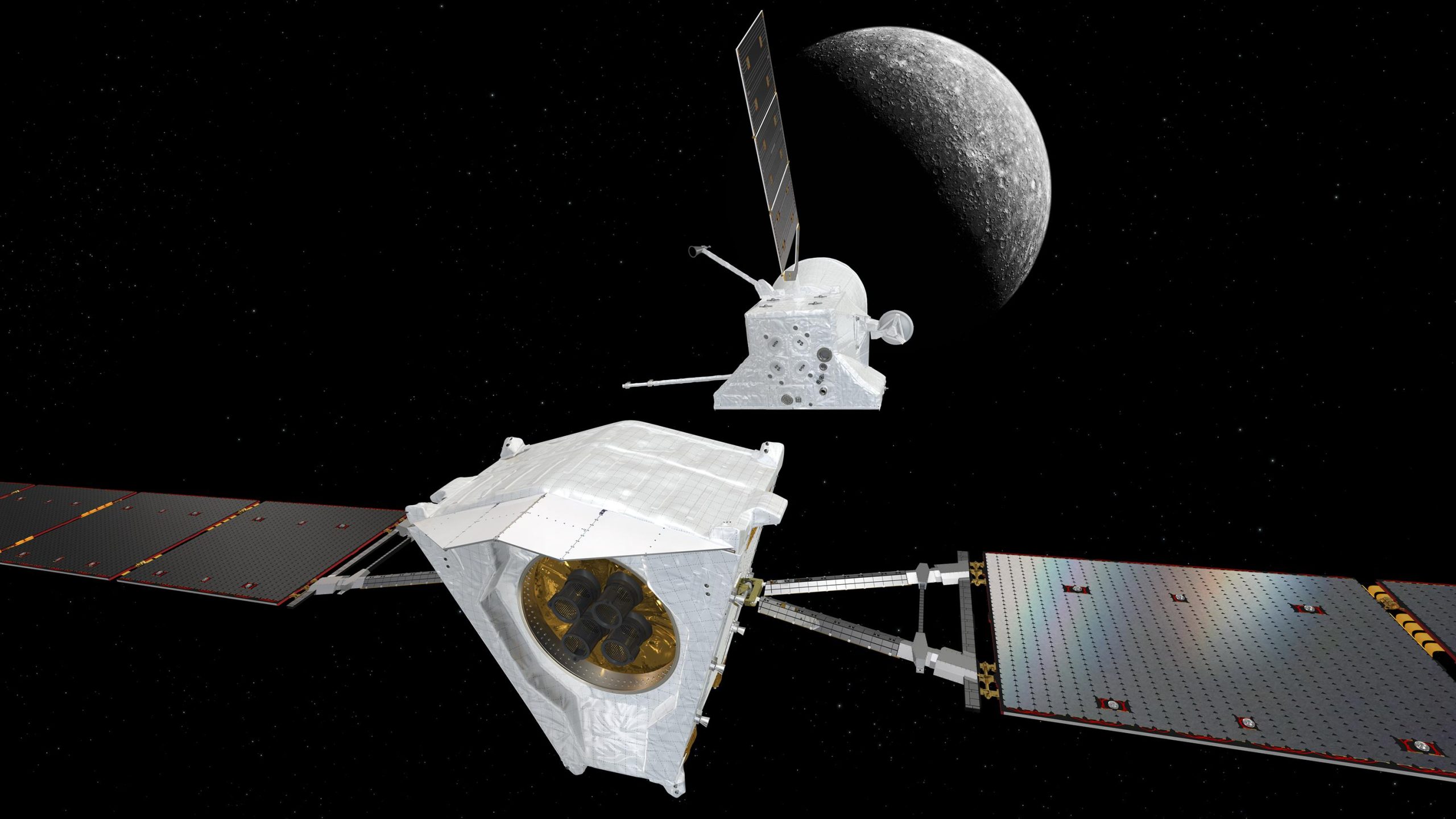
The BepiColombo space mission, a joint venture between the European Space Agency (ESA) and the Japan Aerospace Exploration Agency (JAXA), is due to enter Mercury’s orbit on 21 November 2026 following an eight-year journey. Since launch, the spacecraft have travelled approximately 9.9 billion kilometres and performed nine gravity assists near planets. This has been reported by the European Space Agency. The mission will be the first in which two scientific orbiters will operate simultaneously around Mercury.
BepiColombo is completing its eight-year journey to Mercury
The BepiColombo mission was launched on 20 October 2018 from the Kourou spaceport in French Guiana. According to the original plan, the spacecraft were due to enter Mercury’s orbit in December 2025, but due to technical difficulties with the engines, the journey had to be extended by almost a year.
Unlike flights to the outer planets The Solar System, a journey to Mercury requires the spacecraft to slow down considerably. Due to the Sun’s powerful gravitational pull, entering the planet’s orbit directly is extremely difficult.
To gradually adjust its trajectory, BepiColombo utilised the gravity of Earth, Venus and Mercury itself. In total, the spacecraft carried out nine flybys of the planets before approaching the final stage of the mission.
In September 2026, the MTM transport module, which had been responsible for propelling the spacecraft during their interplanetary journey, separated from the main structure. Thereafter, control of the trajectory passed to the European MPO orbiter.
What the two spacecraft will be studying
The mission consists of two scientific probes, which will operate in different orbits around Mercury.
The European Mercury Planetary Orbiter (MPO) is equipped with instruments to study the planet’s surface, chemical composition, topography and internal structure. Scientists hope to obtain more accurate data on its large metallic core and geological history.
The Japanese Mercury Magnetospheric Orbiter, known as Mio, will study the planet’s magnetic field, flows of charged particles and Mercury’s interaction with the solar wind.
Mercury remains one of the least studied planets in the Solar System. Prior to BepiColombo, it had been studied by the American spacecraft Mariner 10 and MESSENGER, although only the latter operated in orbit around the planet.
The European-Japanese mission will enable simultaneous observation of Mercury’s surface and its space environment, which should help establish a link between processes in the planet’s interior and its magnetosphere.
Why is Mercury so difficult to study?
Mercury is the planet closest to the Sun and the smallest in the Solar System. Its surface experiences significant temperature fluctuations: during the day, temperatures can exceed 400 °C, whilst at night they can drop to around −180 °C.
Such conditions pose serious challenges for spacecraft. Scientific instruments require special thermal protection, whilst solar panels must operate in conditions of intense radiation.
Mercury’s magnetic field is of particular scientific interest. Unlike most other rocky planets, it has its own global magnetic field, the origin and characteristics of which researchers are seeking to understand.
Data from BepiColombo will help refine models of the formation of Earth-like planets and the processes that took place during the early stages of the Solar System’s development.
When will BepiColombo begin its main scientific investigations?
The entry into orbit on 21 November is just the start of the final series of manoeuvres. After being captured by Mercury’s gravity, the two scientific spacecraft still need to separate and move into their respective operational orbits.
Key stages of the mission
-
21 November 2026
The planned launch of the combined spacecraft into Mercury’s orbit.
-
9–10 December 2026
Disassembly of the Japanese Mio device.
-
16 December 2026
Removal of the Mio protective housing.
-
10 March 2027
The European MPO is set to reach its scientific orbit.
-
6 April 2027
The planned start of the main research phase.
ESA timetable; subject to change for operational reasons.
Over the coming months, specialists will be checking the equipment, calibrating the instruments and preparing the devices for regular observations.
As at 21 November ESA confirms the scheduled date for BepiColombo to enter orbit; however, there is as yet no report in verified official updates regarding the successful completion of this manoeuvre. Once entry into orbit has been confirmed, the mission will move on to preparing for the separation of the two probes and the launch of the scientific programme in 2027.