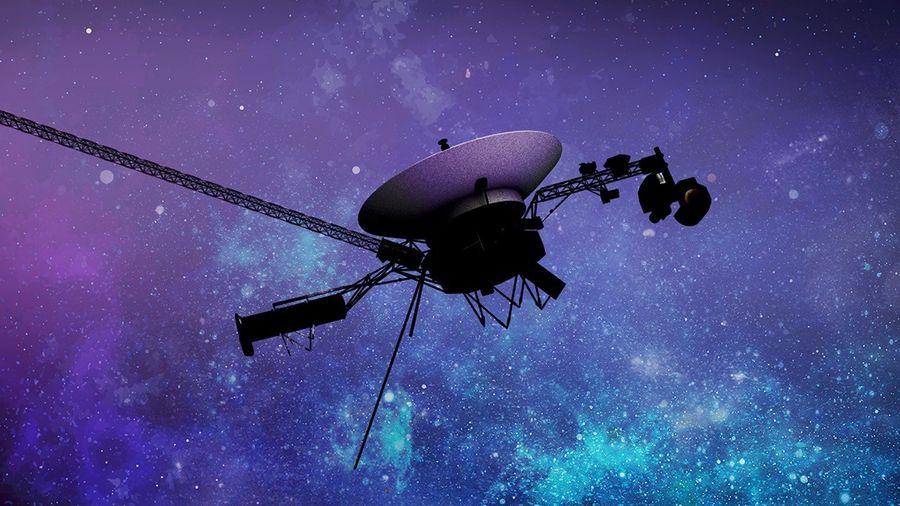
On 19 November 2026, the US space agency NASA officially confirmed a new record set by the Voyager 1 space probe. Launched in 1977, the probe became the first man-made object to travel one light-day’s distance from Earth — approximately 25.9 billion kilometres. It reached this historic milestone on 18 November at 12:16 Kyiv time, but confirmation came the following day, as it took the radio signal 24 hours to reach Earth.
- Voyager 1 reached a distance of 25.9 billion km from Earth on 18 November 2026.
- The radio signal from the spacecraft now takes approximately 24 hours to reach Earth.
- NASA confirmed the record on 19 November after receiving a signal from the probe.
- Since 14 November, Voyager 1 has not been transmitting scientific or technical data, but contact with it has been partially maintained.
Voyager 1 has travelled the distance that light covers in a day
According to calculations NASA, Voyager 1 reached this historic milestone on 18 November at 05:16:07 Eastern Time. The distance between the spacecraft and Earth at that moment was 25,902,068,356 kilometres.
This means that even radio waves, which travel at the speed of light, now take a full day to travel from the probe to our planet.
By way of comparison, sunlight takes approximately 8 minutes and 20 seconds to reach Earth, and around four hours to reach Neptune.
Voyager 1 continues to move away from the Solar System at a speed of around 61,000 kilometres per hour. Despite this, after nearly half a century of flight, the spacecraft has covered only a small fraction of the distance to the nearest stars.
Head of NASA’s Heliophysics Division Joe Westlake He described reaching one light-day as a unique achievement, but emphasised that the mission’s significance extends far beyond simply setting records. The probe continues to help scientists explore space beyond the heliosphere.
NASA has confirmed the record, but has identified a problem with data transmission
Along with the announcement of the historic record, NASA has revealed a new technical problem with Voyager 1.
According to the agency, the spacecraft stopped transmitting scientific measurements and engineering telemetry on 14 November. However, ground-based antennas continue to receive a carrier signal, which confirms that the spacecraft’s transmitter is operational.
It was this signal, together with trajectory calculations, that enabled NASA to confirm that Voyager 1 had successfully travelled a record-breaking distance.
Engineers suspect that the problem may be linked to the on-board computer, which collects information from various systems and prepares it for transmission to Earth.
Diagnosis is made more difficult by the vast distance involved. A command sent from Earth takes approximately 24 hours to reach the spacecraft, and the reply takes a further 24 hours to return. Consequently, a single complete cycle of signal exchange takes around 48 hours.
NASA is continuing to investigate the fault. A similar problem occurred in 2023, and on that occasion the specialists managed to restore normal data transmission.
Almost 50 years in space: how Voyager 1 set a record
Voyager 1 was launched from Cape Canaveral on 5 September 1977. Its mission was originally intended to explore Jupiter and Saturn, but the spacecraft continued its journey far beyond these planets.
The main stages of the Voyager 1 mission
-
1977 — launch of a NASA spacecraft
-
1979 — research into Jupiter and its moons
-
1980 — flyby near Saturn and its moon Titan
-
2012 — exit from the heliosphere into interstellar space
-
18 November 2026 — reaching a distance of one light-day
In 2012, Voyager 1 became the first spacecraft to cross the heliopause — the outer boundary of the region dominated by the solar wind.
Its twin spacecraft, Voyager 2, reached interstellar space in 2018. According to NASA’s forecasts, it will be one light-day away from Earth at around November 2035.
Both probes carry gold discs containing photographs, sounds from Earth and other information about humanity. They were created as a message to potential extraterrestrial civilisations.
How much longer will Voyager 1 continue to operate?
The gradual reduction in electricity reserves remains the main challenge for the mission.
Voyager 1 is powered by a radioisotope thermoelectric generator, the output of which is gradually decreasing. As a result, NASA is gradually switching off individual scientific instruments to conserve energy for the most critical systems and for communication with Earth.
In April 2026, engineers switched off the Low-Energy Charged Particles instrument, which was studying charged particles in outer space. This decision was intended to help keep the organisation running.
According to estimates by NASA’s Jet Propulsion Laboratory, energy-saving measures could enable the Voyager spacecraft to maintain contact with Earth for a further three to four years or so. However, the actual duration will depend on the technical condition of the equipment.
As of 19 November, Voyager 1 remains the most distant man-made object. NASA has confirmed its record based on a radio signal received, although the question of whether scientific and technical data can be recovered remains open. Engineers are continuing their diagnostics, whilst the spacecraft continues its journey through interstellar space.