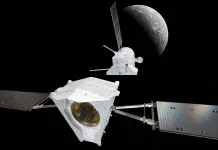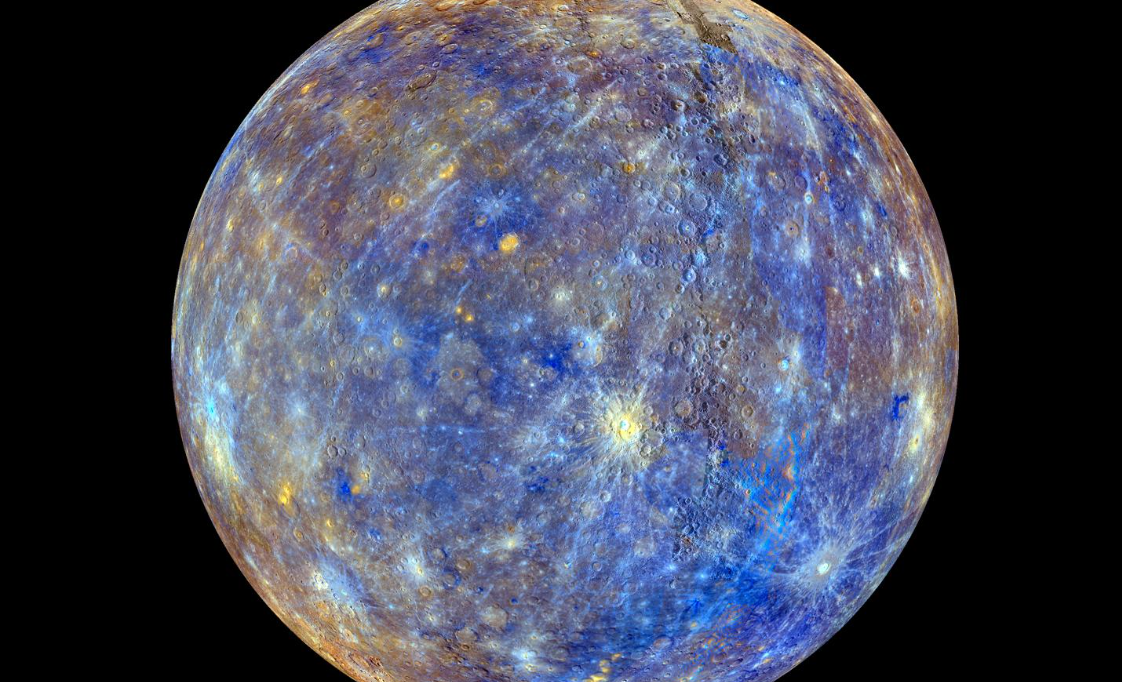
After eight years of travelling through the Solar System, the European-Japanese space mission BepiColombo has reached a crucial stage in its exploration of Mercury. The spacecraft is scheduled to enter orbit around the planet closest to the Sun on 21 November 2026. One of the mission’s main objectives is to determine how deposits of water ice could have survived in this extremely hot world.
- The BepiColombo space mission travelled to Mercury for over eight years.
- The surface temperature of the planet can reach +430°C during the day.
- Signs of water ice have been discovered in permanently shaded polar craters.
- Full-scale scientific research into Mercury is due to begin in April 2027.
Why did the journey to Mercury take eight years?
Spacecraft BepiColombo It was launched on 20 October 2018. During its journey, it has travelled billions of kilometres and performed nine gravitational manoeuvres near Earth, Venus and Mercury.
Despite the planet’s relative proximity to Earth, entering its orbit is extremely difficult. The Sun’s powerful gravitational field accelerates the spacecraft, so engineers have to gradually reduce its orbital velocity. Without doing so, the probe would simply fly past the planet.
According to the European Space Agency, reaching a stable orbit around Mercury requires even more energy than sending a mission to Pluto.
How can ice exist on the planet closest to the Sun?
Mercury is one of the most extreme worlds in the Solar System. Its surface temperature reaches +430°C during the day, and at night it drops to −180°C.
However, there are deep craters near the poles, the bottoms of which are never reached by sunlight. As a result, the temperature there remains low enough for water ice to persist for long periods.
Previous studies by the American MESSENGER spacecraft have provided strong evidence for the existence of such deposits. BepiColombo will help to investigate their composition and origin in greater detail.
Five amazing facts about Mercury
| Characteristics | Meaning. |
|---|---|
| Maximum daytime temperature | +430°C |
| Night-time temperature | down to −180°C |
| Length of the year | 88 Earth days |
| Length of the solar day | 176 Earth days |
| The diameter of the planet | 4,879 km |
Despite its proximity to the Sun, Mercury is not the hottest planet. That record is held by Venus, whose dense atmosphere causes an extremely powerful greenhouse effect.
What secrets might BepiColombo reveal?
The mission consists of two spacecraft that will study Mercury’s surface, its internal structure, its magnetic field and its interaction with the solar wind.
The planet’s disproportionately large metallic core is of particular interest to scientists. Understanding its origin could help us reconstruct the process by which rocky planets, including Earth, formed.
According to the current ESA schedule, the main scientific phase of the mission will begin on 6 April 2027.