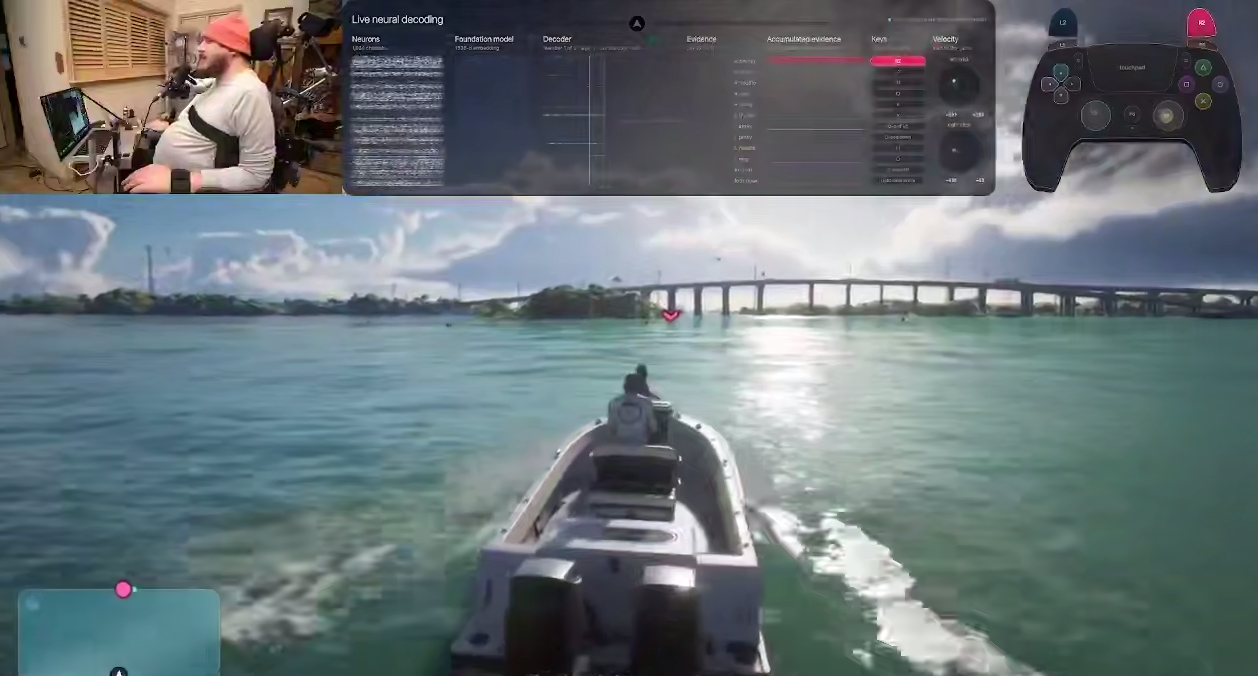
Elon Musk’s company Neuralink has demonstrated how a participant in a brain implant clinical trial controls a character in Grand Theft Auto VI using neural signals. The man was able to steer a speedboat, fly a seaplane, drive a car and take part in fights without using a conventional games controller.
- A participant in Neuralink’s clinical trials played GTA 6 using a neural implant.
- The system converts the brain’s neural signals into commands for a virtual games controller.
- The player drove a car, a speedboat and a seaplane, and took part in fights.
- Neuralink’s technology remains experimental and is currently undergoing clinical trials.
Neuralink has demonstrated how to play GTA 6 without a gamepad
The video was published on 20 November, the day after the official release Grand Theft Auto VI. The recording simultaneously shows the gameplay, the participant in the experiment, the neural activity decoding panel and the virtual controller, on which the activated buttons are highlighted.
The man explains that, to carry out certain actions, he uses signals associated with the intention to move his fingers. The system recognises these signals and converts them into the corresponding in-game commands.
The demonstration took place against a backdrop of excitement surrounding the new release from Rockstar Games, which received 99 points on Metacritic.
How the Neuralink brain implant works
At the heart of Telepathy technology lies a neurocomputer interface that records the brain’s electrical activity using implanted electrodes. The software analyses the signals received, recognising activity associated with the intention to perform a specific movement.
Once the system has been calibrated, these signals can be used to control the cursor, enter text and interact with digital devices. However, the company did not reveal all the details of the control configuration during the GTA VI demonstration.
New opportunities for people with paralysis
Prior to the implant being fitted, the participant used a special stick, which he held in his mouth to interact with the iPad screen. The neural interface significantly expanded his ability to use digital devices.
Neuralink is also researching the control of robotic arms, wheelchairs and other devices. At present, the technology remains experimental and has not been approved for widespread medical use.