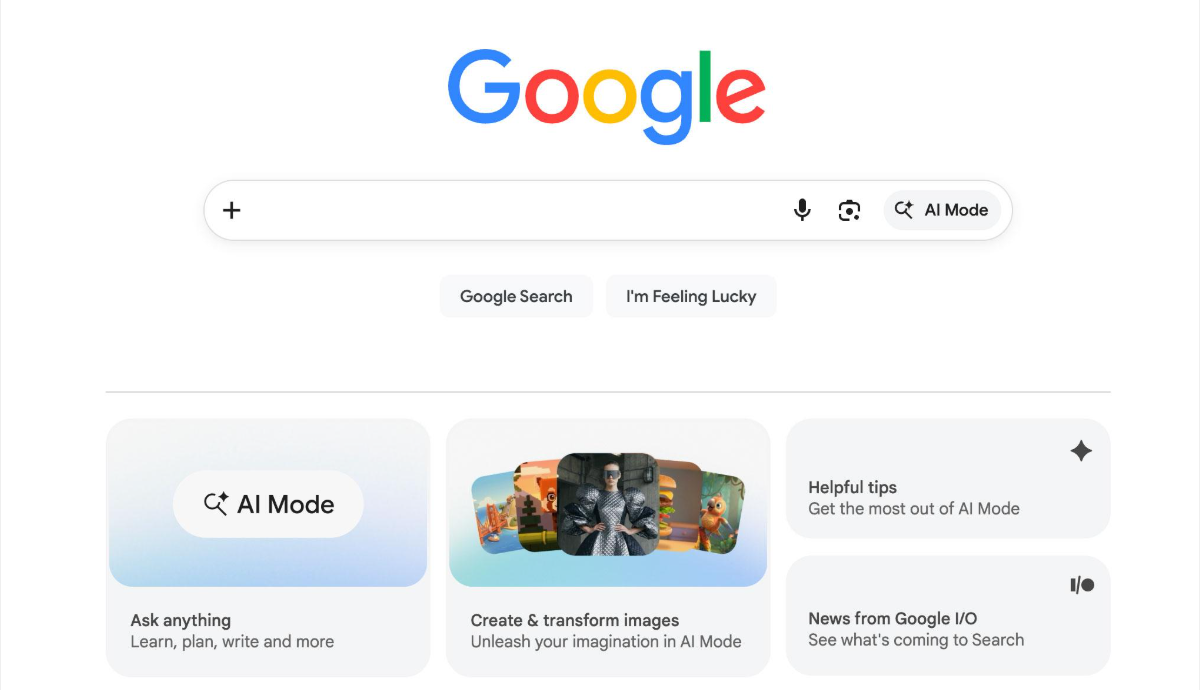
Google has launched a major redesign of its search engine, removing the traditional ‘Google Search’ button from the homepage of the desktop version. It has been replaced by tools powered by the Gemini artificial intelligence, and users can now return to previous conversations with the AI directly from the search page. The global roll-out of the update was announced on 19 November by Robbie Stein, Vice President of Google Search.
- Google is removing the traditional search button from its homepage.
- Its place is now taken by Gemini’s artificial intelligence tools.
- The sidebar provides access to the AI Mode query history.
- Standard search results and links to websites remain available.
What Google looks like now
Google has retained its recognisable logo and the search bar in the centre of the screen, but has changed the set of features below it.
Users were offered three tools:
- image generation using Nano Banana;
- uploading and analysing files;
- discussing ideas with Gemini.
The «I’m Feeling Lucky» button has remained, whilst the usual «Google Search» button has disappeared.
Authorised users also have access to a sidebar displaying their search history in AI Mode. It allows you to continue previous discussions without having to start the search all over again.
Will the standard Google search disappear?
Traditional search results remain available. Users can still enter a query, press Enter and receive a list of links to websites.
However, the new interface reflects a shift in the company’s priorities. Google is gradually transforming its search engine into an environment where users can not only find information, but also analyse documents, compare data and ask follow-up questions.
Back on 12 November, the company integrated the model into its search function Gemini 4 Hydrogen, by improving the processing of complex queries and the generation of structured responses.
What does this mean for website owners?
The more widespread adoption of artificial intelligence could change user behaviour and the distribution of organic traffic across websites.
A study by the Pew Research Centre, based on nearly 69,000 search queries made by American users in March 2025, revealed a significant difference in the number of visits to websites.
15%
8%
This information is not a forecast consequences new redesign, but they do show how the availability of ready-made answers can influence audience behaviour.
At the same time, Google emphasises in its official guidelines for webmasters that traditional SEO remains relevant. The company advises focusing on original content, the accuracy of information, the technical accessibility of pages and user-friendliness.
Google has not yet announced that it is moving away from traditional search results. However, the redesign of the homepage is further evidence of the shift from searching for links to interacting with information using artificial intelligence.