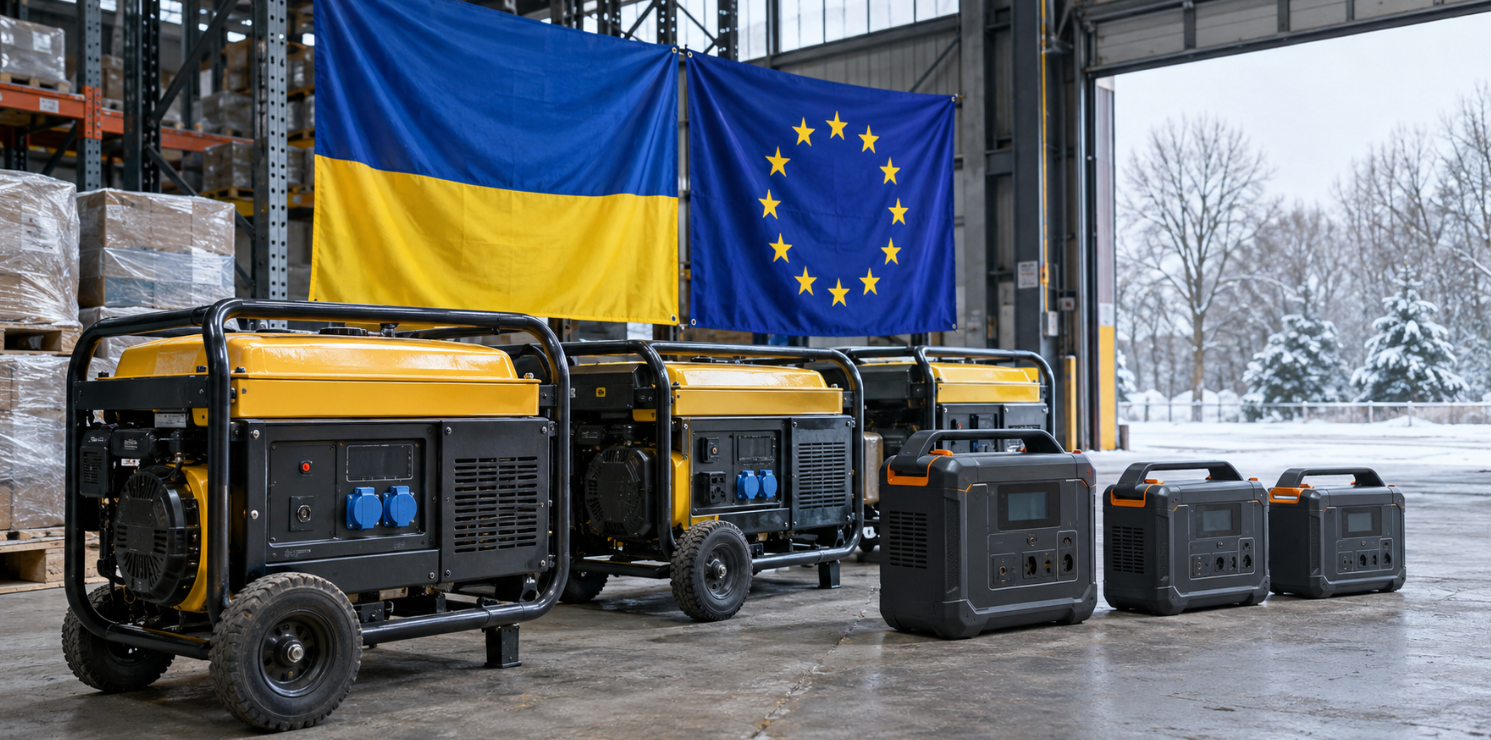
Ukraine and the European Union are working on an emergency winter aid package, which will include generators, charging stations, buses and equipment for the restoration of transport infrastructure. Prime Minister Serhiy Koretskyi has announced that on 16 November he will discuss the key details of the package with European Commission President Ursula von der Leyen in Brussels.
- Ukraine and the European Union are preparing an emergency aid package for the winter.
- The package will include the supply of generators, charging stations and passenger buses.
- The EU will help Ukraine to ensure transport links between the banks of the Dnieper.
- Ukraine also plans to speed up the implementation of reforms with a view to joining the European Union.
What will be included in the EU’s winter aid package?
According to Koretsky’s, the new support package is intended to help Ukrainian cities cope with the consequences of systematic Russian attacks on their energy and transport infrastructure.
Particular attention will be paid to the restoration of bridges and crossings, which are essential for ensuring reliable links between the banks of the Dnieper.
Previously, regarding additional supplies energy equipment Lithuania has also recognised Ukraine.
The Prime Minister emphasised that, following the Russian strikes on 15 November against power lines and substations in the Zaporizhzhia and Dnipropetrovsk regions, hundreds of thousands of people were left without electricity.
The Ukrainian side expects to finalise the agreement on the package in the near future and begin receiving the necessary equipment. The total cost and the quantities to be supplied have not yet been announced.
Ukraine is stepping up reforms with a view to joining the EU
During a working visit to Brussels, Koretsky and the Speaker of the Verkhovna Rada Ruslan Stefanchuk They also held talks with the European Commissioner for Enlargement Marta Kos.
The parties discussed the fulfilment of the interim benchmarks for the first negotiation cluster, «Fundamentals», which covers the rule of law, democratic institutions, the judiciary and the fight against corruption.
Ukraine aims to fulfil the necessary conditions and receive a positive report from the European Commission in the first half of 2027.
Ukraine has so far opened four of the six negotiation clusters. The remaining two are expected to open by the end of 2026.