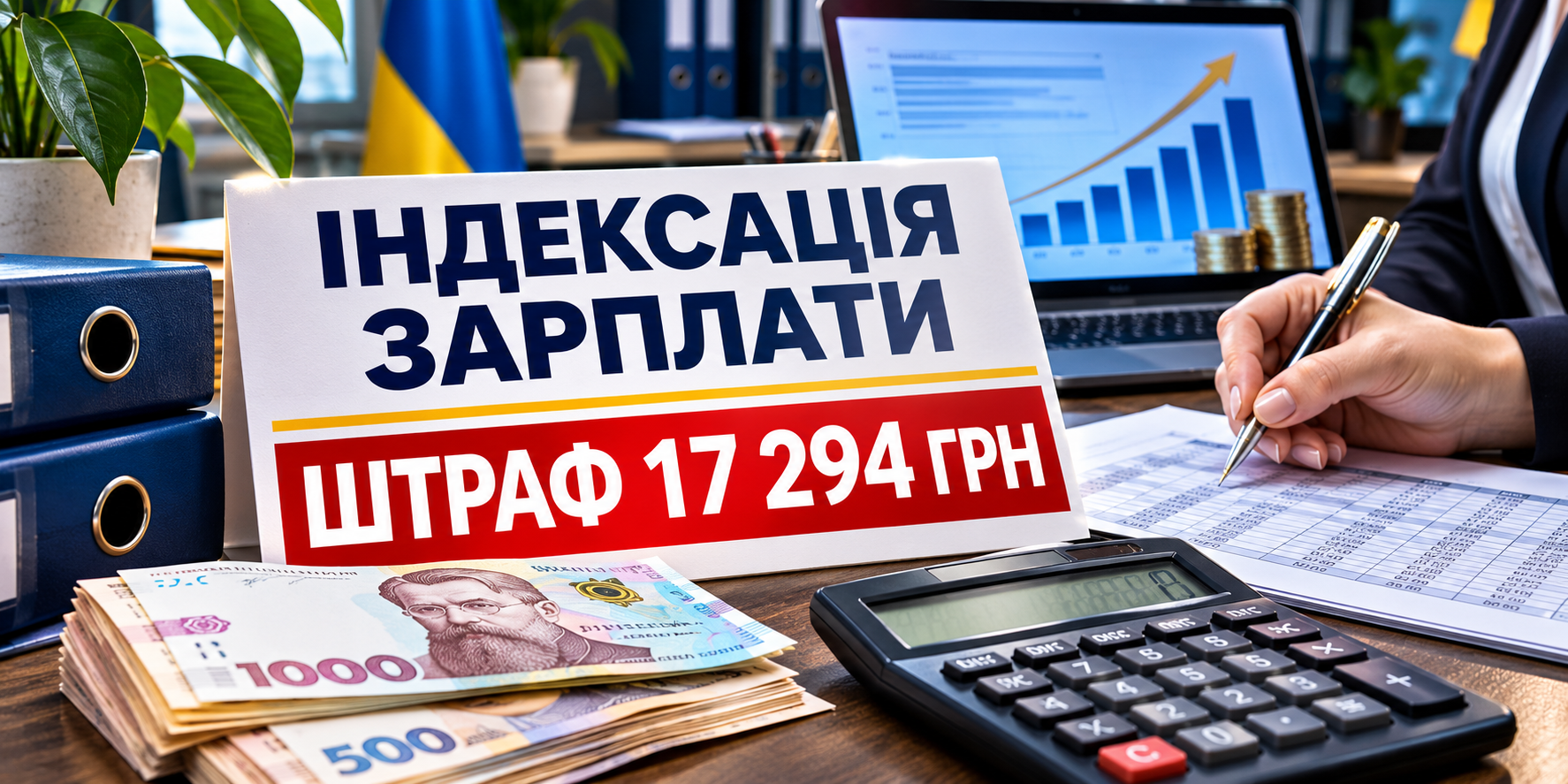
In Ukraine, employers are obliged to index employees’ wages in line with the rate of inflation. If a company or public sector organisation fails to comply with this requirement, the fine in 2026 may amount to 17,294 UAH for each employee in respect of whom a breach has been identified. There is also criminal liability for the deliberate and unjustified non-payment of wages for more than one month, and, under certain aggravating circumstances, imprisonment. This is reported by TSN, citing the provisions of labour legislation. The amounts of the financial penalties have been confirmed by the State Tax Service and the State Labour Service.
Key points at a glance:
- In 2026, the fine for failing to carry out the mandatory indexation of salaries is 17,294 UAH per employee.
- Officials also face an administrative fine of between 510 and 1,700 UAH.
- Criminal liability applies for the deliberate and unjustified non-payment of wages for more than one month.
- Imprisonment for a term of up to five years may be imposed for non-payment resulting from the misuse of funds.
- During martial law, special rules apply regarding the imposition of financial penalties and the rectification of breaches.
To whom and when is an employer obliged to index salaries?
Indexation wages — a mandatory mechanism for partial compensation for rises in consumer prices. It applies to both employees of public sector organisations and staff of private companies.
Employer must carry out indexation when the cumulative consumer price index exceeds the statutory threshold of 103 per cent. This does not mean that the manager is obliged to increase the basic salaries of all staff every month.
In 2026, the calculation rules changed: January was designated as the starting month, and the indexation calculated in December 2025 was not carried over to the new year.
According to calculations by the publication «Debit-Credit», in November 2026, the indexation rate for employees whose salaries have not been increased since January will be 7.6 per cent. The maximum additional payment for a full month’s work is 252.93 UAH.
If the salary was increased at a later date, the calculation is carried out on a case-by-case basis.
What penalties might an employer face for failing to pay the cost-of-living adjustment?
Under Article 265 of the Labour Code, failure to comply with the minimum state guarantees regarding pay is punishable by a fine of two times the minimum wage for each employee whose rights have been infringed.
As the minimum wage in 2026 is 8,647 UAH, the financial penalty amounts to 17,294 UAH per employee. If the breach affects ten employees, the total fine could reach 172,940 UAH.
Separate provisions are in place regarding the administrative liability of officials. Under Article 41 of the Code of Ukraine on Administrative Offences, the fine ranges from 510 to 1,700 UAH.
When a manager faces criminal liability
Article 175 of the Criminal Code of Ukraine provides for criminal liability for the deliberate and unjustified non-payment of wages or other statutory payments for a period exceeding one month.
Under the basic form of the offence, the penalties may include a fine of between 8,500 and 17,000 UAH, community service or probation for a period of up to two years, with a ban on holding certain posts.
A more severe penalty is imposed if the non-payment resulted from the misuse of funds intended for salaries. In such cases, the manager may face a prison sentence of up to five years.
However, the mere refusal to increase a salary does not automatically entail criminal liability. For criminal liability to apply, it is necessary to prove the circumstances specified by law, in particular that the non-payment was deliberate and without justification.
How does martial law affect employees, and where can they lodge a complaint?
During martial law, special rules apply to the imposition of labour fines. If an employer complies fully and within the prescribed time limits with an order to rectify breaches identified during an unscheduled inspection, fines under Article 265 of the Labour Code shall not be imposed.
Furthermore, an employer may be exempt from liability for failing to meet the deadlines for payment of wages if they can prove that this was caused by hostilities or other circumstances beyond their control. However, the obligation to pay employees the sums due to them remains.
If an employee does not receive the statutory pay rise, they may submit a written request to their employer demanding that their pay be recalculated. If this request is refused, they may lodge a complaint with the local State Labour Service office or bring a claim before the court to recover the outstanding payments.
As of November 2026, the mandatory indexation of salaries remains in force. The amount of the supplements depends on the month in which the last salary increase took place and on inflation figures, whilst the imposition of fines depends on the specific breaches identified and the applicable control regulations during martial law.