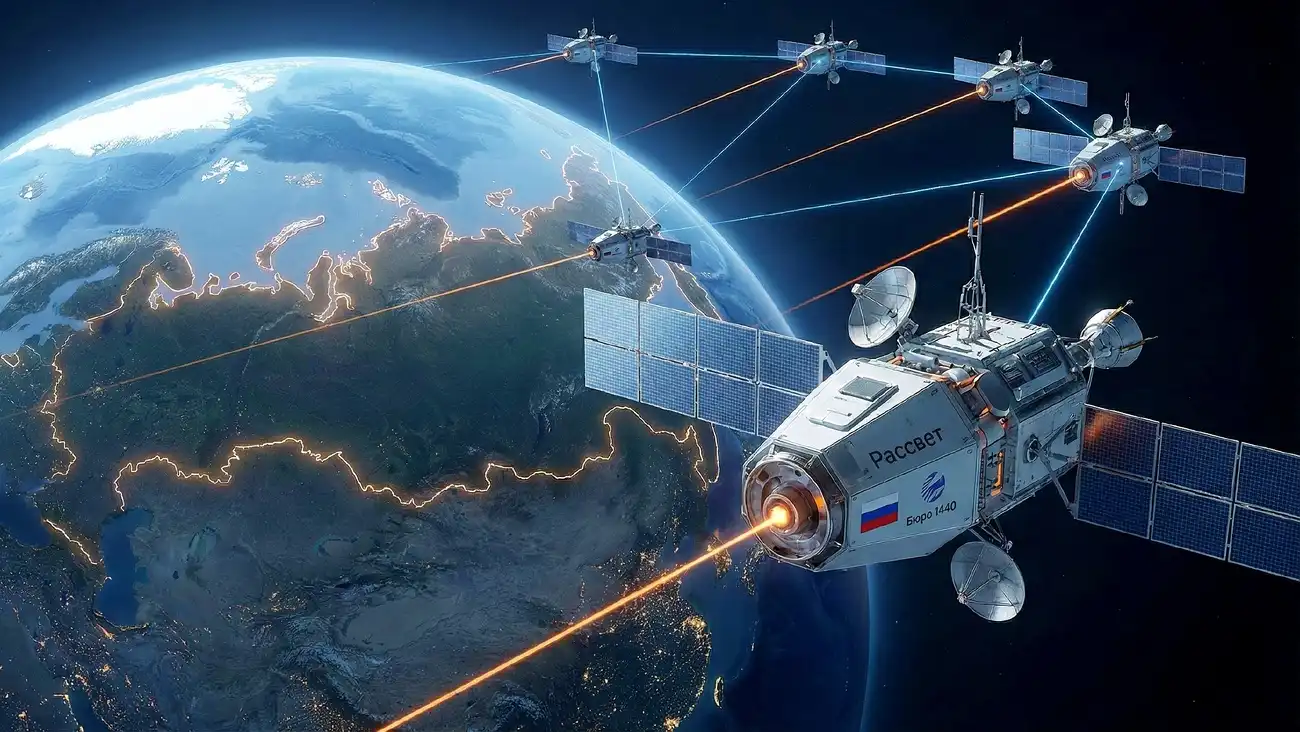
On 19 July, the Russian company «Bureau 1440» announced the second batch launch of «Rassvet» satellites, which are being developed for a low-Earth orbit broadband communications network. The operator did not specify the number of satellites in the new batch. According to independent space monitoring data, there may be 16 satellites, although they have yet to undergo testing and integration into the constellation.
Briefly about the main points
- «Bureau 1440» announced its second batch launch on 19 July.
- The number of satellites in the new batch has not been officially disclosed.
- Independent data suggests that 16 spacecraft may have been launched.
- The first production batch comprised 16 «Rassvet-3» satellites; one of them fell out of orbit.
- The current number is not sufficient to ensure continuous, large-scale connectivity.
The standard configuration could be expanded to around 31 units
The first production batch of 16 satellites «Dawn-3» were launched on 23 March. In early June, one of these satellites fell out of orbit and burned up in the atmosphere, so 15 production satellites were being tracked ahead of the new launch.
If the second batch did indeed consist of 16 satellites, once they have been separated and brought into service, the operational constellation will comprise around 31 satellites. The estimate of «up to 40» may also include six older experimental satellites from the «Rassvet-1» and «Rassvet-2» missions.
Independent industry sources link the July launch to the Soyuz-2.1b rocket and the Plesetsk Cosmodrome. The company has not publicly disclosed these details.
The devices have yet to be connected to the network
The launch does not mean that the constellation is immediately ready to provide services. The satellites must manoeuvre into position along the orbital plane using their own engines, undergo testing and be integrated into the network.
Open data on the first batch shows that most of its satellites are at altitudes of approximately 502–523 km. At the same time, the «Bureau 1440» website states a target orbit of 800 km, whilst four months after launch, three satellites remained at altitudes of 361–386 km.
A Russian industry expert, speaking to ComNews, noted that post-launch fine-tuning is standard procedure and can take around half a year. This suggests that the second phase is part of the roll-out process, rather than a fully operational network.
The project is designed to accommodate hundreds of satellites
«Rassvet» is designed as a low-Earth orbit broadband communications system. «Bureau 1440» claims it will offer speeds of up to 1 Gbit/s, latency of up to 70 milliseconds, global coverage and laser inter-satellite links. These are the project’s target parameters, not confirmed performance figures for a production network.
The previously announced federal plan envisaged 156 aircraft in 2026, 292 in 2027 and 318 in 2028. The plan linked the launch of a fully-fledged commercial service to 2027.
A few hundred satellites could significantly expand the capabilities of satellite communications in restricted areas. However, the current number of satellites is insufficient to provide a continuous, large-scale service. There is no information from reliable open sources regarding the actual use of «Rassvet» by Russian forces in the war against Ukraine.
Lagging behind the major low-Earth orbit networks
The scale of «Dawn» is currently significantly smaller than that of existing global constellations. The SpaceX prospectus states that there are around 9,600 satellites Starlink in low Earth orbit as at 31 March 2026, whilst an independent tracker estimated the active constellation at 10,839 satellites in mid-July.
Eutelsat reports that the OneWeb network has over 600 satellites in 12 orbital planes. Following its launch on 2 July, Amazon announced that over 390 satellites from its Leo network were in orbit or in operation. This comparison shows that the Russian project is only just beginning to build up its operational constellation.