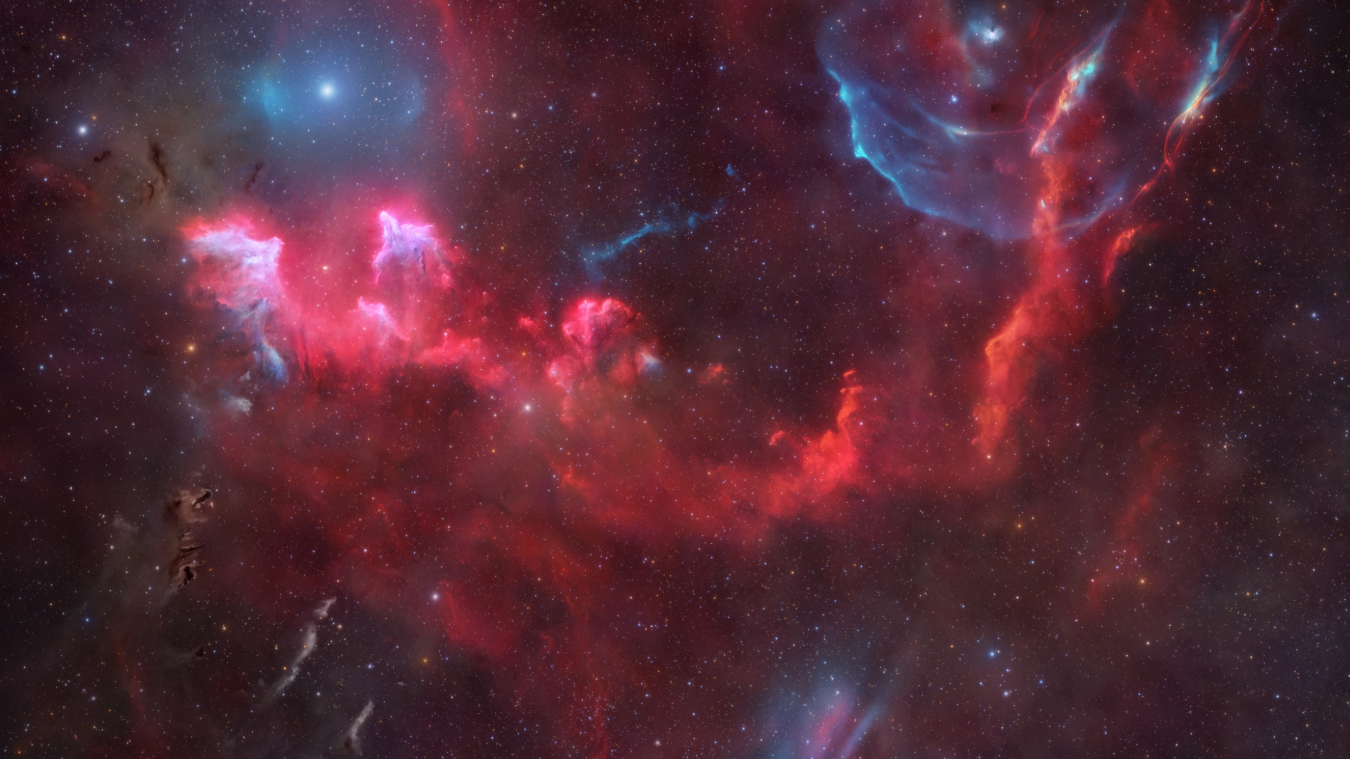
Astronomers have discovered three extremely faint luminous structures in the constellation Cassiopeia, the nature of which scientists are as yet unable to explain definitively. To capture these unusual objects, the researchers needed around 100 hours of observations and a special optical filter that allows the detection of ionised oxygen emission. On 21 October 2026, NASA published the image in its Astronomy Picture of the Day project. The new formations are located near two well-known nebulae, long known as the «Ghosts of Cassiopeia». One of the newly discovered structures may be the result of a shock wave around a bright star, whilst the other may be a remnant of a star’s evolution. However, neither hypothesis has yet been confirmed.
- On 21 October, NASA published a new image of mysterious structures in the constellation Cassiopeia.
- Astronomers have detected three previously unknown faint luminous objects.
- It took around 100 hours of observations to produce the image.
- The new formations were detected thanks to the radiation emitted by ionised oxygen.
- The well-known nebulae IC 59 and IC 63, known as the «Ghosts of Cassiopeia», are located nearby.
What exactly did astronomers discover in the constellation Cassiopeia?
A team of astrophotographers from Starfront Observatories managed to capture these unusual structures. The following people worked on the image: Louis Leroux-Gérès, Thibault Ruyé, Vincent Martin and Cedric de Decker.
Unlike a normal photograph of the starry sky, It took around 100 hours of observations to create this image. The astronomers used a special filter that detects the faint radiation from ionised oxygen.
It was precisely thanks to this that three previously unknown formations were observed. The researchers have provisionally labelled them Object 1, Object 2 and Object 3. In the image, they resemble semi-transparent blue clouds set amongst numerous stars and reddish gas nebulae.
NASA selected this photograph for its ‘Astronomy Picture of the Day’ project on 21 October 2026.
What are the «Ghosts of Cassiopeia» and why do they glow?
Title «The Ghosts of Cassiopeia» It originated long before the current discovery. This is the unofficial name astronomers give to the IC 59 and IC 63 nebulae, which are situated near the bright star Gamma Cassiopeiae.
IC 63 is particularly well known — a gas and dust cloud approximately 550 light-years from Earth. Its unusual shape resembles a ghostly figure with long, semi-transparent tendrils. In fact, what we are looking at is a vast cluster of interstellar gas and dust.
Powerful ultraviolet radiation from a neighbouring star affects the hydrogen atoms, causing the gas to glow red. At the same time, dust reflects and scatters the star’s light, creating blue hues.
Zorya Gamma Cassiopeia extremely bright. According to NASA, its energy output may exceed that of the Sun by approximately 34,000 times.
Therefore, it not only illuminates the surrounding clouds, but also gradually alters their structure.
Why do new celestial objects have a blue glow?
A key feature of the new discovery was the detection of ionised oxygen radiation.
Under normal conditions, the extremely rarefied interstellar gas is almost invisible. However, when exposed to high-energy radiation or shock waves, atoms can lose electrons. As a result, the gas begins to emit light at characteristic wavelengths.
Special astronomical filters make it possible to distinguish such faint radiation from the light of stars and other objects. In the case of the new structures in Cassiopeia, it was the oxygen signal that helped to identify formations that had previously been obscured by brighter nebulae.
It is important to note that the colours in astronomical photographs may be enhanced during image processing. Therefore, the blue structures in the image would not necessarily appear the same to the human eye.
One of the cosmic «ghosts» may be a shock wave
Scientists have already put forward several hypotheses regarding the origin of these new objects. The structure of Object 3 has attracted particular attention. It may be linked to the movement of the Gamma Cassiopeiae star system through interstellar gas.
When a star moves relative to its surroundings, under certain conditions a region of compressed and heated gas — a shock wave — may form ahead of it. This process can be compared to the wave that forms ahead of the bow of a ship as it moves through the water.
If this hypothesis is confirmed, Object 3 may turn out to be a region of heated oxygen that emits light as a result of the star system’s interaction with the interstellar medium.
However, further observations and measurements are needed to confirm this explanation.
Another object may be obscuring the remnants of a dead star
The structure of Object 1 proved to be no less intriguing. Astronomers suggest that it may be a planetary nebula — a shell of gas that a star shed during the final stages of its evolution.
Despite their name, such nebulae have nothing to do with planets. They are formed when certain stars, nearing the end of their lives, shed their outer layers. The central part of the star may then become a white dwarf.
It is the remnants of the hot star that are capable of illuminating the surrounding gas, creating unusual shapes.
However, in the case of Object 1, the corresponding white dwarf has not yet been identified. Therefore, the hypothesis that it is a planetary nebula remains one of the possible explanations.
The origin of Object 2 has not been established either.
Is it possible to see the «Ghosts of Cassiopeia» from Earth?
The constellation Cassiopeia is well known to many amateur astronomers. In the Northern Hemisphere, it is easily recognisable by its five bright stars, which form a distinctive W-shaped figure.
In Ukraine, Cassiopeia can be observed throughout the year, and in autumn it is particularly well-suited to evening observations. However, it is much more difficult to see its famous nebulae.
IC 59 and IC 63 have very low surface brightness. They are not visible to the naked eye, and detailed photography requires specialised astronomical equipment, a dark sky and long exposures.
The three newly discovered structures are even fainter. That is why it took around 100 hours of observation to detect them.
Why are discoveries important for science?
New features in Cassiopeia show that even well-studied regions of the night sky can conceal unidentified objects. It is particularly interesting that the image was captured by a team of astrophotographers, rather than solely by one of the large space telescopes.
Modern digital cameras, narrow-band filters and image-processing techniques make it possible to detect extremely faint radiation that previously went unnoticed. However, photographs alone are not sufficient to definitively determine the physical nature of these new structures.
This may require spectroscopic observations to help determine the characteristics of the gas, possible sources of ionisation and the behaviour of the substance.
The discovery of three new «ghosts» shows that even a familiar constellation may contain objects whose origins modern astronomy is not yet able to explain.