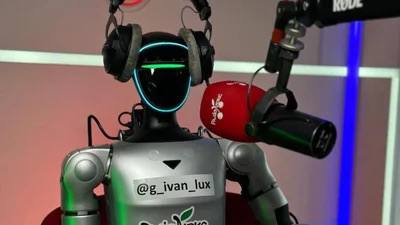
«Lux FM» has approached the Verkhovna Rada Committee on Humanitarian and Information Policy and the National Council on Television and Radio Broadcasting regarding the rules governing the live broadcasts of the AI humanoid Jivanka. The radio station is seeking to clarify its legal status, liability for the content it produces, copyright issues and the application of broadcasting regulations.
Briefly about the main points
- «Lux FM» is preparing its AI humanoid, Jivanka, for live broadcasts.
- The station is asking for clarification on what the robot’s legal status will be.
- Among the issues is liability for inaccurate or prohibited comments.
- The media also wishes to establish the rights to content generated by the system.
- The station has promised to publish the official responses once it has received them.
Jivanko is already working with the radio station’s team
A humanoid from artificial intelligence At «Lux FM», they call it Jivan Luksiovich Vyshnya, or Jivanok. He is settling into the editorial office, interacting with presenters, helping to create content and managing his own social media pages.
The radio station announced its intention to bring in a humanoid back in April. The original plan was for it to work alongside people on air, taking part in interviews, media projects and advertising campaigns. «Lux FM» emphasises that the robot is intended to complement the team, not to replace its staff.
Responsibility for broadcast content and human oversight
The key issue for the station is whether a humanoid can legally be considered an employee, or whether it should be classified as a technical device or a software and technology system. It also asks for clarification on who would be held liable if the system were to broadcast inaccurate or prohibited information live: the robot, the software developer or the media organisation.
The Media Act provides for the liability of media organisations for breaches of legislation and licensing conditions; however, it does not establish a separate category for autonomous AI presenters. Recommendations for the media, drawn up with the involvement of the Ministry of Digital Transformation and the National Council, advise that such content be clearly labelled the use of AI, to review the content they have created and to leave the final editorial decision to a person.
«Lux FM» also wants to find out whether there need to be any specific restrictions on the topics and information that Ivanco will be able to discuss live, and how to proceed in the event of technical faults or an inappropriate response from the humanoid.
Copyright and language requirements
The system can generate scripts, jokes, responses to listeners and other material whilst on air. The radio station is therefore raising the question of who will own the rights to such content and who will be responsible for its content. The Copyright Act provides for a sui generis right for non-original works generated by a computer programme; the allocation of rights may be determined by contract.
Separately, the station is asking for clarification on how to treat the humanoid’s Ukrainian-language remarks in accordance with media legislation. Once it has received the views of the parliamentary committee and the National Council, «Lux FM» plans to make them public.