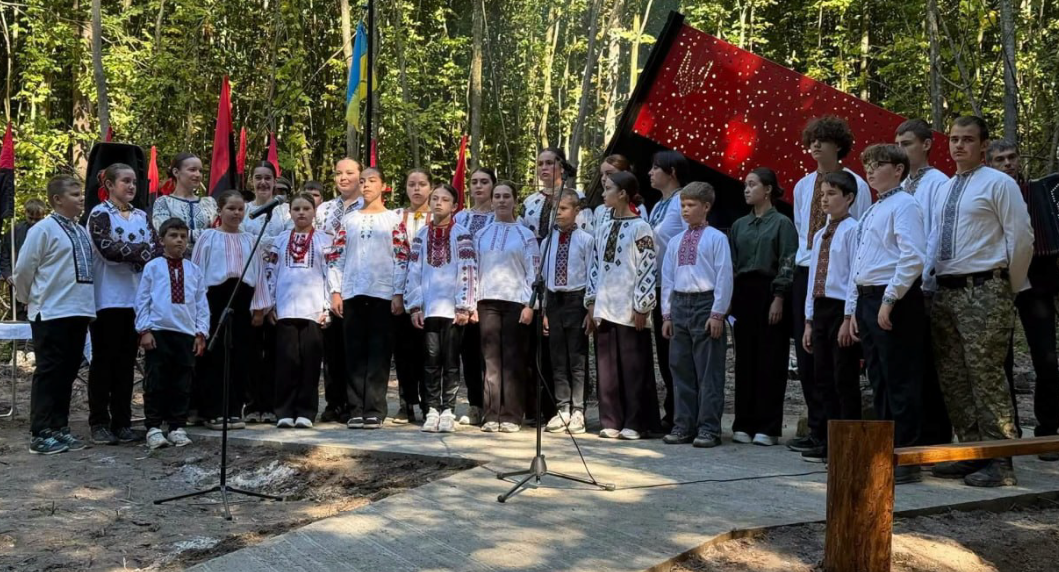
On 1 October 2026, in the Verteby area of the village of Zhukiv, to mark Defenders’ Day in Ukraine, a memorial was consecrated at the site where prominent figures of the Ukrainian liberation movement lost their lives: Mykola Arsenych, founder of the OUN’s military counter-intelligence and head of the OUN (b) Security Service; his wife and assistant, Hanna Gunka; bodyguard Stepan Melnyk; and Maria Rymyk, liaison officer for the OUN Central Leadership (specifically Roman Shukhevych) Maria Rymyk.
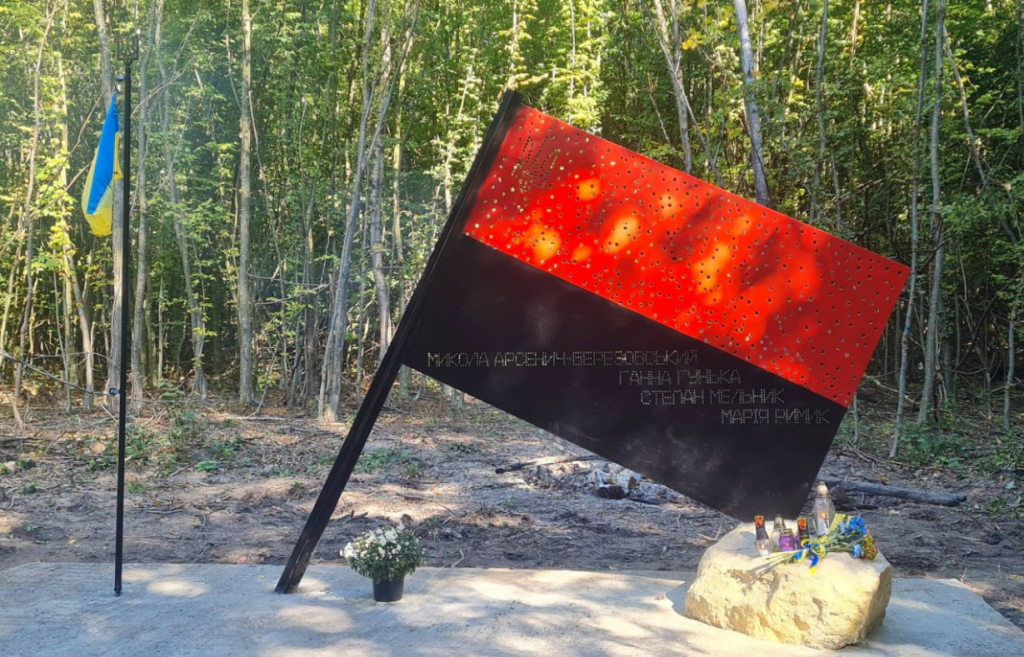
Rostyslav Bortnyk, Chair of the Berezhany Town Council, in his Facebook page In particular, he noted:
«”… every hole in the flag symbolises the fallen Ukrainian insurgents – both men and women – who fought, at the cost of their own lives, for Ukraine’s independence from Soviet occupation … … and that is precisely how the canvas came to be filled with red and black colours …” (from Rostyslav Bortnyk, the creator and designer of the memorial installation)
Also today, at this historic site, with the “Pride of Berezhany Region” commemorative medals, Certificates of Appreciation and Commendations from myself and the Berezhany Town Council, I honoured many male and female defenders, as well as civilians, who, through their daily service and work, maintain order and assist in the defence of our Mother Ukraine.
Glory to Ukraine! »Glory to the heroes!’
Maria Rymyk was born on 10 September 1923 (she operated under the pseudonyms «Marusya», «Natalka» and «Maria») — a fighter for Ukrainian independence in the 20th century. During the most intense period of the struggle, when the UPA was engaged in fierce fighting amidst shifting front lines and a brutal confrontation between two totalitarian regimes — the Nazi and Soviet regimes — — Maria Rymyk directly maintained strategic liaison between the UPA’s Commander-in-Chief, Roman Shukhevych («Bilyi», «Tur», «Taras Chuprynka»), and the Central Leadership of the OUN.
Her education at the Chortkiv Gymnasium held brilliant prospects for the young woman, but she chose to fight for Ukraine’s freedom by joining the OUN in 1939. Participants in the liberation movement remembered Maria Rymyk as a person of «crystal-clear character» — it was precisely this description that later appeared in the publication *Historical and Memoir Collection of the Chortkiv District* (New York [et al.]: NTSH, 1974; Ukrainian Archive, vol. XXVI, p. 927). Amidst the brutal realities of war and the harsh conditions of underground work, such words signified the highest praise: absolute reliability, uncompromising honesty and unwavering steadfastness in the face of death.
The OUN’s Security Service, led by Mykola Arsenych, operated as a highly effective counter-intelligence organisation. The figure of Maria Rymyk reveals her intellectual depth: whilst maintaining strict secrecy and weighing up the risks, she carried out the most critical tasks alongside the leadership. Although her duties as a liaison officer took her to various areas, she died heroically in battle at the age of 23 in her native Chortkiv-Berezhany district of the OUN.
She did not have time to start a family of her own, for her destiny was to fight. Volodymyr-Ihor Porendovskyi, in his book *Relay Lines. Memoirs« (Centre for Research into the Liberation Movement, edited by Ruslan Zabilyi, Lviv, 2010), recounts an episode which illustrates just how much the Soviet punitive authorities regarded »Marusya« as a bitter enemy, and her elimination an extremely important achievement. Even in 1948, when the liaison officer herself, as well as members of the OUN Central Leadership, Mykola Arsenych and Dmytro Maiivskyi (Porendovskyi’s immediate superior), had already been killed, the Chekists, making no secret of their satisfaction, chose to display her photograph in particular as the main proof of their power:
«During my interrogation in 1948, the Chekists took great pleasure in showing me a photograph of the murdered „Marusya”, saying, »Our hands can reach anywhere”.’.
Due to Maria Rymyk’s underground activities, her family suffered repression and was deported to Siberia. There, her brother married the sister of Ivan Dmytryk — a well-known UPA soldier and author of the memoir *In the Forests of Lemkivshchyna*. The academic and historical journal *Visti Kombatanta* has repeatedly published reviews of Ivan Dmytryk’s book *In the Forests of Lemkivshchyna*, highlighting its exceptional documentary and emotional nature, and in issue No. 3 of 1976, I. Kedrin’s review emphasises the unique authenticity of these memoirs: «…memoirs whose most striking feature is their unpretentiousness and directness, which rules out any artificiality and attests to the absolute truth of everything the author writes about.». And today, this publication remains relevant; it continues to be printed and finds its readership.
The final battle — the Verteby area
In a letter dated 11 January 1947, Mykola Arsenych wrote to Roman Shukhevych regarding the international situation and the prospects of a Third World War; however, the courier was unable to deliver this letter to the Commander-in-Chief of the UPA.
On 23 January 1947, in the Verteby area — a wooded region between the villages of Zhukiv, Hynovychi and Kuropatnyky near the town of Berezhany in the Ternopil region — the head of the OUN Security Service, Mykola Arsenych, a member of the OUN Central Leadership; his wife and assistant, Hanna Gunka; his bodyguard, Stepan Melnyk; and Maria Rymyk, a liaison officer for the OUN Central Leadership and the UPA Commander-in-Chief Roman Shukhevych, were heroically killed in a battle with the Soviet occupiers. This battle resulted in one of the heaviest losses for the leadership of the OUN and the UPA during that period.
It is symbolic that, on the memorial, the names of the four heroes – men and women – are commemorated on an equal footing. This principle of equality was also enshrined in the primary sources: the insurgents« report »News from the Field«, published in volume 49 of the »Chronicle of the UPA« (a digitised copy of this unique document is available on the website of the State Archives of the Ternopil Region), attests that women were mentioned on an equal footing with men. At the same time, this very report refutes the Soviet myth about suicide. A linguistic analysis of the insurgent document demonstrates that, to describe the act of self-sacrifice, the compiler used restrictive markers (»themselves«, »with their own pistols«, »last bullet«), which are absent from the text describing the hideout where the heroes died. Instead, the dead are referred to as »beaten’ — a term used in underground correspondence to describe those killed in battle.