Russia is increasingly deploying jet-powered versions of Shahed-type attack drones against Ukraine, forcing the Ukrainian air defence system to adapt to significantly faster targets. The new drones can reach speeds of up to 500 km/h, and according to some Ukrainian estimates, even higher. In response, Ukrainian and Western manufacturers are accelerating the development of a new generation of interceptor drones capable of catching up with such targets.
The main problem is not just a matter of speed. Jet-powered drones could transform the very economics of air defence: if expensive anti-aircraft missiles have to be used more frequently to shoot them down, Russia will be able to step up the pressure on Ukraine’s limited air defence resources. That is precisely why the race to develop a cheap, mass-produced interceptor is becoming one of the key technological fronts in the war.
Why are «Shahed» jet aircraft more difficult to shoot down?
Traditional Shahed Propeller-driven aircraft have one characteristic that is important for air defence — their relatively low speed. This has enabled Ukraine to establish a multi-layered system to counter them, utilising not only anti-aircraft missile systems but also mobile fire groups, anti-aircraft guns, aircraft and, increasingly, interceptor drones.
A jet engine makes a significant difference.
According to Reuters, the new Shahed jets can reach speeds of approximately up to 500 km/h. Yuriy Ignat, a spokesperson for the Ukrainian Air Force, also spoke of Russian jet-powered drones capable of travelling at speeds of up to 500–600 km/h.
The faster a target moves, the less time there is to detect, track and intercept it. This becomes a particularly challenging task for low-cost electric interceptor drones, which may not be fast enough to catch up with a jet-powered target.
That said, Russia does not necessarily need to switch entirely to jet-powered models. A combination of large numbers of cheaper Shahed propeller-driven drones and a smaller number of high-speed jet-powered drones could place an additional strain on Ukraine’s air defence systems.
According to estimates cited by Reuters, jet-powered variants may now account for around 15–20% out of the total number of Shahed drones deployed by Russia.
Ukraine is developing a new generation of interceptors
The response to this new threat is set to be significantly faster interceptor drones.
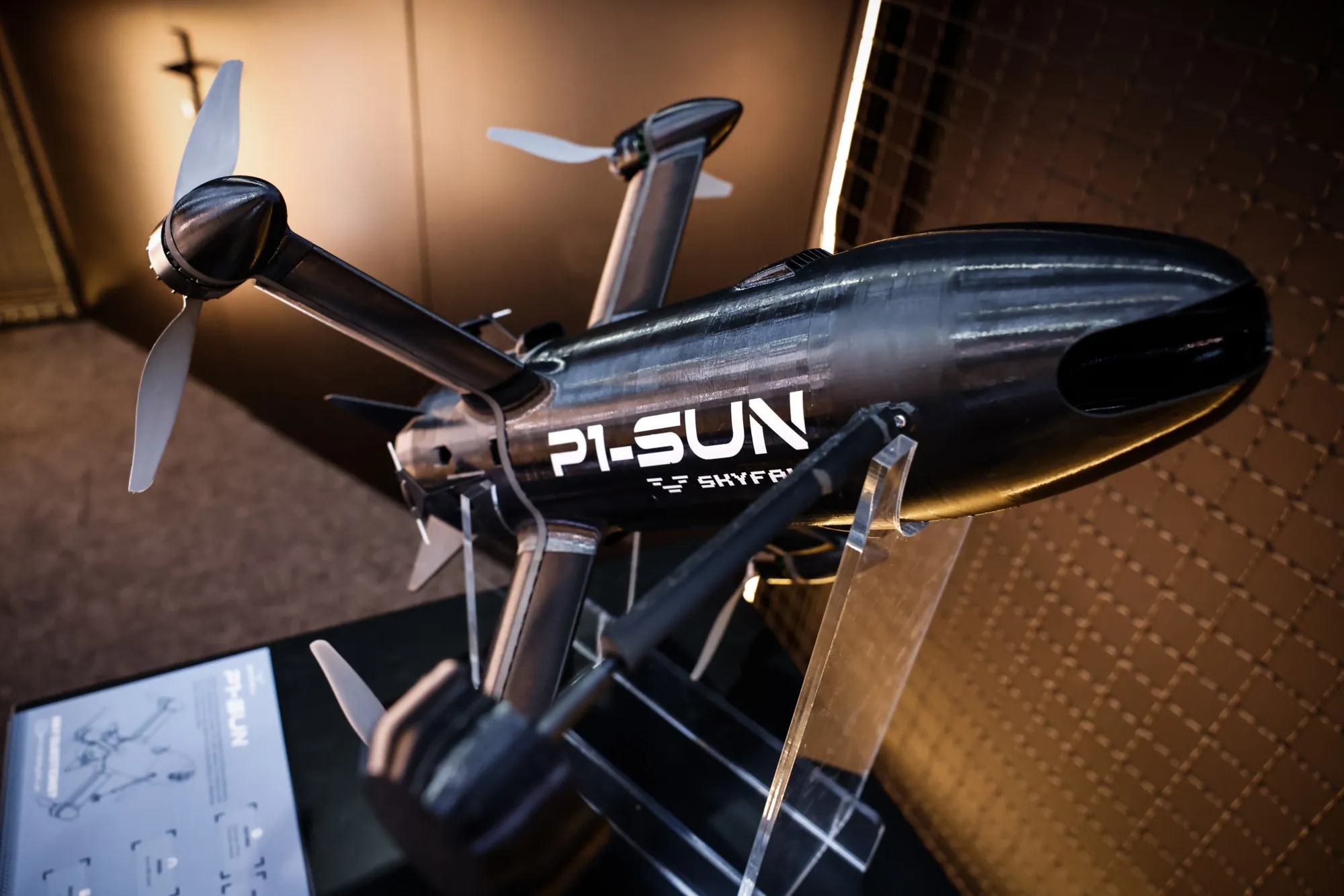
Ukrainian company SkyFall unveiled a new model at the Farnborough Airshow P1-SUN Jetkiller, designed specifically to engage high-speed aerial targets. The aircraft is capable of reaching a speed of around 370 km/h, and its prototypes have already been used against Shahed drones. The company claims to have carried out more than a dozen successful interceptions of such targets. Mass production of the updated version is scheduled to begin in August.
According to the company’s own figures, the previous version of its interceptor has, since November 2025, helped to destroy more than 5,500 Russian drones. Reuters notes that it has not been possible to independently verify this figure.
This is an important point: Ukraine’s anti-drone system is gradually moving from experimental solutions to the industrial production of specialised interceptors.
The race for speed has already begun
SkyFall — is not the only company working to solve the problem.
The Ukrainian manufacturer General Cherry is finalising the development of a new version of the Bullet drone. It is expected to be capable of reaching speeds in excess of 400 km/h, and the developers’ aim is to get close to the 500 km/h mark.
The British-Ukrainian company Firebolt Engineering has developed the Griffen jet interceptor. During testing, it reached a speed of around 350 km/h, and the developers plan to increase this to 400 km/h.
In effect, a technological race has begun: Russia is increasing the speed of its attack drones, whilst Ukraine and its partners are forced to develop even faster means of intercepting them.
And this is just one area of focus. At the same time, Ukraine is developing a comprehensive system to counter drones, which may combine mobile units, electronic warfare, anti-aircraft systems, aviation and various classes of interceptors.
Why the cost per interception becomes critical
Speed is only half the problem. The other half is cost.
If a cheap attack drone is shot down by an expensive anti-aircraft missile, the enemy can achieve a strategic effect even without hitting its primary target: forcing the air defence forces to use up their scarce ammunition.
Right here interceptor drones could tip the balance.
Electric models can cost around a few thousand dollars. Jet interceptors are more expensive: Firebolt is trying to keep the cost of its aircraft below 10,000 dollars, whereas for cheaper electrical systems, the benchmark might be around 2,000 dollars.
Developers therefore face a difficult challenge: to create an interceptor that is, at the same time, fast enough to Shahed drone, accurate enough to guarantee a hit and cheap enough to be produced in their thousands.
The drone war is entering a new phase
The emergence of the «Shahed» drones does not mean that previous methods of air defence have become obsolete. However, it demonstrates the rapid pace of technological evolution in warfare.
Just a few years ago, the main question was how to shoot down slow attack drones cheaply, without wasting expensive missiles on them. Now the challenge has become more complex: the interceptor must not only be cheap, but also extremely fast.
Ukraine has already become one of the world’s leading centres for the development of anti-drone technologies. Ukrainian solutions are also attracting attention abroad: Reuters previously reported that the US had begun using Ukrainian anti-drone technology to protect one of its key air bases in Saudi Arabia.
The key question now is whether the production of new high-speed interceptors can scale up as quickly as Russian tactics are changing. If this proves possible, interceptor drones could take on a significant share of the burden of combating new aerial targets and preserve costly air defence missiles for cruise and ballistic missiles.
That is precisely why the current race between the «Shahed» drones and Ukrainian interceptors goes far beyond a mere contest between individual drone models. It could determine the nature of Ukraine’s air defence capabilities in the next phase of the war.