US President Donald Trump is seeking to reach a peace agreement between Ukraine and Russia by mid-December and sees the G20 summit in Florida as a possible venue for its signing, according to The Atlantic. In Kyiv, there is concern about possible pressure from Washington, particularly regarding territorial concessions. There are no agreements in place regarding the deal or Vladimir Putin’s participation in the meeting.
Briefly about the main points
- Trump wants to finalise the agreements between Kyiv and Moscow by mid-December.
- The G20 summit is scheduled to take place in Florida on 14–15 December.
- The US President would like to be present at the signing of the agreement.
- Putin agreed in principle to resume negotiations after 10 November.
- Kyiv fears pressure from the US regarding territorial concessions.
How Trump envisages the summit scenario
Advisers to the US President told *The Atlantic* that Trump depicts a ceremony at which Volodymyr Zelenskyy і Vladimir Putin They are signing the agreement, whilst he stands between them. According to the publication, in order to reach agreements within the desired timeframe Trump is prepared to step up the pressure on Ukraine.
The US will host the G20 summit on 14–15 December 2026 at the Trump National Doral Miami complex near Miami, according to the US Department of the Treasury. However, the scenario described by *The Atlantic* represents the US President’s vision, not an agreed plan for the negotiations.
What risks do they see in the Ukrainian leadership?
Ukrainian officials interviewed by *The Atlantic* fear that decisions regarding the country’s future may be taken without its full involvement. One of the publication’s sources, speaking on condition of anonymity, expressed concern that Ukraine’s fate might be decided without Kyiv’s input.
A particular risk in Kyiv is seen as the possibility of being forced to make territorial concessions, particularly regarding the Donbas. Zelenskyy had previously stated his readiness for peace talks, but rejected any solutions that would require Ukraine to cede its territories.
According to the publication, Ukrainian leaders also acknowledge that military aid and the exchange of intelligence could be used as leverage. The US administration denies that it is deliberately limiting its support for Ukraine in order to cause it harm.
Following Witkoff’s talks, Moscow is open to further negotiations
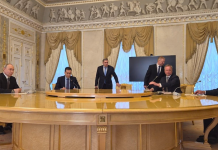
21 October: the US President’s Special Envoy Steve Witkoff met with Putin in St Petersburg. The day before, he had held talks with Zelenskyy and European leaders in Oslo, where they discussed security guarantees for Ukraine, a ceasefire and post-war reconstruction.
As reported by Reuters, Witkoff presented new proposals to the Russian side and called for the resumption of talks involving Ukraine, the US and Russia. Putin’s adviser Yuriy Ushakov Following this meeting, he stated that the Russian president had, in principle, agreed to this format after 10 November.
This agreement does not imply that the Russian side has accepted the Ukrainian or American conditions. Moscow continues to put forward its own demands regarding Ukraine’s territories and its future security status.
Events in November could set the pace for diplomacy
*The Atlantic* cites the US mid-term congressional elections on 3 November as one of the factors likely to influence the domestic political context of Trump’s foreign policy. Russia has also proposed a meeting between Trump, Putin and the President of the People’s Republic of China Xi Jinping on the sidelines of the APEC summit in China; Trump stated that he was prepared to consider taking part, although the format has not yet been agreed.
Zelenskyy expressed his willingness to hold direct talks with Putin, with Trump in attendance and, if desired, with the involvement of European partners. As of 21 October, the parties had not agreed on a peace deal; the next practical step could be the resumption of the trilateral dialogue after 10 November.