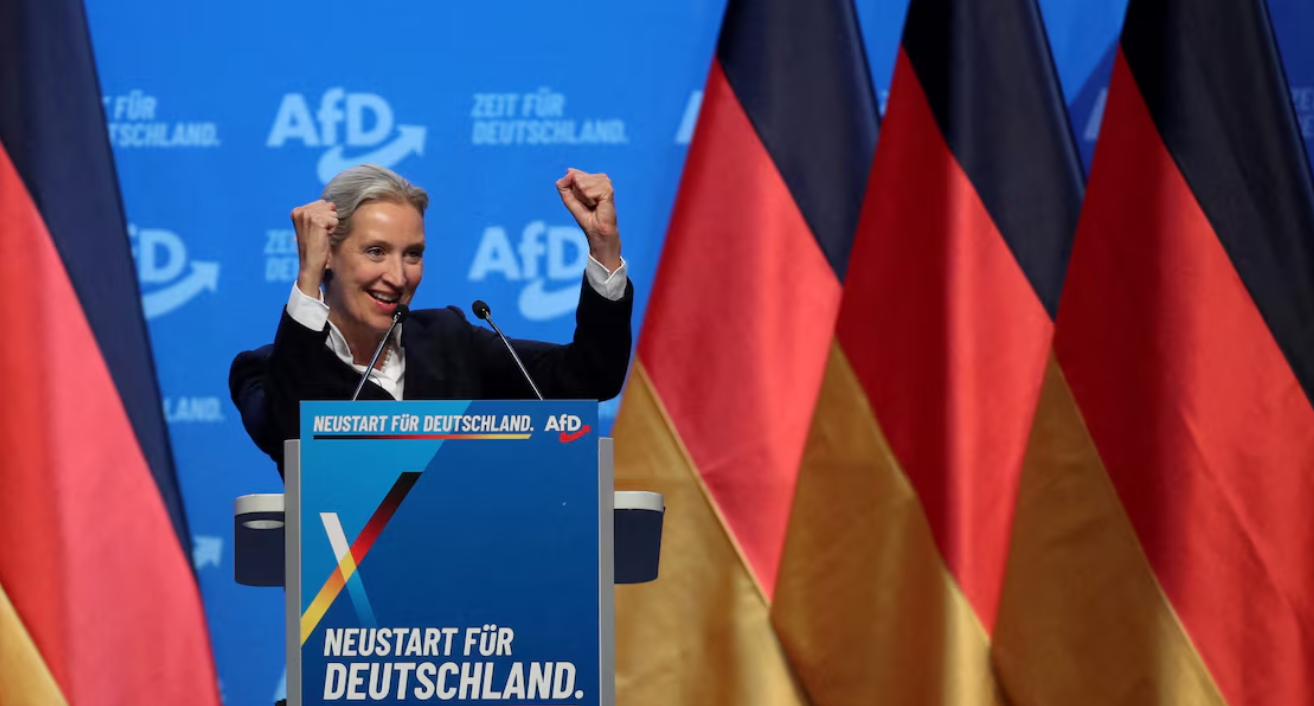
The German far-right party «Alternative for Germany» (AfD), which has opposed European integration for over a decade, has begun to reconsider its stance on the country’s membership of the European Union and the eurozone. Following a record result in the regional elections, the party is proposing to reform the EU from within rather than leaving it immediately. According to Reuters, the change in approach is linked to the AfD’s growing political influence and discussions about its possible participation in the federal government.
- The German far-right AfD is reconsidering its stance on leaving the EU and the eurozone.
- The new strategy envisages reforming the European Union and expanding the powers of national states.
- In the elections in Saxony-Anhalt, the party secured a record 43.8% per cent of the vote.
- There are ongoing disputes within the AfD regarding the future of the euro and European integration.
- The party continues to oppose military aid to Ukraine and to call for the restoration of relations with Russia.
The AfD proposes reforming the European Union rather than leaving it
The «Alternative for Germany» party was founded in 2013 amid widespread dissatisfaction with the bailout policies for eurozone countries facing a debt crisis. One of its initial demands was for Germany to abandon the single European currency.
Subsequently AfD She extended her criticism to the European Union as a whole, and opposing immigration became the central theme of her political campaigns.
There is now increasingly active discussion within the party about a different approach to European policy.
In October, the co-chair of the AfD Alice Weidel presented the strategic document «A New Course for Europe» to the European Parliament in Strasbourg (A New Deal for Europe). It was developed in collaboration with allies from the far-right group «Europe of Sovereign Nations» (ESN).
The document proposes a review of the EU’s founding treaties and transform the union into a less centralised alliance of sovereign states. In particular, the AfD advocates a mechanism that would allow individual countries to opt out of certain common policies, notably regarding migration and defence spending.
The party also proposes to tighten controls over compliance with budgetary rules and to return some powers from European institutions to national parliaments.
However, the document does not envisage Germany immediately abandoning the euro. If attempts to reform the EU prove fruitless, the authors of the strategy propose putting the country’s future European course to a referendum.
The victory in Saxony-Anhalt has strengthened the party’s position
The debate over the AfD’s new European policy intensified following the regional elections in Saxony-Anhalt, which took place on 6 September.
The party received 43.8% of the vote — its best ever result in regional elections. This secured it 39 of the 83 seats in the regional parliament, although it did not secure an absolute majority.
The result has fuelled debate about the AfD’s prospects of participating in the running of the country and its potential relations with other political forces.
One of the key issues remains cooperation with the Chancellor’s conservative Christian Democratic Union (CDU) Friedrich Merz.
At present, the CDU rules out the possibility of forming a coalition with the AfD. Merz himself confirmed after the election in Saxony-Anhalt that he has no intention of cooperating with the far-right party. At the same time, some AfD representatives believe that categorical demands for withdrawal from the EU and the eurozone could complicate the search for political partners.
The AfD’s youth wing is in favour of keeping the euro
Among those in favour of revising European policy is a 29-year-old Jean-Pascal Gom, head of the AfD’s youth wing, Generation Deutschland. According to him, abandoning the single currency would cause Germany significant economic damage.
Young party representatives stress that, against the backdrop of competition with China and changes in transatlantic relations, European countries need to maintain economic cooperation.
A professor of political science at the University of Kassel shares this view Wolfgang Schröder. He points out that the German economy is heavily dependent on exports and international trade, so leaving the EU or the eurozone would pose a serious threat to its stability.
The issue of the euro remains a contentious one within the AfD itself.
In August, Gom proposed a resolution to the youth wing in support of the European ideal. However, the document had to be withdrawn due to a lack of support from the delegates.
Consequently, the new strategy does not yet signify a definitive abandonment by the entire party of its previous Eurosceptic positions.
Right-wing parties in France, Italy and Austria have already changed their approach to the EU
Several influential far-right political movements in Europe have undergone a similar evolution in the past.
The French «National Union», led by Marine Le Pen For a long time, it had advocated rejecting the euro, but gradually dropped this demand from its political programme.
In Italy, the Prime Minister’s party Giorgi Meloni «After coming to power, the »Brothers of Italy’ softened their Eurosceptic rhetoric and focused on promoting their own priorities within the EU.
The Austrian Freedom Party (FPÖ), which maintains close ties with the AfD, has also abandoned some of its most radical anti-European demands.
During the presentation of the new strategy, Alice Weidel stated that her party advocates the concept of a «Europe of nations», in which nation states would retain greater powers.
However, this change in the party’s European strategy does not imply a revision of its other foreign policy positions. The AfD continues to oppose military support for Ukraine and to advocate for the restoration of Germany’s relations with Russia.