A sociological survey in Poland has revealed that negative attitudes towards Ukrainians rose to a record high of 43% in 2026. At the same time, Ukrainians continue to hold a predominantly positive view of Poles.
- The proportion of Poles with a negative attitude towards Ukrainians has risen to 43%.
- In 2022, this figure stood at 25%.
- The negative attitude of Ukrainians towards Poles in 2026 stands at just 8%.
- Experts attribute this trend to political debates and historical disputes.
Polish society is changing its attitude towards Ukrainians
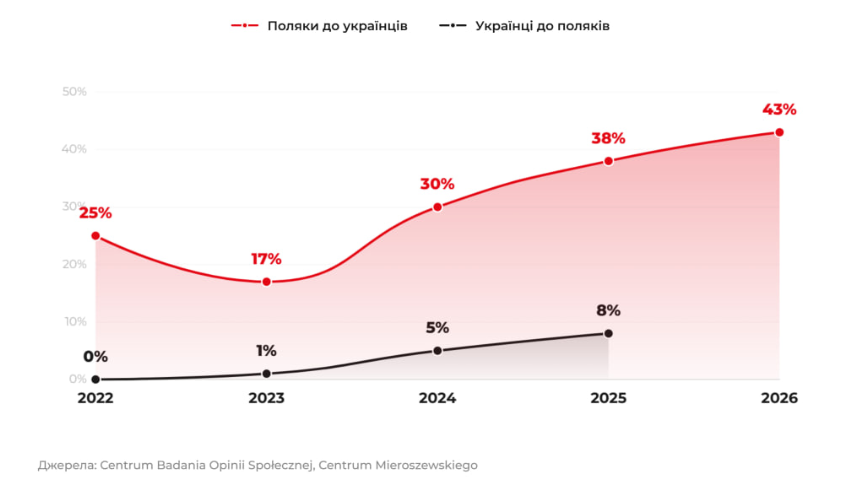
Data from a sociological survey prepared by Centre for Public Opinion Research and the Mieroszewski Centre indicate a sharp rise in negative attitudes amongst Poles towards Ukrainians. Whilst this figure stood at 25% in 2022, by 2026 it had reached 43%. In 2023, negative attitudes fell to 17%, but the situation subsequently changed. In 2024, the figure rose to 30%, in 2025 to 38%, and in 2026 it reached a record high of 43%. Thus, over the course of two years, the number of Poles with a negative attitude towards Ukrainians more than doubled.
In contrast, Ukrainians continue to hold a more positive view of Poles. In 2022, fewer than 1% of Ukrainians held a negative or very negative view of Poles; in 2023, this figure stood at 1%; in 2024, it rose to 5%, and in 2025 – to 8%. Despite a certain increase, the level of distrust among Ukrainians remains more than five times lower than that of Poles towards Ukrainians.
What led to the change in sentiment
Analysts attribute the shift in public opinion to several factors. These include internal political struggles in Poland and debates surrounding Ukrainian refugees, competition in the labour market, as well as disputes over historical issues, in particular the Volhynia tragedy and the activities of the UPA. In recent years, the subject of Ukraine has been raised with increasing frequency by Polish politicians during election campaigns, which also influences public sentiment.
Why it matters
Ukraine and Poland remain strategic partners in the fields of security, the economy and support for Kyiv in the war against Russia. At the same time, the rise in negative sentiment within Polish society may create additional political risks for bilateral relations. Survey data indicate that, despite the continued official partnership between the two countries, public sentiment on both sides of the border is gradually shifting, and the level of support is no longer as unequivocal as it was in the early years of the war.