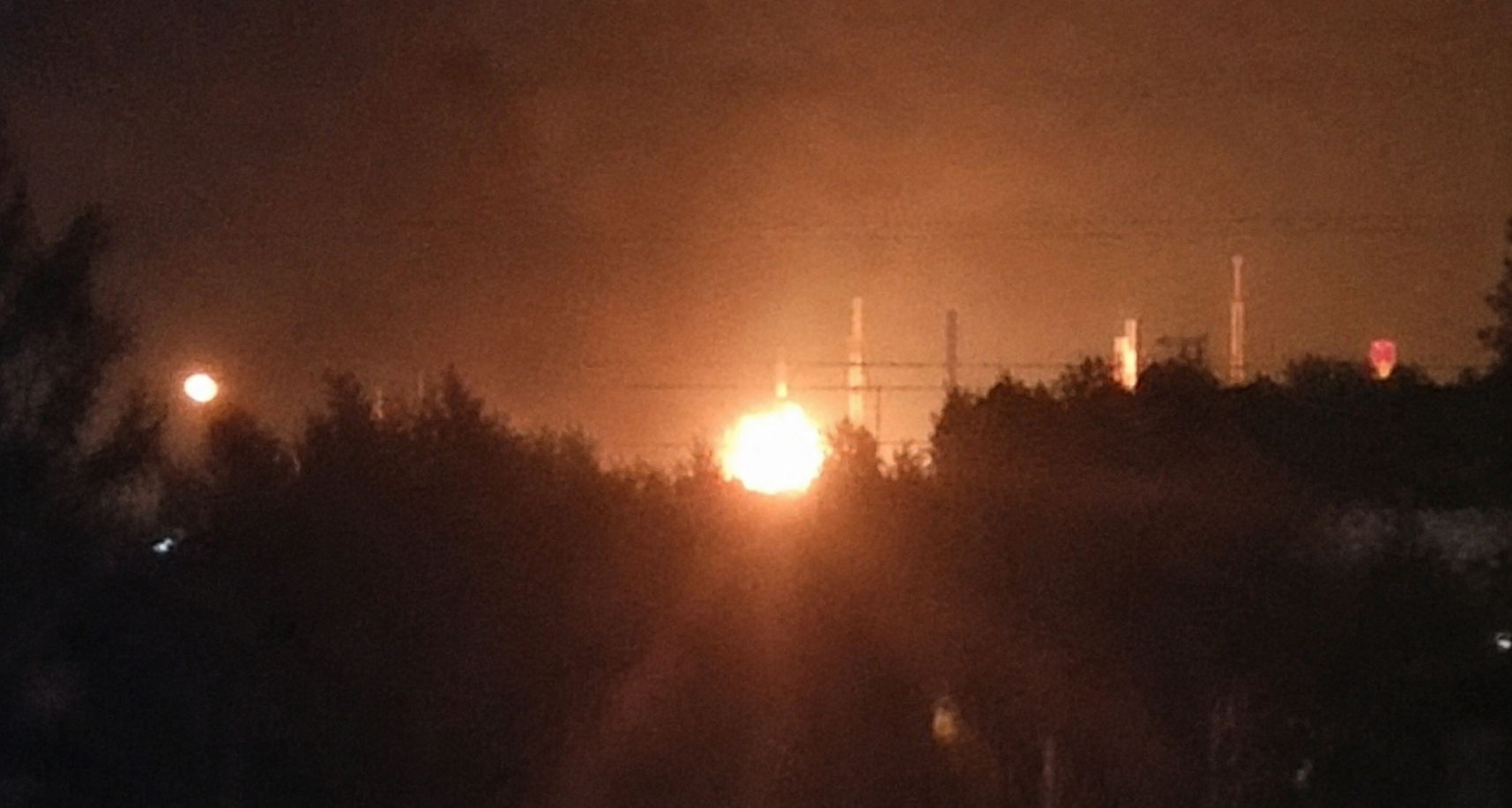
On the night of 30 August, drones attacked the Leningrad Oblast in the Russian Federation. The Kirishnefteorgsintez oil refinery – one of the largest in Russia, with a capacity of around 20 million tonnes of crude oil per year – was hit. A fire broke out in the industrial area of Kirishi following the explosions. Monitoring sources report that the plant’s production facilities may have been damaged, though the exact extent of the damage is still being assessed.
Briefly about the main points
- On the night of 30 August, drones attacked the Leningrad Oblast in the Russian Federation.
- The «Kirishnefteorgsintez» oil refinery in the town of Kirishi came under attack.
- A fire broke out in the industrial area following the attack.
- KINEF is one of Russia’s largest oil refineries, with a capacity of around 20 million tonnes of crude oil per year.
- Monitoring sources report possible damage to industrial facilities.
The fire broke out following a massive drone attack
The authorities in the Leningrad Region issued a warning about the danger posed by drones at around 2 am on 30 August.
Governor of the region Oleksandr Drozdzenko He later claimed that dozens of UAVs had allegedly been shot down over the region. According to him, as a result of the attack A fire broke out in the industrial area of Kirishi.
It is in this industrial zone that the large «Kirishnefteorgsintez» oil refinery complex, better known as KINEF, is located.
Ukrainian and Russian monitoring sources reported that the strike had hit the refinery area directly. Footage released by local residents showed a bright glow over the industrial part of the city.
What is known about possible damage
According to preliminary assessments by OSINT sources, the strike may have targeted the plant’s production facilities.
This refers to the area where the facilities involved in the refining and purification of petroleum products are located. However, at the time of publication, there were no sufficiently detailed satellite images available to accurately determine the extent of the damage caused by this particular attack.
Therefore, information regarding damage to specific installations remains previous.
As is customary, the Russian authorities did not name the site where the fire broke out, merely stating that a fire had occurred in the Kirish industrial zone.
Why «Kirishnefteorgsintez» is important to Russia
KINEF is owned by Surgutneftegaz and is one of the largest oil refineries in the Russian Federation.
The plant’s design capacity is approximately 20 million tonnes of crude oil per year. The plant produces motor petrol, diesel fuel, aviation kerosene, fuel oil and other petroleum products.
By way of comparison, in 2024 the company actually processed around 17.5 million tonnes of oil, which corresponded to approximately 6.6% of Russia’s total oil refining volume.
Consequently, even a partial shutdown of individual production units at such a plant could affect fuel production across the entire Russian market.
The factory has been attacked on several occasions
«This is not the first time that »Kirishnefteorgsintez’ has been the target of long-range strikes.
On the night of 5 May 2026 The Ukrainian Unmanned Systems Forces, the SBU and the Special Operations Forces have already attacked KINEF and the «Kirishi» oil pumping station. According to Ukrainian reports, strikes were recorded on three crude oil refining units and a process tank.
The plant had previously come under attack in 2025. Following one such attack, the plant was forced to shut down its largest primary processing unit, ELOU-6, with a capacity of around 8 million tonnes per year — approximately 40% of the refinery’s total capacity.
The blows to the Russian oil refining industry continue
The attack on Kirishi was the latest in a series of strikes against Russia’s fuel and energy infrastructure.
In August alone, the Defence Forces reported damage to the oil refinery in Orsk, Kstovo and Yaroslavl. The General Staff explains that these strikes are necessary to weaken the Russian Federation’s military and economic capabilities and to reduce its ability to supply Russian troops with fuel.
In the case of the Kirishas The Russian authorities confirmed that a fire had indeed broken out in the industrial zone following the attack, however, the exact list of affected equipment and the extent of the plant’s downtime will only become clear once further satellite data or information from the Ukrainian side becomes available.