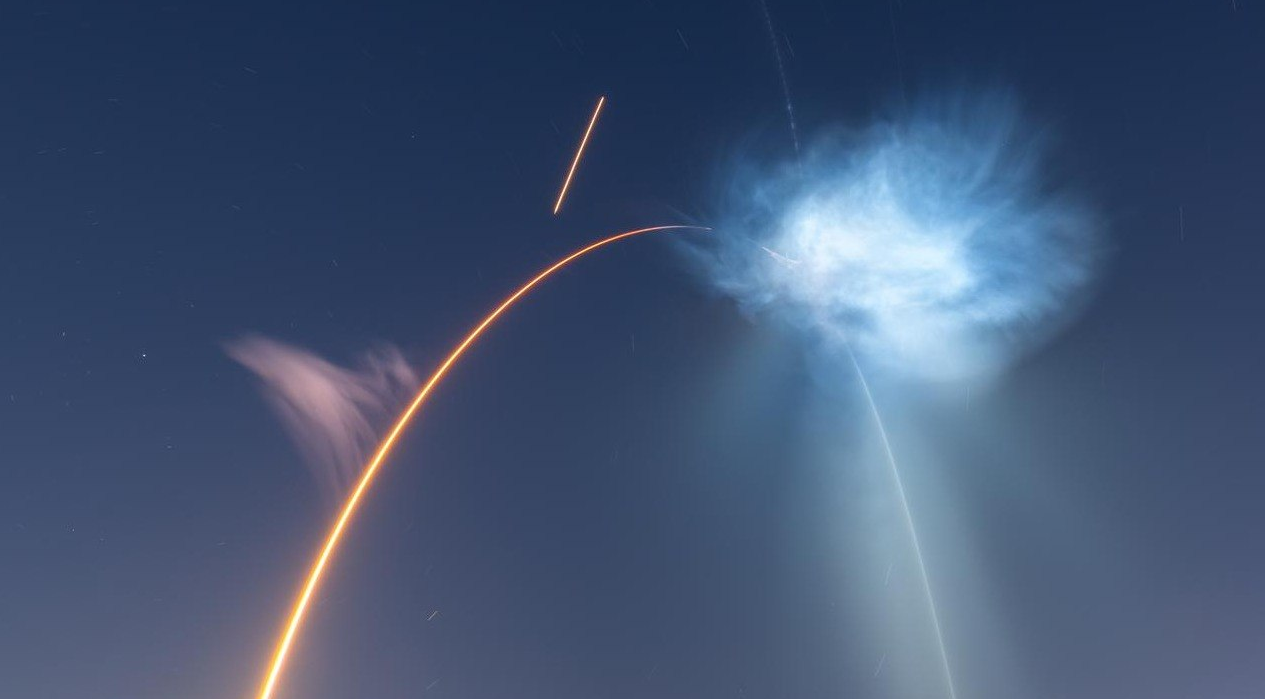
On 13 October 2026, an unusual light phenomenon appeared in the sky over the eastern United States, which eyewitnesses described as a «space jellyfish». A giant blue-and-white cloud formed following the launch of SpaceX’s Falcon 9 rocket carrying the Dragon cargo spacecraft as part of the CRS-35 mission. The glow was caused by sunlight illuminating the rocket’s exhaust plume at high altitude, whilst pre-dawn twilight still prevailed on the Earth’s surface. Residents of several US states witnessed the unusual phenomenon, and on 14 October, NASA published a photograph of the launch and explained the reason for the luminous cloud.
Briefly about the main points
- SpaceX launched a Falcon 9 rocket carrying the Dragon cargo spacecraft.
- After the launch, a gigantic glowing cloud, resembling a jellyfish, formed in the sky.
- NASA explained that the glow was caused by sunlight reflecting off the rocket’s exhaust.
- The CRS-35 mission is delivering over 2.8 tonnes of cargo and scientific equipment to the ISS.
How a giant «space jellyfish» appeared in the sky»
Rocket Falcon 9 It was launched on 13 October at 06:33 US Eastern Time (13:33 Kyiv time) from the SLC-40 launch complex at the US Space Force base at Cape Canaveral in Florida.
As the rocket gained altitude, a large exhaust plume formed behind it, which gradually expanded in the thin upper layers of the atmosphere. The sun’s rays illuminated the gases and fine particles in the exhaust. As a result, an unusual luminous structure appeared in the sky, with a bright centre and broad, translucent edges. Its shape resembled a giant jellyfish with long tentacles.
NASA explained that this phenomenon occurs mainly during rocket launches shortly before sunrise or after sunset.
Why does the «space jellyfish» glow blue?
This unusual glow is caused by a combination of atmospheric conditions, sunlight and the way rocket engines operate. At high altitudes, atmospheric pressure is significantly lower than at the Earth’s surface. As a result, the gases escaping from the rocket engine expand rapidly and form a huge cloud. Water vapour and other combustion products can form tiny ice crystals which scatter sunlight.
It is the scattering of light by the particles in the exhaust plume that creates these unusual shades of white and blue. At the same time, it may still be dark on the ground, so the cloud, illuminated by the Sun, stands out particularly clearly against the sky.
Despite its unusual appearance, the «space jellyfish» is not a separate celestial object or an unknown atmospheric phenomenon. It is an optical effect caused by a rocket launch.
What SpaceX sent to the International Space Station
The launch took place as part of the mission CRS-35 — the 35th trade mission SpaceX to deliver cargo to the International Space Station on behalf of NASA. The Dragon spacecraft is carrying over 6,300 pounds of cargo, or approximately 2.86 tonnes. Among the equipment is the latest pair of new iROSA deployable solar panels, which are set to increase the station’s power capacity.
In addition, materials for scientific research are being delivered to the ISS:
-
the manufacture of an artificial retina in microgravity;
-
the creation of three-dimensional models of heart tissue for drug testing;
-
research into the formation of specialised types of glass in space;
-
research into brain organelles associated with neurodegenerative diseases.
The Dragon’s automatic docking with the Harmony module is scheduled for 15 October at approximately 11:00 US Eastern Time. The spacecraft is due to remain in orbit until mid-November, after which it will return to Earth with the results of the experiments and other cargo.
Will we ever see the «space jellyfish» again?
Such light phenomena are not unique to SpaceX. They can occur following the launches of various rockets, provided the right conditions are met. «Space jellyfish» are best seen when the observer is in twilight and the rocket trail at high altitude is already illuminated by the Sun.
Other important factors include the weather, atmospheric transparency, the rocket’s trajectory and the distance from the launch site. This is why some launches are almost imperceptible to people on the ground, whilst others create huge luminous clouds visible from hundreds of kilometres away.
The launch of the CRS-35 served as yet another example of how a technical process that is commonplace in the space industry can create a spectacular phenomenon in the Earth’s atmosphere.