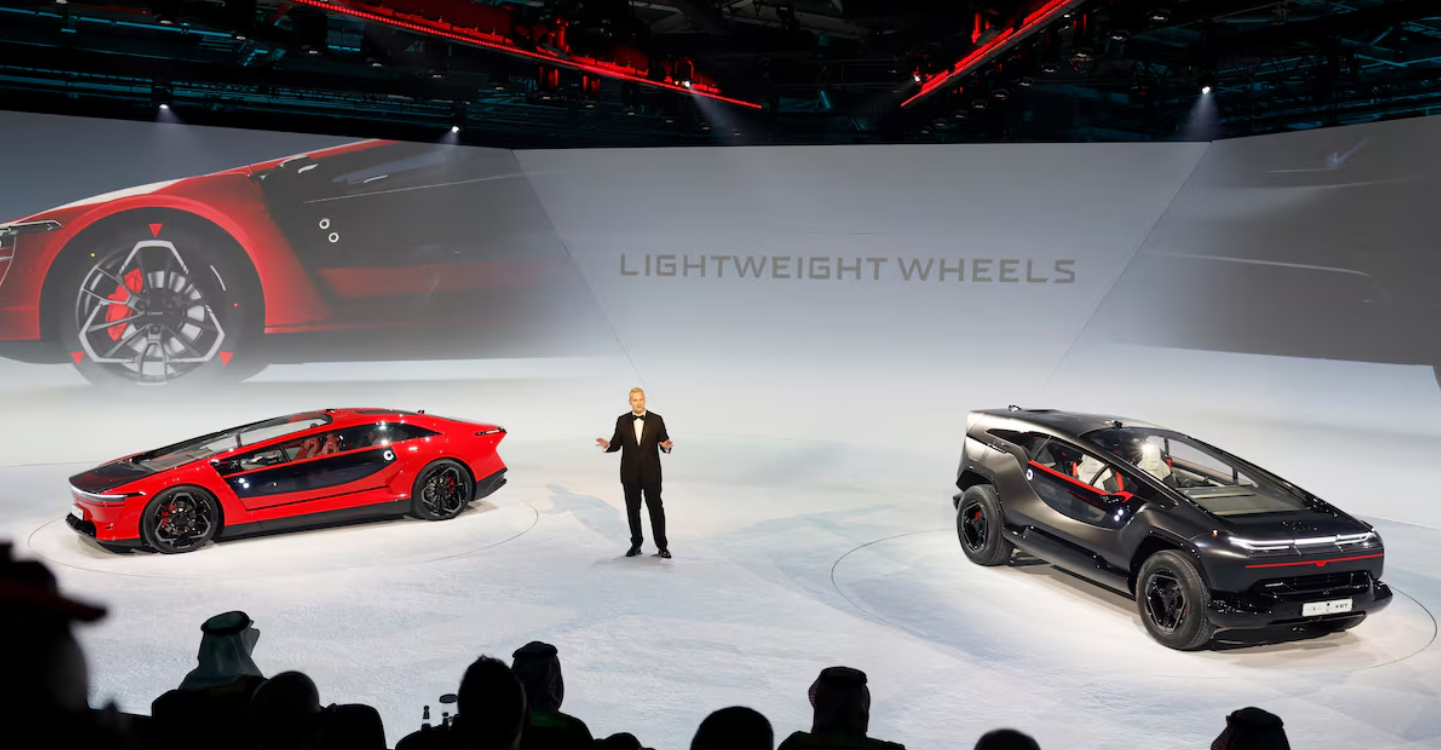
The Saudi start-up Ceer has unveiled its first all-electric models, called the Exobot — a premium saloon and an SUV. The company plans to begin sales in Saudi Arabia in early 2027. The launch is part of the government’s strategy to establish its own automotive industry and reduce the kingdom’s dependence on oil revenues.
Briefly about the main points
- Ceer has unveiled its first Exobot electric models.
- Sales of the saloon and SUV are scheduled to begin in early 2027.
- Between 2028 and 2030, the brand plans to launch a further five models.
- The range will include electric cars, plug-in hybrids and cars with internal combustion engines.
- Ceer plans to begin expanding into neighbouring markets in 2028.
Exobot’s design and roadmap up to 2030
Both debut models feature doors that open upwards and a design without the usual central pillars between the front and rear seats. According to Ceer’s CEO Jim DeLuca, the required body rigidity is ensured by high-strength materials.
After the start Exobot The company intends to launch five mass-market models between 2028 and 2030. Ceer was originally established as a manufacturer of purely electric vehicles; however, the full range will also include plug-in hybrids and cars with internal combustion engines. De Luca explained that this was necessary to respond to changes in demand.
Ceer has described the Exobot as the first in a range of seven models to be launched by 2030. The saloon and SUV will be manufactured at the Ceer Manufacturing Complex in King Abdullah Economic City.
Relying on international partners and local supply chains
Ceer is a joint venture between Saudi Arabia’s sovereign wealth fund, the Public Investment Fund, and the Taiwanese electronics manufacturer Foxconn. Foxconn provided the electrical architecture for Exobot, whilst the German car manufacturer BMW contributed the engineering design.
Previous plans to set up car manufacturing in the kingdom have not come to fruition. In particular, the Jaguar Land Rover plant project was shelved more than ten years ago, and in 2019 Toyota pulled out of a deal, citing high labour costs and a lack of local suppliers.
Ceer is relying on global partners and an expanding domestic supply chain. The US-based Lear, South Korea’s Shin Young, Germany’s Benteler and China’s Fangxin have set up production facilities in Saudi Arabia with government support. The company has stated its aim to increase the proportion of locally sourced materials in its vehicles to 45% by 2034.
Cautious expansion against a backdrop of fierce competition
Ceer plans to begin entering neighbouring markets in 2028 and to gradually expand its presence by 2034 in the Middle East and in North Africa. DeLuca stated that the company would proceed methodically, as a single mistake could destroy the start-up.
The brand is entering the market at a time of significant change in the automotive industry: Chinese manufacturers are increasing their share of the global market and actively developing new electric vehicles. According to estimates by the International Energy Agency, more than 20 million electric vehicles were sold worldwide in 2025.
Reuters also cites logistical and inflationary problems linked to the war between the US and Israel against Iran as among the challenges facing Ceer.