In Indonesia, thousands of people have taken to the streets to protest against large-scale forest fires, rising prices and dissatisfaction with President Prabowo Subianto’s policies. In the first nine months of 2026, the fires destroyed over 1.9 million hectares of natural areas, and toxic smog spread to neighbouring countries. Against the backdrop of the crisis, the president’s approval rating has fallen to 44.5%. Demonstrators are demanding that the fires be declared a national disaster, that the fight against corruption be stepped up, and that public spending be reviewed.
- Protests are continuing in Indonesia against President Prabowo Subianto’s policies and the authorities’ response to the forest fires.
- In the first nine months of 2026, fires engulfed more than 1.9 million hectares of natural areas.
- The toxic smog caused widespread respiratory illnesses and spread to Malaysia and Singapore.
- According to the results of an SMRC poll, the President’s approval rating has fallen to 44.5%.
Thousands of Indonesians have taken to the streets over the forest fires
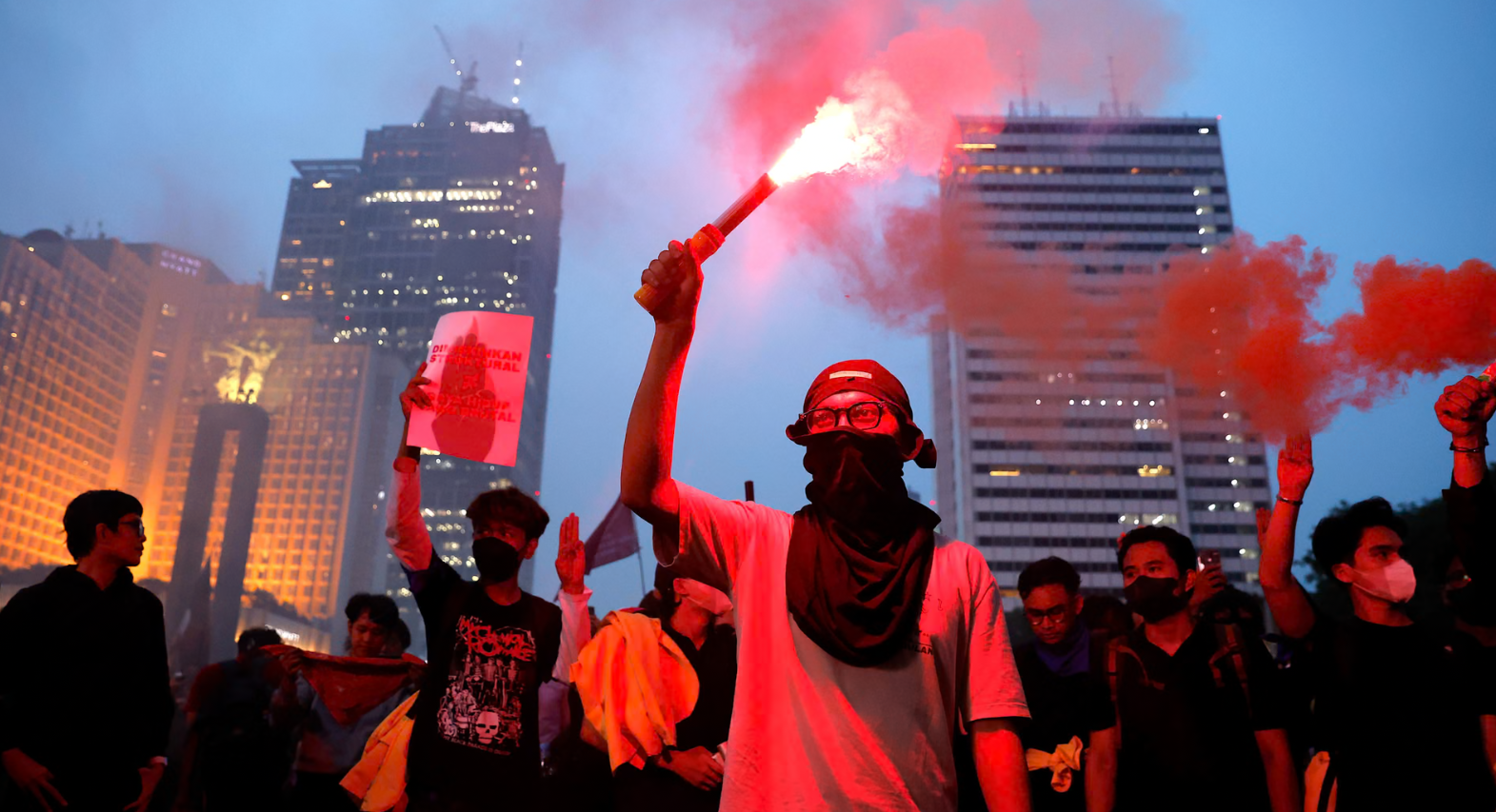
On Wednesday, 28 October, students and representatives of civil society organisations held demonstrations in Jakarta and other cities across Indonesia. The protesters demanded that the president Prabowo Subianto to recognise large-scale forest fires as a national disaster.
Some of the demonstrators took to the streets wearing gas masks, drawing attention to the dangerous levels of air pollution.
The fires that have swept across the islands of Kalimantan and Sumatra are the most extensive in the last 11 years. According to the Nusantara Atlas monitoring project, between January and September the fires destroyed over 1.9 million hectares of natural areas.
The situation was exacerbated by drought and a weather phenomenon El Niño. Smoke from the fires has spread to Malaysia and Singapore.
The government has deployed 70,000 people to fight the fires
According to the Indonesian authorities, around 70,000 emergency service personnel, military personnel and volunteers have been deployed to tackle the fires.
Four volunteers died whilst fighting the fires in October. Despite a large-scale mobilisation of resources, dangerous levels of air pollution continue to be recorded in some regions.
The government has announced an investigation into the activities of companies and individuals suspected of deliberately setting fire to land.
The President’s approval rating has fallen to 44.5%
The protests are taking place against a backdrop of deteriorating economic sentiment. Citizens are complaining about the rising cost of living, the weakening of the national currency and problems with the implementation of government programmes.
According to the results of the October survey by Saiful Mujani Research and Consulting, 44.5% of respondents approve of the President’s performance. In November 2025, this figure stood at 81.2%.
The government’s programme providing free meals for schoolchildren and pregnant women has also sparked discontent. Since the programme was launched, there have been reports of tens of thousands of cases of food poisoning.
According to an SMRC survey, 62% respondents opposed the programme. At the same time, government representatives state that they will continue to implement it and tighten controls on food quality.
Economic problems are fuelling discontent with the government
In addition to the environmental crisis, Indonesia has been faced with a weakening of the rupiah, fuel supply disruptions and concerns amongst international investors.
The index provider MSCI has warned of a possible downgrade of the Indonesian stock market’s classification due to a lack of transparency regarding the ownership structure of shares and suspicions of concerted trading.
For its part, the government emphasises economic growth: in the second quarter of 2026, the country’s GDP rose by 5.29%.
In a statement dated 28 October, government representatives said they were taking the protesters’ demands into account and were working on reforms in the economic, environmental and legal spheres.