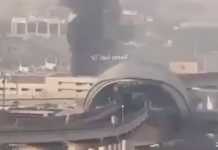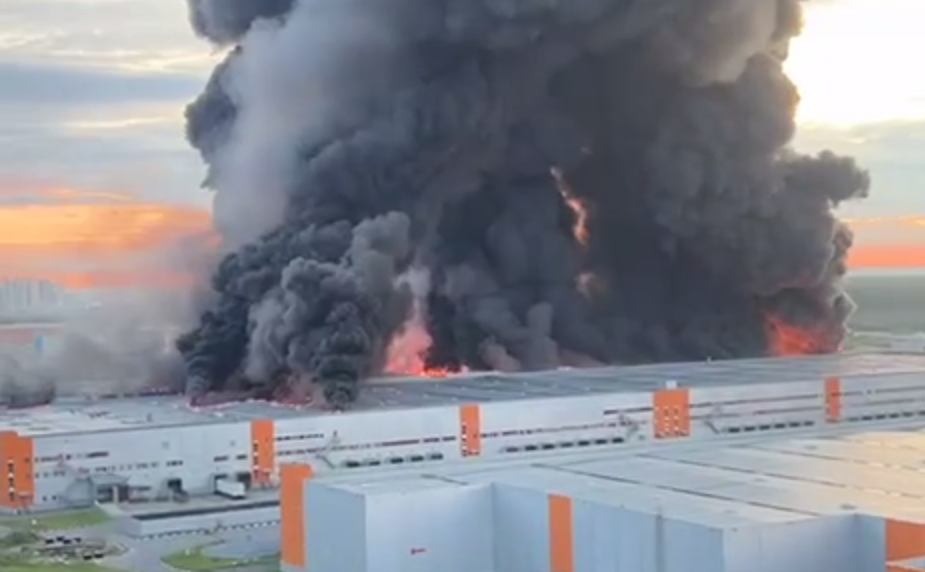
In St Petersburg, a fire broke out in the warehouses of the Russian e-commerce platform Wildberries following an attack by Ukrainian drones. The fire engulfed a significant part of the complex, and thick black smoke rose above the building. According to preliminary reports, the company’s logistics facility has been virtually destroyed. Details regarding people who may have been inside and any possible casualties are currently being verified.
Briefly about the main points
- Following a drone attack in St Petersburg, the Wildberries warehouse complex caught fire.
- According to preliminary reports, the building has suffered critical damage.
- The Russian authorities have announced that their air defence systems are operational.
- At least six of the company’s major facilities have been hit over the past week.
- Previous attacks have already disrupted delivery routes and warehouse operations.
The fire and details of the consequences
Footage circulating online shows open flames and a column of thick black smoke rising above the building. It is believed that the fire has engulfed a significant area of the warehouse.
The Russian authorities have reported that air defence systems were activated, but have not released a full list of the targets hit. Details regarding staff who may have been in the complex at the time of the attack, as well as the number of casualties, are currently being verified.
Six sites hit in a week
A series of strikes on the logistics infrastructure Wildberries It began on the night of 18 July, when drones attacked large warehouses in Elektrostal and Kotovsk in the Tambov Region. The fire in Elektrostal spread across around 250,000 square metres, and in Kotovsk — over 100,000 square metres.
According to reports from the Russian authorities, night-shift workers were killed in the strikes and dozens of people were injured. Wildberries has temporarily withdrawn from sale any goods that were located at the damaged sites.
On the night of 22 July fires The incidents occurred at the company’s logistics centres in Krasnodar and Nevinnomyssk, where staff were evacuated and warehouse operations were suspended. On the night of 24 July, a warehouse in occupied Simferopol was hit; almost simultaneously, reports emerged of a fire in St Petersburg.
How strikes affect the running of the marketplace
More fires in Simferopol In Moscow and St Petersburg, the damage affected around 552,000 square metres of Wildberries’ warehouse space. This represents approximately 10% of the company’s logistics capacity, calculated using this method.
The company is having to redirect goods to other platforms and change delivery routes. Following previous attacks, Wildberries offered sellers free relocation of goods, discounts on storage and preferential loans through Wildberries Bank; it also warned its partners about the possible cancellation or redirection of deliveries.
The strain on undamaged power stations is increasing. The loss of facilities serving as distribution hubs could be particularly significant: according to the AP, the Elektrostal complex supplied the Moscow area, and it took three days to extinguish the fire there.
The parties’ positions on the appointment of panels
The Ukrainian side had previously stated that some of the logistics centres were supplying Russian military units with electronics, equipment, components for drones and other dual-use goods. Commenting on the previous strikes, President Volodymyr Zelenskyy spoke of the supply, via such facilities, of sanctioned components for the production of drones and navigation equipment.
The Kremlin and the marketplace’s management deny that the warehouses are being used for military purposes. A Kremlin spokesperson Dmitry Peskov At the same time, he acknowledged the financial losses suffered by the company and by the small and medium-sized businesses that sell goods via the platform.
The expansion of the geographical scope of the attacks — from central and southern Russia to occupied Crimea and the north-west of the country — may force Wildberries to reorganise its warehousing and distribution network, if any of it remains intact.