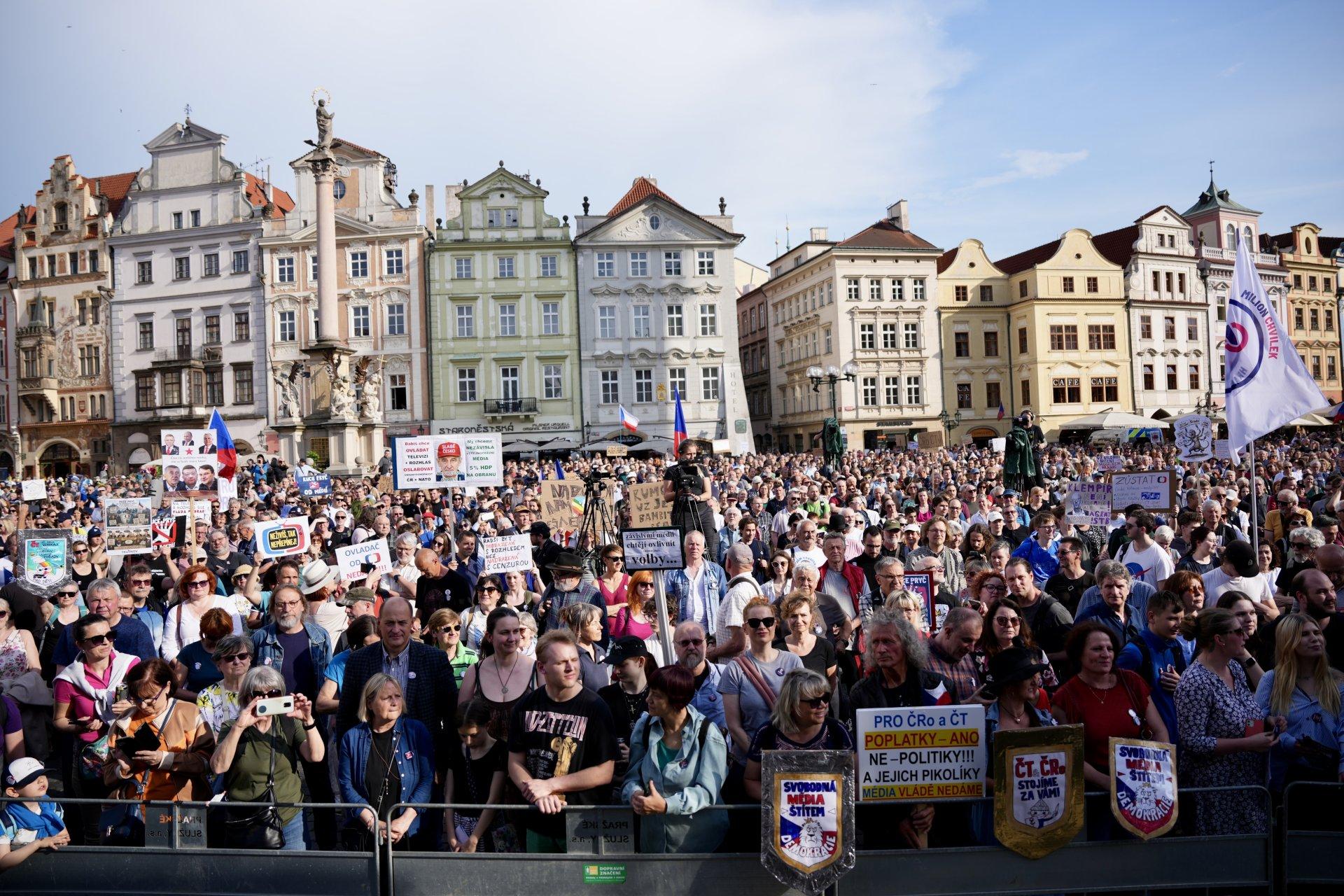
On 23 October, thousands of people gathered in Malostranské Square in Prague to protest against the government’s plan to switch Czech Television and Czech Radio to state funding. Critics believe that the change in funding model will increase the broadcasters’ political dependence. Staff at ČT and ČRo have called a one-day strike for 3 November, whilst parliament has referred the bill to its committees.
Briefly about the main points
- A protest in Prague brought together thousands of supporters of independent public broadcasters.
- The Government is proposing to replace household contributions with budgetary funding.
- Planned expenditure may be approximately 15% lower than current revenue.
- The strike was supported by nearly 3,200 employees of the two public broadcasters.
- The bill has passed its first reading in parliament and has been referred to the relevant committees.
People were listening to the parliamentary debate in the square; the police stopped an attempt to get inside
The protest was organised by the civil society initiatives Média nedáme («We won’t give up the media») and Stojíme za kulturou! («We stand up for culture»). It began at around 1.00 pm on Friday after MPs from the ruling coalition secured an urgent debate on the bill.
In the evening, protesters filled Malostranská Square near the parliament building. They carried Czech flags and placards, chanted «We won’t give up the media» and «Shame on you», and demanded the resignation of the politicians responsible for the proposed changes.
A live audio broadcast of the parliamentary debates was organised in the square. The reaction to the Culture Minister’s speech was particularly emotional Oto Klempera, who explained the reasons behind the reform.
Late in the evening, several dozen people tried to gain access to the parliament building. The police stopped them and temporarily closed off the surrounding streets. At around 10.30 pm, several hundred people remained in the square protesters.
The government promises lower household expenditure and a new funding model
The current system provides direct funding for two broadcasters through household payments. The total monthly licence fee for television and radio is 205 kroner.
The Prime Minister’s Government Andrey Babish He explains that the initiative is intended to reduce household expenditure and to adopt a model already in place in certain European countries. He denies that the changes are intended to establish state control over journalists or to restrict editorial independence.
At the same time, the proposed level of funding is approximately 15% lower than the current revenue of ČT and ČRo. There are no plans to change the nominal level of expenditure over the next few years.
Media organisations are warning of the risk of broadcasters becoming politically dependent
Journalists’ organisations, representatives of public service broadcasters and opposition politicians have spoken out against the bill. Their main argument is that dependence on annual budgetary decisions could increase political influence over editorial teams.
The European Federation of Journalists has stated that the draft bill contravenes the principles of the European Act on Media Freedom, which provides for adequate, stable and predictable funding for public service media. Concerns have also been raised by Reporters Without Borders, the International Press Institute and the European Broadcasting Union.
The management of Czech Television has called for a full discussion of the reform. The Director-General Ginek Hudarek He emphasised that financial independence from the state is a key safeguard of editorial independence. The opposition compares the plan to media reforms in Hungary, but the government rejects such comparisons.
Thousands of workers supported the strike, and the bill has been referred to the relevant committees
The Veřejnoprávně initiative, which brings together staff from the two broadcasters, has announced an all-day strike. At the time of the announcement, it had been backed by signatures from nearly 3,200 of the approximately 4,250 employees of ČT and ČRo.
A representative of the initiative Daniel Stach said that the protest would be prominently featured on all Czech Television channels, including the news channel ČT24. The organisers are to announce separately exactly how the programming will be affected.
In the early hours of 24 October, MPs voted on the document at 04:36 — the Speaker set this time Tomio Okamura. The ruling coalition secured the referral of the bill to parliamentary committees for further consideration.
The current licence fee system remains in place for the time being. Civil society organisations have announced their next protest for 25 October, whilst broadcasters’ staff are preparing for the planned strike.