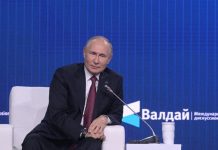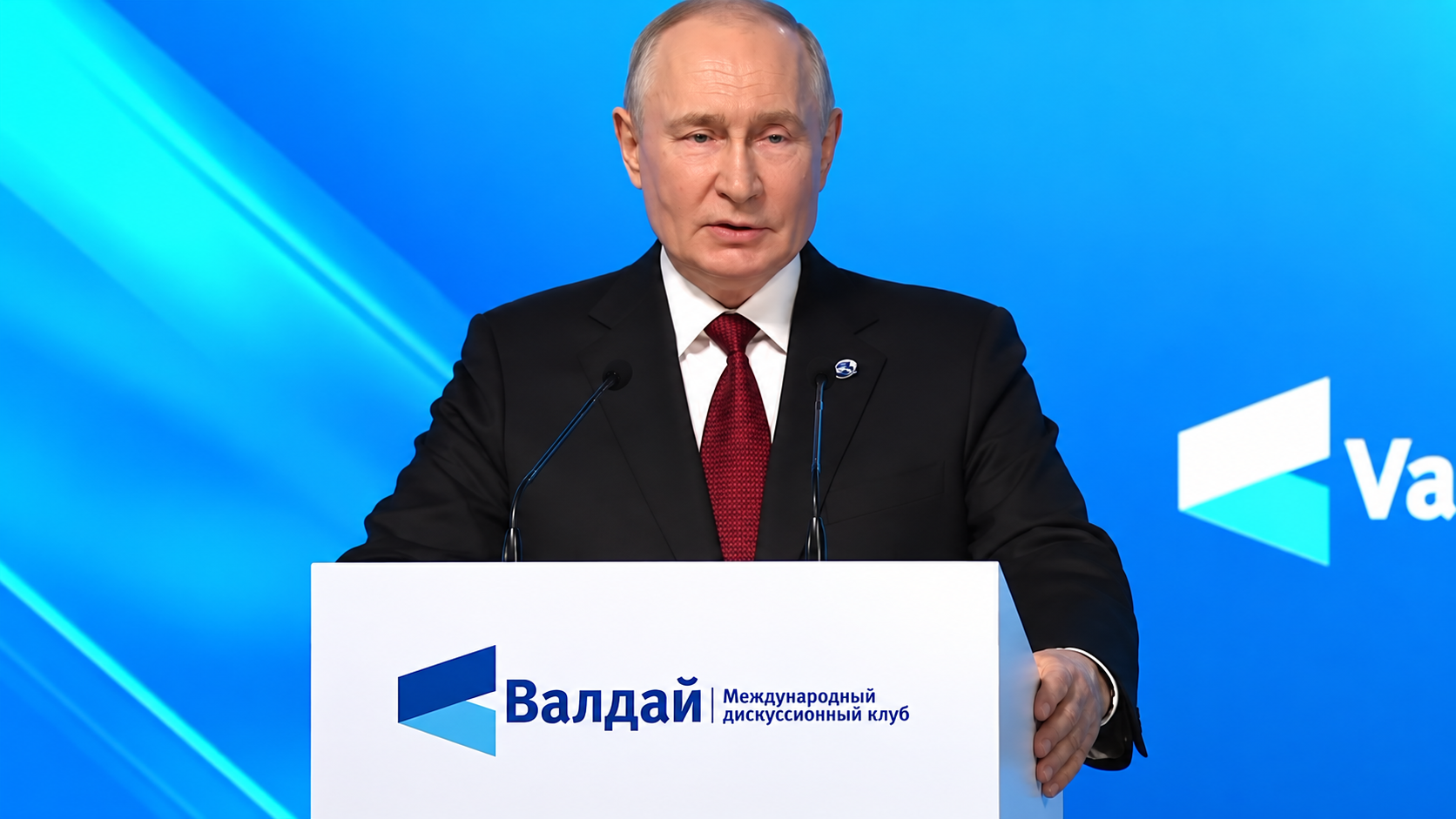
On 1 October, during a plenary session of the Valdai International Discussion Club, Russian President Vladimir Putin once again claimed that Russia allegedly «did not start the war» against Ukraine, but was forced to «respond to aggression». He also blamed NATO, Ukrainian nationalism and the West for the outbreak of the war, and spoke of the risk of uncontrolled escalation and the use of weapons capable of causing catastrophic consequences.
- Putin claimed that Russia had allegedly «not started the war», but had been forced to «defend itself».
- He accused NATO of taking action in territories which he described as «historical» for Russia.
- The President of the Russian Federation reiterated his claims about «Russophobia» and Ukrainian nationalism.
- He also spoke of the risks posed by the use of weapons capable of causing a global catastrophe.
Putin has once again shifted the blame for the war onto Ukraine and the West
During the speech Putin He repeated one of the Russian authorities« key arguments: Moscow allegedly did not start the war, but »responded« to the actions of Ukraine and the West. According to him, Russia was »deliberately placed in a situation’ where it was forced to defend itself with arms.
He also claimed that NATO was supposedly not supposed to «encroach on our historical territories», whilst the Ukrainian authorities were not supposed to «encourage nationalism». Among other arguments, Putin once again spoke of «Russophobia» and accused Ukraine of persecuting Russian speakers.
The Kremlin has been promoting this version of the reasons for the war for many years. At the same time, international documents record a different sequence of events. The UN has defined Russia’s actions in 2022 as aggression, and the UN Human Rights Monitoring Mission explicitly states that On 24 February 2022, it was the Russian armed forces that launched a full-scale armed attack on Ukraine.
Ukraine was not a member of NATO
Putin devoted a separate section of his speech to NATO, linking the Alliance’s expansion and its cooperation with Kyiv to decisions taken by Moscow.
At the same time, at the time of the full-scale invasion, Ukraine was not a member of NATO and was not covered by Article 5. Ukraine’s relations with the Alliance have developed as a partnership. From 2010 to 2014, Ukraine officially maintained its non-aligned status, and its course towards membership was resumed following Russia’s annexation of Crimea and the outbreak of hostilities in the Donbas.
NATO also points out that, until 2014, the Alliance had formal mechanisms for cooperation directly with Russia — in particular, the Russia–NATO Council, established in 2002. Practical cooperation was suspended following the annexation of Crimea.
Putin stated that Russian troops «did not attack civilian targets first»
During his speech, the President of the Russian Federation also said that the Russian military had allegedly always adhered to humanitarian standards and «had never been the first to attack non-military targets».
This statement contradicts numerous documented cases attacks on civilian infrastructure Ukraine. On 1 October alone, a Russian drone struck a school in Kyiv. Reuters verified footage of the moment of the strike; over a hundred children were in the shelter at the time. On the same day, the South Bridge and other sites in the capital were attacked. Moscow traditionally claims that it targets only military objectives.
The UN Human Rights Monitoring Mission has previously documented thousands of civilian deaths and injuries since the start of the full-scale Russian invasion, as well as widespread damage to residential buildings, hospitals, schools and critical infrastructure.
«Escalation is never a one-sided affair»
A separate part of the speech dealt with global security. Putin stated that escalation is allegedly «never one-sided», and that the point beyond which it will no longer be possible to change the situation could be reached very quickly.
He also spoke of weapons capable of «destroying all life» and called for catastrophic scenarios to be avoided.
During his speech, Putin predicted that there was a high likelihood of international conflicts continuing due to changes in the world order. At the same time, he expressed the view that the situation would improve over time as what he calls «Western hegemony» diminishes.
Putin has once again described the collapse of the USSR as a «tragedy»
The President of the Russian Federation also returned to the subject of the collapse of the Soviet Union. According to him, this event was a tragedy for tens of millions of people who, following the redrawing of borders, found themselves outside Russia.
Putin attributed responsibility for the subsequent deterioration in relations with the West, amongst other things, to the late Soviet leadership, accusing it of placing too much trust in Western states.
He also reiterated the argument that Russia had been trying for many years to become part of the Western world, but that the West had allegedly sought to weaken or divide Russia itself. This is the Kremlin’s political interpretation, not an established fact.
«Let’s Live in Harmony» and the New World Order
Despite his harsh rhetoric about war and escalation, Putin simultaneously called on Western countries to normalise relations, using the phrase «let’s live in harmony».
He devoted a significant part of his speech to what he described as the world’s transition to a new balance of power. According to him, the influence of Western states is gradually waning, whilst other centres of power are gaining greater political and economic clout.
Putin also promoted Russia’s concept of a «Great Eurasian Partnership» and spoke of the need to reform international institutions, including the UN. The Russian president described the current global situation as a turning point, at which technological, political and economic changes could radically transform the international system.
The main argument regarding Ukraine has remained unchanged
In the section devoted to Ukraine, the speech did not reveal any fundamental change in Russia’s position. Putin once again denied Moscow’s responsibility for starting the war and portrayed the invasion as a forced response to the actions of Ukraine, NATO and the West.
However, this version contradicts the mainstream, internationally recognised chronology of the conflict. Russia annexed Crimea in 2014, carried out a military intervention in eastern Ukraine, and in February 2022 launched a full-scale invasion. The UN General Assembly condemned Russian aggression by an overwhelming majority — resolution ES-11/1 was supported by 141st country, five voted against, and 35 abstained.
Putin’s statement today is therefore a continuation of the Kremlin’s long-standing political line: Moscow blames Ukraine and Western countries for Russia’s decision to launch large-scale military operations.