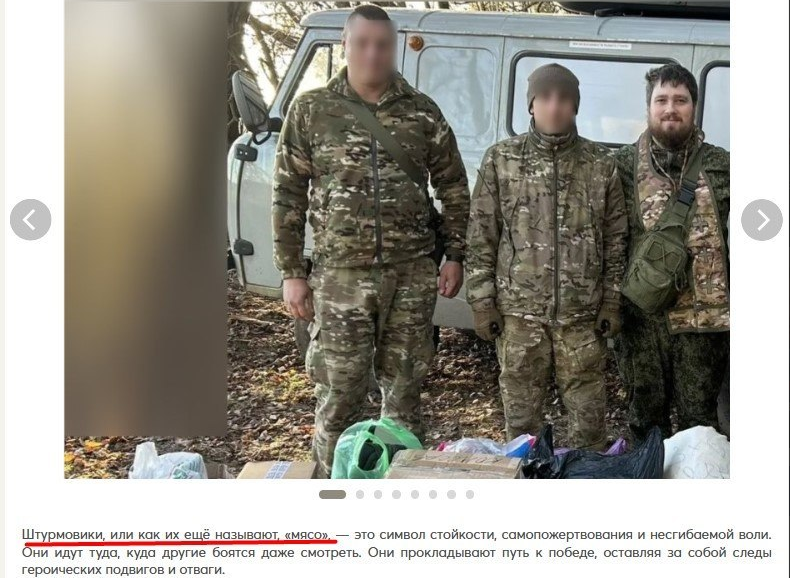
The Bryansk Diocese of the Russian Orthodox Church referred to servicemen in the Russian Federation’s assault units as «meat» in an official statement regarding a priest’s visit to Russian troops. Following the outcry, the wording was removed from the diocese’s website, though the original text remains in archived copies and media reports.
How the Russian Orthodox Church referred to its soldiers
In a statement by the Bryansk Diocese regarding a visit to an assault unit of the Russian army, the servicemen were described using a word that is unusual for an official church publication.
«Assault troops, or, as they are also known, “cannon fodder”, are a symbol of resilience, self-sacrifice and an unbreakable will.».
The article went on to discuss the alleged heroism of Russian soldiers carrying out combat missions.
The use of the word itself «meat» caught the attention of journalists. In the context of the Russian-Ukrainian war, the term «meat grinders» is used to describe attacks resulting in heavy casualties among troops.
Following the public outcry, the wording was removed
After the post had been shared by the media and social media users, the first sentence was edited on the diocese’s official website.
The new version retains only the statement that the assault troops are a symbol of resilience, self-sacrifice and unbreakable will.
As of 29 October, the amended text is available on the Bryansk Diocese’s website. The original version has been preserved by archive services and has also been quoted by independent Russian publications.
A priest blessed the Russian assault troops
The article was about a trip undertaken by the head of the military department of the Bryansk Diocese, a priest Konstantina Vasilyeva, to a unit of the Russian «Sever» military group.
The trip was organised with the blessing of Metropolitan Alexander of Bryansk and Sevsk. The priest handed over to the soldiers food, warm clothing, medicines, camouflage netting and other items collected by the parishioners.
During his visit to the unit, Vasilyev conducted a church service, sprinkled the Russian soldiers and military equipment with holy water, and blessed the assault troops as they set out to carry out their combat mission.
The diocese’s statement also notes that the priest led a prayer service for the victory of the Russian army.