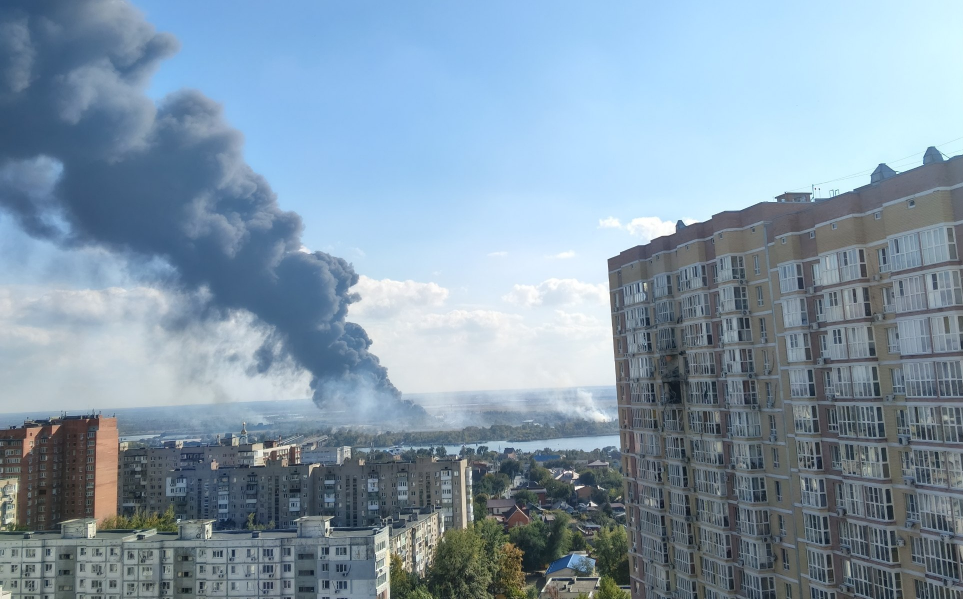
In Rostov-on-Don, Russia, on 10 October, the aftermath of a night-time drone attack on an oil-loading terminal linked to the Novoshakhtinsk Oil Products Plant (NZNP) continues to be assessed. A huge plume of black smoke is rising above the industrial part of the city, visible from residential areas. The irony of the situation lies in the fact that the massive fire broke out just a few hours after Donald Trump and Vladimir Putin reached an agreement on the supply of Russian diesel to the American and global markets.
- On 10 October, drones attacked an oil terminal in Rostov.
- Thick black smoke is rising above the city.
- Residential buildings have been damaged in Rostov.
- The attack took place following Trump’s diesel deal with Putin.
Fire at the NZNP terminal: black smoke rises over Rostov
On the night of 10 October, Rostov-on-Don suffered massive drone attacks. Following a series of explosions at the oil loading terminal linked to the Novoshakhtinsk Oil Products Plant, a major fire broke out.
Following an analysis of the video footage, OSINT experts identified the point of origin of the fire as the «Yug Rus» terminal in the Zaliznychnyi district of the city. The facility is designed for the storage and transhipment of petroleum products, particularly for export.
New footage from Rostov shows a huge plume of black smoke rising above the industrial area. The smoke is visible from distant residential areas, and local media are reporting a strong smell of burning in the city.
Damage to such infrastructure could complicate the shipment of fuel and create additional logistical problems for the Russian oil sector. At the same time, the exact extent of the damage to the terminal and the volume of petroleum products lost have not yet been established.
Residential buildings damaged in Rostov: six people injured
The aftermath of the night-time attack was also observed in residential areas of Rostov-on-Don. According to local authorities, apartment blocks and private houses, as well as municipal infrastructure, were damaged.
Governor of the Rostov Region Yuriy Slyusar reported that six people had been injured. Some of them were taken to hospital, whilst two remained in hospital in a moderately serious condition.
A local state of emergency has been declared in three districts of the city to deal with the aftermath of the attack. A railway bridge was also damaged. Train services were temporarily suspended but were later resumed.
Diesel for Trump and the fire in Rostov: a coincidence of two events
The attack attracted the most attention because of the timing. Just the day before Donald Trump announced the an agreement with Vladimir Putin regarding the supply of Russian diesel fuel to the US and global markets.
The US President announced that Russia had agreed to supply over 300,000 tonnes of diesel in the near future, a further 500,000 tonnes in November and one million tonnes thereafter. Looking ahead, Moscow has promised additional volumes, depending on the condition of its oil refineries.
To facilitate such transactions, Washington has temporarily eased certain sanctions restrictions on Russian diesel.
Against this backdrop, the images of the burning terminal in Rostov provide a striking contrast: Whilst the Kremlin promises to increase fuel exports, one of its logistics facilities is being destroyed.
What adds a particular irony to the situation is that Trump himself has linked the forthcoming additional supplies to the condition of Russian oil refineries, which have previously been targeted by Ukrainian strikes on numerous occasions.
How attacks on oil infrastructure are affecting Russia
The Russian oil sector simultaneously supplies the domestic market, generates export revenue and provides fuel for the armed forces. Damage to oil refineries, storage tanks and transhipment terminals results in additional costs for repairs, transport and the organisation of supplies.
Repeated attacks may exacerbate these problems, particularly if facilities through which large volumes of finished fuel pass are damaged.