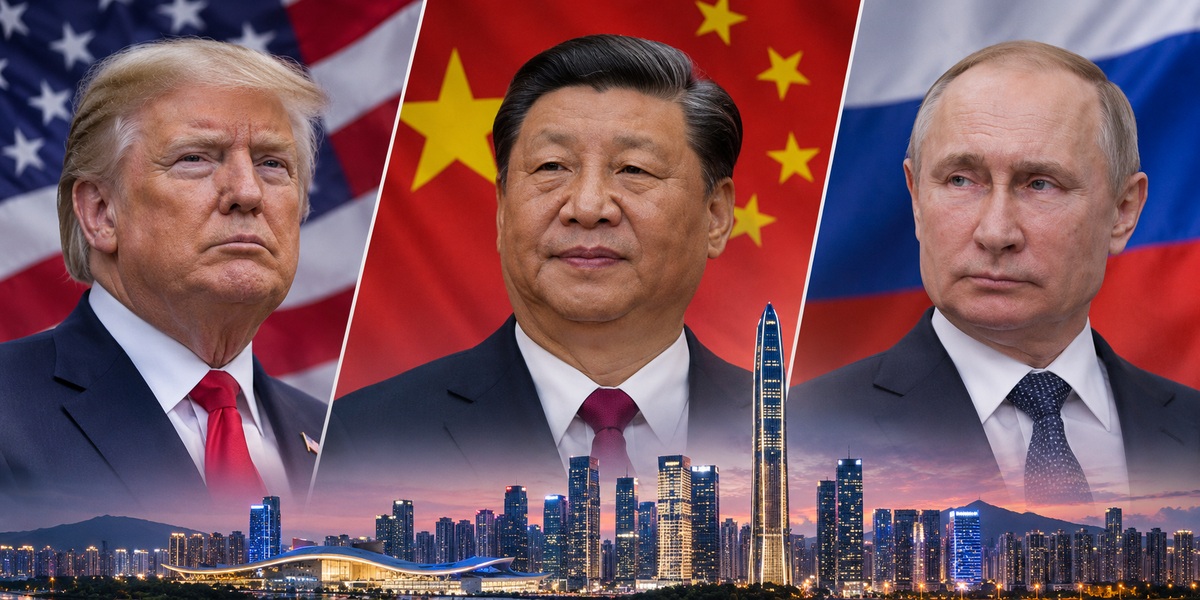
On 19 November 2026, US President Donald Trump will hold a trilateral meeting with Russian President Vladimir Putin and Chinese President Xi Jinping in Shenzhen, China. The White House announced the planned talks on 13 November. The meeting will take place on the sidelines of the Asia-Pacific Economic Cooperation (APEC) summit. According to US officials, the parties will discuss nuclear arms reduction and the war in Iran, whilst the issue of Ukraine is not on the agenda.
- A trilateral meeting between Trump, Putin and Xi Jinping is scheduled for 19 November in China.
- The talks will take place on the sidelines of the APEC summit in Shenzhen.
- The main topics are the reduction of nuclear arsenals and the war in Iran.
- The US has no plans to discuss Ukraine in a trilateral format.
- Washington does not expect any specific agreements to be signed following the meeting.
What will Trump, Putin and Xi Jinping be discussing?
White House spokeswoman Olivia Wails told journalists that one of the main issues to be discussed would be the reduction of nuclear weapons. According to her, Trump considers the spread of nuclear weapons a serious threat to international security.
The second important issue will be war in Iran. Washington hopes to discuss the conflict with Russia and China, which maintain relations with Tehran.
According to Reuters, the US administration does not expect the leaders of the three countries to reach any specific agreements following the meeting. The talks are seen primarily as the start of a dialogue on future nuclear arms control.
Why was Ukraine not included on the agenda?
Despite Russia’s full-scale war against Ukraine, the US does not intend to raise this issue during the trilateral talks.
A senior US administration official explained to journalists that Washington is conducting separate negotiations with Kyiv and Moscow, in which China is not directly involved.
At the same time, the Kremlin’s position is different. As early as 12 November, an aide Putin Yuriy Ushakov stated that the Russian president intends to discuss with Trump the issue of resolving the war in Ukraine during the summit in China.
However, according to the latest information from Reuters, no separate bilateral meeting between Trump and Putin is currently planned.
President of Ukraine Volodymyr Zelenskyy He had previously expressed concern about the possibility of discussing Ukraine’s future without the participation of the Ukrainian side. At the same time, the agenda announced by the White House does not mean that the issue of Ukraine is guaranteed not to be raised during the meeting.
Why negotiations on nuclear weapons can be difficult
The meeting in Shenzhen will take place after the New START treaty between the US and Russia expires in February 2026. This treaty placed limits on the two countries’ strategic nuclear arsenals.
Trump is calling for a new format for the agreements, which would involve China. However, Beijing has previously refused to take part in trilateral arms reduction talks, citing the significant disparity between the countries’ nuclear capabilities.
According to Pentagon estimates cited by the AP, China has more than 600 nuclear warheads, whilst the US and Russia each have more than 5,000.
US officials acknowledge that rapid progress is not to be expected. It remains to be seen to what extent Moscow and Beijing are prepared to support the format of talks proposed by Washington.
What is known about the meeting on 19 November
The APEC Summit will take place on 18–19 November in Shenzhen. Before travelling to China, Trump plans to visit the Philippines, where he will take part in meetings with leaders from South-East Asian countries.
In China, the US President is also due to hold a separate bilateral meeting and a working lunch with Xi Jinping. Following this, trilateral talks involving Putin are scheduled to take place.
As of 14 November, the White House had confirmed that the meeting would take place, although it had not yet taken place. The final outcome of the talks, the possibility of a joint statement and the parties’ readiness for future agreements remain open questions.