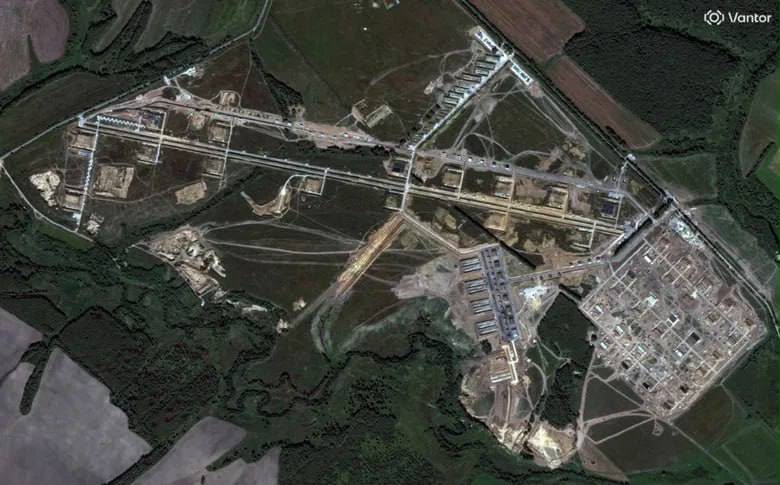
Russia is actively expanding a drone base near the village of Tsymbulova in the Oryol Oblast, approximately 175–180 kilometres from the Ukrainian border. Satellite images from August, analysed by OSINT researchers, have identified around 101 drones at the site, as well as new launch pads for the «Geran-4» and «Geran-5» jet-powered drones, which reduce the time taken to detect aerial targets.
Briefly about the main points
- Satellite images of the base have revealed around 101 drones.
- Among them, 37 «Geranium-5» and eight «Geranium-4» were identified.
- In the space of two months, 16 launchers for jet-powered UAVs have been deployed.
- Construction of the complex will begin in August 2024, and it will be extended in the spring of 2026.
- On 31 August, Ukrainian forces reported that they had struck the facility’s infrastructure.
What drones were spotted in the photographs?
OSINT monitoring of August imagery revealed around 101 aircraft in the area. Analysts identified 37 jet «Geranium-5», eight «Geran-4» jet-powered drones and 56 «Geran-2» strike drones.
Satellite images make it possible to assess the number and types of visible drones, but do not allow us to establish with 100 per cent certainty whether each of them was ready for immediate launch.
The start-up infrastructure was rolled out in two months
Between July and August, 16 launchers arrived at the base equipment for jet drones: ten are intended for the «Geran-5», and a further six for the «Geran-4». Launch pads for other variants of the «Geran» have also been spotted on the site.
Back in May, the US-based Institute for the Study of War, citing Ukrainian sources, reported on the construction of ten new launch pads at the Tsymbulova airfield, compatible with jet-powered models. At the same site, at least eight concrete structures were being built to house unmanned aerial vehicles.
From a small site to a large complex
According to Molfar, construction of the drone port began in August 2024. By February 2025, the main elements of the complex had been erected, and in the spring of 2026, work began in earnest on developing additional areas for the storage and maintenance of attack UAVs.
Planet Labs’ satellite imagery from June estimated the complex to be approximately two by four kilometres in size. Molfar described the architecture of large drone ports as a combination of technical preparation areas, storage facilities, hangars for ready-to-fly drones, and mobile or stationary launch facilities.
Solar panels can power some of the equipment
Analysts also noted the large number of solar panels on the site. In their view, these could serve as an additional power source for communications equipment, meteorological equipment and systems involved in launch preparations.
Such a backup power supply makes it possible to keep some equipment running during disruptions to the centralised electricity supply.
Jet-powered drones reduce the time taken to intercept
The jet-powered variants of the «Gerani» fly faster than the traditional piston-engined «Shahed» and «Gerani» models, reducing the time available to detect and intercept them. The Times described the new models as a more challenging target for Ukraine’s air defences. In response, Ukraine is developing high-speed interceptor drones; on 3 September, President Volodymyr Zelenskyy announced that manufacturers already had suitable prototypes.
On 31 August, Ukrainian forces reported a strike on the drone port’s infrastructure: launch pads and storage facilities for attack UAVs were hit. The facility sustained damage, but there is no information to suggest the base was completely destroyed.