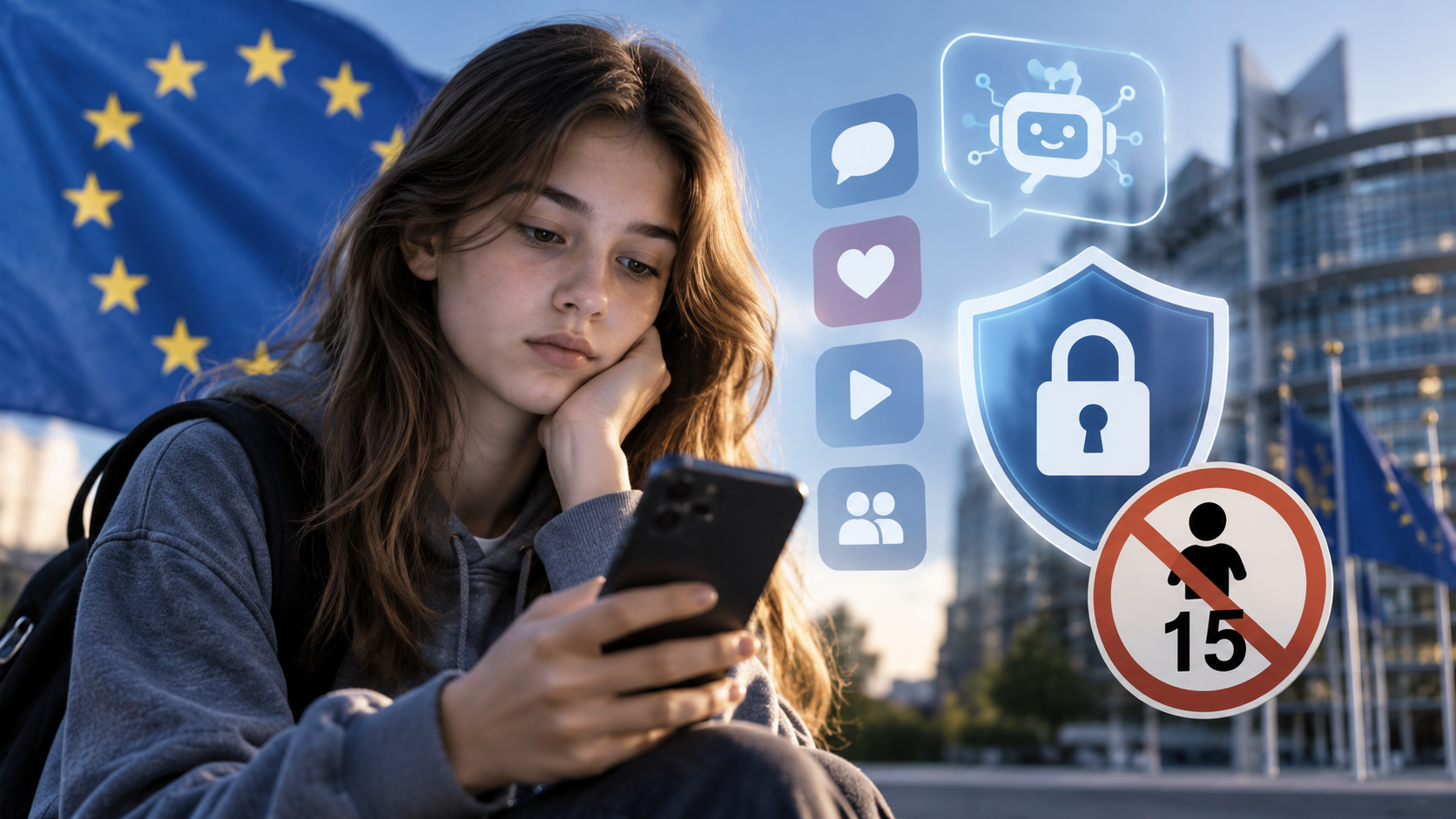
The European Union is drawing up some of the world’s strictest rules on protecting children online. According to a draft document from the European Commission, seen by Reuters, There are plans to restrict children under the age of 15 from accessing social media, video platforms, AI chatbots and online games without supervision. We are talking about the forthcoming EU Kids Act, which European Commission President Ursula von der Leyen and European Commissioner for Technology Henna Wirkkunen are due to present this week. The final provisions of the document may still be subject to change, and following the presentation, it must be approved by the EU Member States and the European Parliament.
- The EU is preparing new restrictions for children under the age of 15.
- They will cover social media, ChatGPT, YouTube and online games.
- Children aged 13–14 will only be allowed to have accounts supervised by their parents.
- Platforms will be required to verify users’ ages.
There are plans to restrict access to social media and ChatGPT for children under 15
The offering covers a wide range of digital services: social media, video-streaming platforms, generative AI chatbots and online games.
Reuters is among the services that may be affected new rules, refers to Facebook, Instagram, TikTok, YouTube and ChatGPT. The tightening of regulations was prompted by concerns about the impact of digital platforms on children’s health, safety and mental wellbeing.
The European Commission does not wish to introduce a blanket ban applicable to all children, but rather gradual access depending on age.
According to the provisional plan:
- for children up to 3 years access to such services will not be provided;
- at the age of 3–12 years it will only be possible to use safe children’s services under the full supervision of parents;
- teenagers 13–14 years old will be able to access special starter accounts set up by their parents;
- з 15 years Users will be able to create their own accounts.
Time limits and parental controls are to be introduced for teenagers
Significantly stricter rules are in place for users aged 13–14 than for adults.
Such accounts will have a limited circle of contacts, strict time limits and enhanced parental control. Platforms will also be required to provide children with simple tools for reporting dangerous or harmful content.
Companies may be banned from using design features that encourage addiction, as well as algorithmic feeds capable of regularly exposing children to harmful content.
The EU is already tightening its control over large digital services. At the end of August, the European Commission, in particular, officially classified ChatGPT, Reddit and Roblox among the largest digital services, in accordance with the rules Digital Services Act, which imposes additional obligations on them regarding the assessment of risks to minors.
Social media platforms will be required to verify users’ ages
One of the key changes is mandatory age verification.
Social media platforms and video-sharing sites will be required to verify a user’s age when a new account is created. For online games, the aim is to carry out age verification before the game is even downloaded.
European regulations already require the use of age verification mechanisms for high-risk services, and also recommend that children’s accounts be set to the highest level of privacy by default and that unwanted contact be restricted.
Tech companies may also be required to pay special supervisory levy, which will be used to fund the monitoring of compliance with the new rules.
The ban has not yet come into force
It is important to note that at this stage we are talking specifically about draft legislation, rather than the ban that has already been introduced.
The EU Kids Act has yet to be officially presented, after which the European Commission will have to negotiate the text with the EU Member States and the European Parliament. This process could take several months, and certain provisions may be amended before it is adopted.
If the proposal is approved in its current form, it will be one of Europe’s most far-reaching measures to restrict children’s access to social media, artificial intelligence and online games.