Crimea, which for over ten years has remained the chief political symbol of Russian expansion and propaganda, clearly demonstrates the limits of the occupation system’s resilience. A series of successive and highly precise strikes by the Ukrainian Defence Forces on military infrastructure, logistics hubs and energy facilities has led to a cumulative effect. The peninsula is gradually losing its strategic significance as an effective military springboard, transforming into a serious economic and psychological burden for the Kremlin.
The current situation in Crimea is not merely a matter of temporary everyday inconveniences, but a systemic logistical and infrastructural paralysis which directly affects the civilian population and erodes what little stability the occupying regime has left.
Key points at a glance: Key indicators of the infrastructure crisis
-
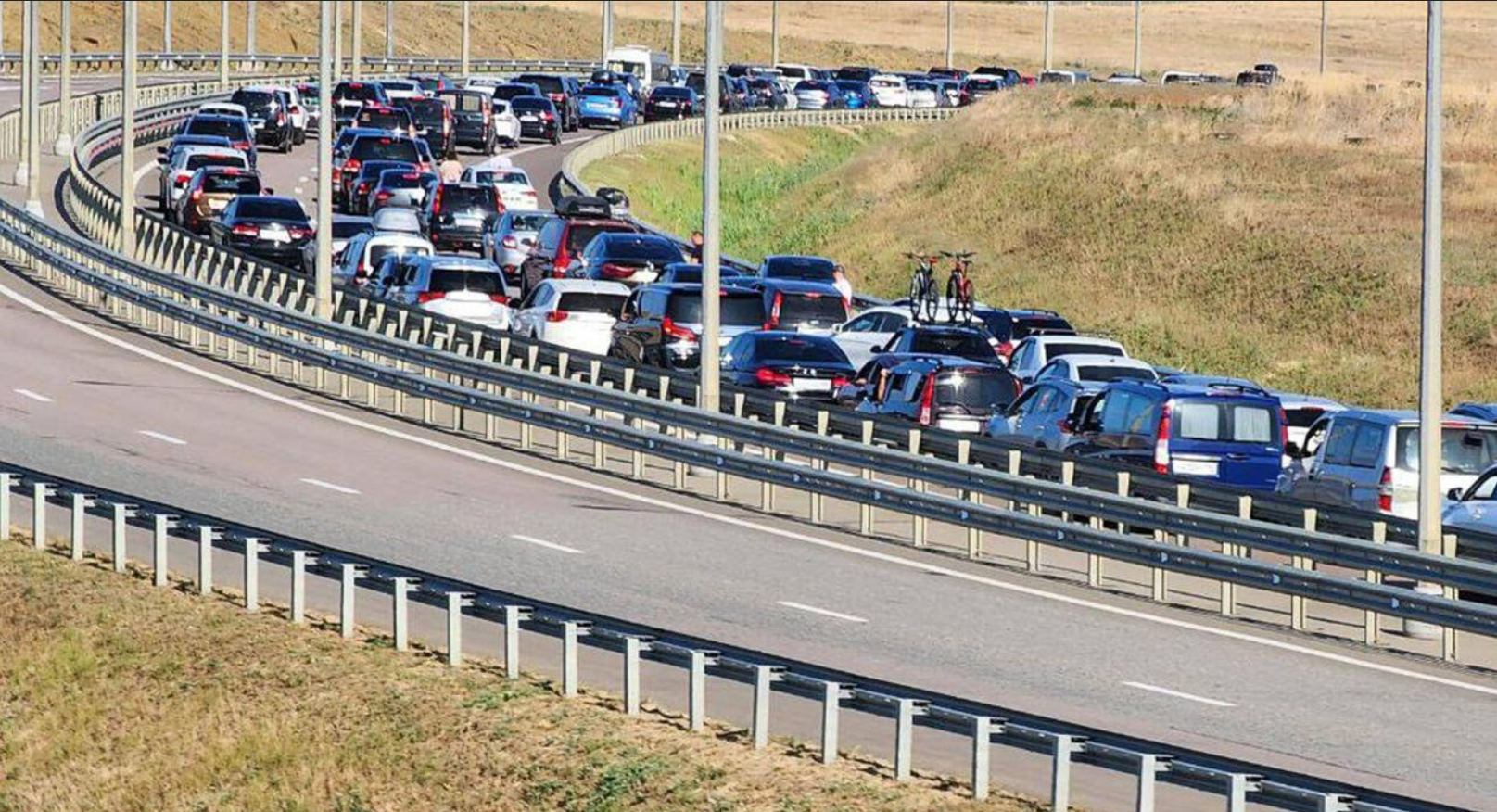
Over 800 cars in queues: Due to heightened security checks by the occupying authorities, the Crimean Bridge is operating at minimum capacity, causing major traffic jams to leave the peninsula.
-
Restrictions until 8.00 pm: Strict time limits have been introduced on the operating hours of the commercial sector (shopping centres, catering establishments) and public transport.
-
Hourly power cut schedules: Key cities on the peninsula, notably Kerch and Sevastopol, have switched to energy-saving measures due to damage to power generation and distribution facilities.
-
Blockade of the civilian fuel market: Sale of petroleum products Access to the private sector has been significantly restricted, whilst commuter rail services have also been suspended.
-
Cancellation of the health resort season: As it is impossible to guarantee safety, children’s sessions at summer camps have been cancelled entirely, and convoys carrying children are being returned to regions of the Russian Federation.
A logistical noose: The paralysis of the Crimean Bridge and ferry crossings
The main transport route linking the occupied peninsula with Russia — Crimean bridge — has become a place of constant tension and hours-long waits. Fearing further coordinated attacks, the occupying administration has tightened control measures as much as possible, leading to a massive transport breakdown.
Traffic jams involving more than 800 vehicles at any one time are being reported at the checkpoints near the bridge. Drivers and passengers are forced to wait for hours whilst thorough checks are carried out, and the queues of vehicles remain at a standstill for long periods.
The situation is further complicated by the fact that alternative supply routes are also blocked. As a result of effective Ukrainian strikes on the Kerch seaport, the occupiers« ferry crossings have been severely damaged. This has effectively cut off the possibility of rapidly diverting freight flows by sea. A mood of evacuation is becoming increasingly evident among the civilian population and the families of Russian military personnel: the bridge is operating predominantly in »outbound’ mode.
Fuel shortage: Sales suspension and rail restrictions
The logistical paralysis immediately disrupted the supply of petroleum products to the peninsula. The occupying authorities have resorted to unprecedented measures, indicating that fuel stocks have reached a critical level. The administration was forced to impose strict limits, announcing a temporary suspension of fuel sales to civilian vehicles.
Such restrictions are crippling not only the private lives of Crimeans, but also small and medium-sized businesses, which are entirely dependent on road transport.
What is more, the suspension of electric train services in the central part of Crimea has been reported. Although the authorities cite «technical problems», the real reason lies in security risks and a shortage of resources following the recent attacks on railway junctions and fuel depots.
Power cuts: Schedules and disruption to essential services
Ukrainian drone strikes on key energy infrastructure sites triggered a chain reaction in the peninsula’s power grid. The Crimean power grid, which had already been operating at the limits of its capacity due to wear and tear and isolation, found itself on the brink of collapse.
Strict hourly power cut schedules have now been officially introduced in Kerch. The occupying authorities in Sevastopol have decided to switch off a significant proportion of street lighting in order to reduce peak loads. Against this backdrop, residents of these cities are increasingly being warned of widespread power cuts, which bring with them associated problems — in particular, disruptions to the water supply due to pumping stations being shut down. The introduction of power cut schedules across the entire peninsula is becoming a new normal, to which the occupiers are preparing the civilian population in anticipation of fresh waves of attacks.
The reality of martial law: Total restrictions on the population
The escalation of security risks has forced the occupying authorities to place Crimea under a semi-martial law regime, with severe restrictions on civil liberties. The following measures have been introduced:
-
Restrictions on trade and services: The opening hours of shopping centres, supermarkets and catering establishments have been significantly reduced (mostly until 8.00 pm).
-
Transport limit: Public transport now operates exclusively between 05:00 and 21:00.
-
Special traffic controls: A ban has been introduced on certain categories of vehicles (in particular, motorbikes and mopeds) travelling after 10.00 pm and during air raid alerts.
-
Cancellation of mass events: All outdoor cultural, entertainment and public events have been cancelled until further notice.
A Season Cut Short: Focus on Recovery
The summer tourist and health resort season, which the occupiers had been trying to present as evidence of stability, has been completely derailed. The main sign of the disaster in this sector was the cancellation of children’s sessions at summer camps and health resorts.
As it is impossible to guarantee safety given the ongoing air defence operations and air strikes on military facilities in Saki, Dzhankoy, Sevastopol and Feodosia, buses carrying children are being turned back at the very entrances to the health resorts and are returning to the Russian Federation. The resort infrastructure is suffering enormous losses, and the very fact of being on the peninsula is perceived by Russian citizens as a direct threat to their lives.
Map of the infrastructure and security collapse in Crimea
| Sector / Region | What has been recorded | Consequences for the population and logistics |
| The Kerch Strait | Major traffic jams on the bridge (over 800 cars), disruption to ferry services. | Inspections lasting many hours, effectively blocking freight traffic with the Russian Federation. |
| Energy (Kerch, Sevastopol, Yalta) | Hourly power cut schedules, street lighting shutdowns, attacks on substations. | Disruptions to the water supply (due to the pumps being switched off), businesses closing in the evening. |
| Transport and fuel | Suspension of fuel sales to the general public; cancellation of suburban train services. | Private transport at a standstill, domestic logistics in disarray, queues at petrol stations. |
| Civil restrictions (Everywhere) | Curfew restrictions for shopping centres and cafés (until 20:00), and a ban on certain vehicles travelling at night. | A complete shutdown of evening and cultural life on the peninsula. |
| Tourism and Wellness | The cancellation of children’s camps; buses carrying children turning round at the entrances to residential blocks. | The financial collapse of the holiday season; the designation of Crimea as a high-risk area. |
Conclusions: The psychological breaking point
The current situation confirms the Ukrainian military command’s assessment: the systematic wearing down of the occupying forces’ infrastructure (a tactic of successive precision strikes) is yielding results. Russia is capable of maintaining control over Crimea politically and in the media, but sustaining its military and logistical operations there is becoming increasingly costly and difficult.
Crimea is gradually being transformed into logistical trap for the Russian forces. Further pressure on fuel depots, air defence systems, the remnants of the Black Sea Fleet and bridges could create a situation in which holding on to the peninsula becomes an insurmountable political and economic burden for the Kremlin. This, in turn, could become a psychological breaking point for Russian society as a whole.
For the civilian population remaining under occupation, the main recommendation remains to keep as far away as possible from any Russian military installations and logistics hubs, as the process of demilitarising Crimea is set to gather pace.