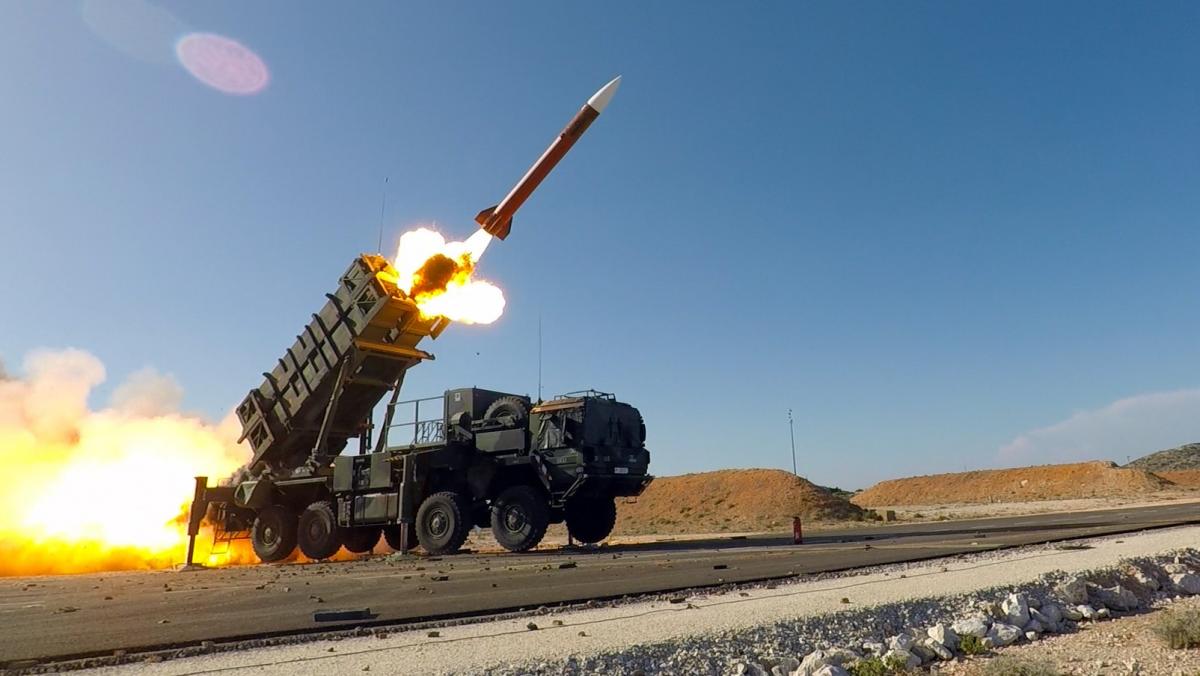
Patriot missile system (MIM-104) — It is not simply a «missile launcher», but one of the most sophisticated, complex and effective air and missile defence systems in the world. It is capable of shooting down everything from aeroplanes and cruise missiles to supersonic ballistic targets.
Let’s take a look at how this technological behemoth works from the inside, why it is considered the «gold standard» of air defence, and exactly how it works wonders on the battlefield.
The main myth: Patriot is not just one car
When people hear «Patriot», they often picture a lorry with missiles launching from it. In fact Patriot - is complex (battery), which consists of several fully integrated machines. They may be kilometres apart, but they operate as a single unit via a highly secure radio link.
Each battery must contain the following:
-
Multifunctional radar station (RLS) — the «eyes» of the system.
-
Command post (AN/MSQ-104) — «the brain», where decisions are made.
-
Launchers (M901/M902/M903) — the «fists» of the complex.
-
Communications and support vehicles — the «nervous system» and power generators.
The anatomy of the complex: How the components interact
To understand the magic of the Patriot, let’s look at the role of each element in the chain of target destruction.
1. Radar (AN/MPQ-53 or MPQ-65 radar)
This is the heart of the system. Unlike older radars, which rotated continuously, the Patriot radar is a stationary phased-array antenna. It «scans» a single sector (usually around 120 degrees), but does so with incredible precision and speed.
-
What it does: It emits thousands of directed beams. It simultaneously searches for targets, detects them, tracks them (up to 100 targets at a time) and even guides its own launched missiles towards them.
-
Latest update: New versions (such as the LTAMDS radar) already have a 360-degree field of view.
2. Command Post (Engagement Control Station – ECS)
The only place in the entire complex where people are present during combat (usually just three operators).
-
What it does: All the information from the radar is fed here. The computer automatically assesses the threat: it identifies the type of target (aircraft, missile, drone), its speed and trajectory, and calculates the priority — what needs to be shot down immediately and what can wait. All the operators have to do is confirm the launch.
3. Launching Stations
Each battery can have between 4 and 8 launchers. They are mobile, self-contained (with their own generators) and can be positioned up to 30 km from the command post. This makes the system resilient: if the enemy destroys one launcher, the entire system will not be lost.
The Evolution of Missiles: From «Fragmentation» to Kinetic Interception
The effectiveness of the Patriot system depends on the type of missiles it is equipped with. There are two fundamentally different generations of missiles, each designed to fulfil entirely different roles:
| Characteristics | The PAC-2 (MIM-104C/D/E) missile family | The PAC-3 (MSE / CRI) missile family |
| Main objective | Aeroplanes, helicopters, cruise missiles | Ballistic and supersonic missiles |
| Type of damage | High-explosive fragmentation. The missile flies close to its target and explodes, showering it with a cloud of debris. | Hit-to-Kill (Kinetic Interceptor). The missile crashes straight into the nose of the target at breakneck speed. |
| The principle of guidance | Track-via-Missile (via a missile and ground-based radar). | Proprietary active radar seeker + manoeuvring micro-ramjet engines (ACM). |
| Start-up capacity | 4 missiles in a container. | Up to 16 missiles (PAC-3 CRI) or 12 (PAC-3 MSE). |
💡 Why is the PAC-3 a revolution? A ballistic missile (for example, «Iskander» or «Dagger») cannot simply be damaged by shrapnel. If its casing is damaged, its half-tonne warhead will still reach the ground by inertia and explode. The PAC-3 missile destroys the enemy warhead in mid-air solely through the immense kinetic energy of a head-on collision (like a bullet hitting a bullet).
Step-by-step guide: How the Patriot shoots down a target in seconds
The entire process, from detection to destruction, takes anywhere from a few tens of seconds to a couple of minutes. The enemy target passes through a «conveyor belt of death»:
[Target detection by radar]
 ⬇️
[Trajectory calculation at the command post]
 ⬇️
[Launch command 🚀]
 ⬇️
[Missile flight correction from the ground]
 ⬇️
[Target acquisition by the missile itself (for PAC-3)]
 ⬇️
[Destruction: Kinetic impact or explosion]
-
Search and detection: The radar scans the sky. As soon as an object appears, the radar instantly highlights it and sends the data to the command post.
-
Identification: The «friend or foe» system checks the target. If it is an enemy, the ECS computer constructs a mathematical model of its flight path.
-
Decision-making: The computer suggests the optimal launch configuration and missile type to the operator. The operator presses the «Start» button.
-
Flight into the interception zone: The missile launches from its container. During the first stage, it flies under command from the ground — the Patriot ground-based radar tracks both the target and the missile itself, adjusting its course.
-
Final (For PAC-3): A few seconds before impact, the missile activates its small but extremely precise radar in its «nose». It detects the target ahead of it. Dozens of micro-engines in the front of the missile fire up, making precise adjustments to its trajectory, and the strike takes place Hit-to-Kill.
Why is the Patriot so effective against «analogue» ballistic missiles?
For a long time, it was believed that it was almost impossible to shoot down ballistic missiles travelling along a steep trajectory from space at immense speeds (and even more so Russia’s so-called «hypersonic» «Kinzhal» missiles).
Patriot proved the opposite thanks to three factors:
-
Incredible computing speed: The ECS computer is capable of calculating the trajectories of objects moving at speeds in excess of 5 Makhov (6000 km/h).
-
Aerodynamic Control Management (ACM): The PAC-3 missile has a «belt» of small solid-fuell engines in its nose section. These function as micro-tuft explosions, enabling the missile to instantly veer off course at high speed. Conventional fins (aerodynamic control surfaces) in the thin air at altitude 20 km They wouldn’t have been able to manoeuvre like that.
-
Integration into the global network (IBCS): The Patriot system can receive advance warning of missile launches — from NATO satellites or AWACS aircraft. In other words, the Patriot radar may not even be able to see the target yet, but the command post already knows where it is coming from and where it is heading.
Pros and cons of the system
Despite its «top-of-the-range» status, the Patriot is a weapon created by humans, and it has its compromises.
Advantages:
-
Versatility: A single system provides protection against drones, strategic bombers and ballistic missiles.
-
Combat experience: It is the most battle-tested missile defence system in the world, having been tested under real, harsh combat conditions.
-
Mobility: All components are mounted on wheeled chassis; the system can be folded up and set up in a new position in less than 30 minutes.
Disadvantages:
-
Price: One set costs around 1 billion, and a single PAC-3 missile costs around 4 million. Firing such missiles at cheap «Shaheds» is financial suicide (which is why the Patriot is backed up by cheaper systems such as NASAMS, Gepard or IRIS-T).
-
Sectoral overview of the basic radar: Whilst the radar is scanning in one direction, the system is vulnerable from the rear (which is precisely why the batteries always operate as part of the country’s layered air defence system, providing mutual cover).
Conclusion.
The MIM-104 Patriot is the pinnacle of Cold War engineering, which, thanks to continuous upgrades (particularly in terms of missiles PAC-3 MSE) remains the most effective defence system of the 21st century. It operates by combining space technology, ultra-fast computing and pure kinetic energy, which together are capable of stopping even an enemy’s «unstoppable» weapons.
Reviewed by: Maksym Krus.