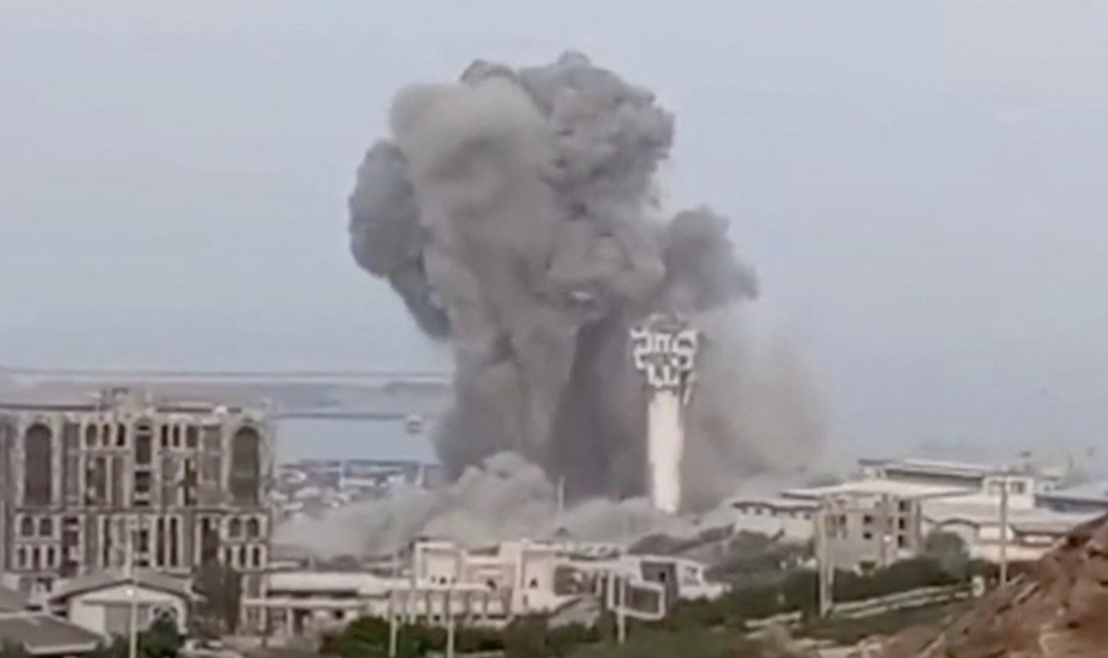
On the night of 16 July, Iran launched missile and drone attacks towards Bahrain, Jordan and Kuwait after the US had escalated its strikes on Iranian territory. The authorities in these countries have confirmed the attacks, according to the Associated Press.
Briefly about the main points
- Iran has launched missiles and drones towards three countries in the region.
- Bahrain, Jordan and Kuwait have confirmed that the attacks took place.
- Jordan intercepted three ballistic missiles on 15 July.
- The US has reported strikes in the Tehran and Semnan areas.
- The tension stems from the blockade of Iranian ports and the Strait of Hormuz.
A new wave of attacks in the region
Iranian state media reported that US facilities in Jordan and Kuwait had been targeted. In particular, Tehran reported a strike on the Al-Azraq base in Jordan and a US logistics centre in Mina Abdullah in Kuwait.
At the same time, the authorities in Bahrain, Jordan and Kuwait confirmed that the attacks had indeed taken place on the night of 16 July. The specific targets and results of the strikes in Jordan and Kuwait, as claimed by Tehran, were not immediately confirmed.
Yesterday, the Jordanian armed forces reported that they had intercepted three ballistic missiles that had entered the country’s airspace from Iran. According to Amman, there were no fatalities, injuries or material damage, and the debris had been neutralised.
The US has stepped up its strikes against Iran
On the night of 16 July The US has launched further strikes against Iran. According to the AP, citing Iranian state media, explosions or strikes were reported in areas of Tehran and in Semnan Province, where facilities linked to Iran’s ballistic missile and space programmes are located.
Separately, the US military stated that it had fired on the Belma, a tanker flying the Curaçao flag, which was heading for an Iranian oil terminal on Hark Island. According to their account, the vessel did not respond to warnings; the missile struck the funnel and put the tanker out of action.
The blockade of the ports is escalating the confrontation
The current escalation is centred on Strait of Hormuz. On 15 July, the US reinstated the blockade of Iranian ports, citing Iranian attacks on vessels attempting to pass through the strait as the reason for this move.
The Islamic Revolutionary Guard Corps responded by stating that, under the conditions of the blockade, energy exports from the region would be «either for everyone or for no one». The Speaker of Parliament and chief negotiator Mohammad Bagher Ghalibaf said that Tehran was prepared for a wider military conflict if the US failed to comply with the terms of the interim agreement.
President of the United States Donald Trump On 15 July, he stated that Iran was allegedly seeking a deal, but left open the possibility of the military campaign continuing. Statements from both sides indicate that military pressure and political signals are currently being deployed in parallel.
Risks to transport and the oil market
According to a Reuters report dated 13 July, US forces carried out strikes on more than 300 Iranian military targets over the course of three nights. Washington has stated that it aims to weaken Iran’s ability to attack civilian shipping in the Strait of Hormuz.
The latest attacks are spreading the conflict to countries where there is a US military presence, whilst the attack on the tanker adds a maritime dimension to the conflict. This could exacerbate both security and logistical risks for the region.
The market is already reacting to the threats to shipping: 16 July Brent was trading above $85 a barrel — approximately 15% above pre-war levels, although below the peak levels seen during the current war, the AP notes.