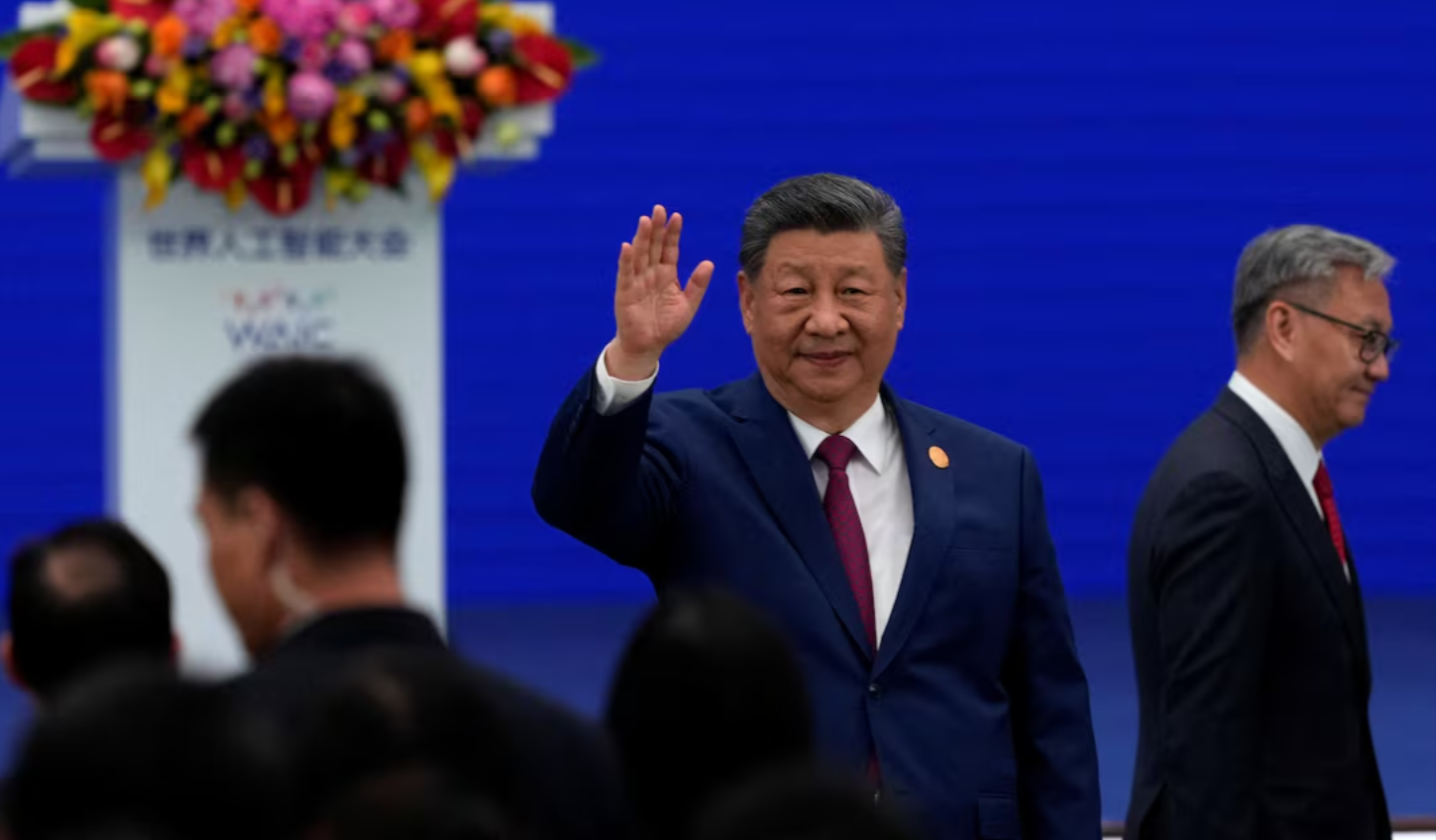
Speaking at the World Artificial Intelligence Conference in Shanghai, Chinese leader Xi Jinping stated that Beijing is prepared to share AI technologies and expertise with developing countries and to participate in the creation of global standards. The day before, 29 countries signed an agreement to establish the World Artificial Intelligence Cooperation Organisation (WAICO).
Briefly about the main points
- Xi Jinping called on countries to develop open artificial intelligence technologies.
- In Shanghai, 29 states became founding members of WAICO.
- China is promising training and cooperation centres for countries in the Global South.
- Beijing also emphasised human oversight and mechanisms for responding to the risks posed by AI.
- Moonshot AI has unveiled the Kimi K3, with 2.8 trillion total parameters.
China’s proposal for the Global South
Speaking on 17 July at the opening World Artificial Intelligence Conference, Xi Jinping called on countries to seize the «rare historical opportunity» presented by open AI. He stated that unequal access to the technology could give rise to «new historical injustices».
The Chinese leader compared the significance AI with the advent of the steam engine and electricity. According to him, China is ready to share its technology and expertise with countries in the Global South, as well as to help develop international standards for this new industry.
Xi announced plans to organise training in the field of AI and to establish centres for cooperation with the BRICS countries, ASEAN, Latin America and the African Union. This approach combines Beijing’s technology policy with its diplomatic presence within major groupings of developing nations.
WAICO is evolving from an initiative into an international organisation
The agreement to establish the World Artificial Intelligence Cooperation Organisation was signed in Shanghai on 16 July, one day before the conference began. The Chinese side describes WAICO as an independent intergovernmental international organisation for cooperation and global governance of AI.
Representatives from 29 countries became founding members. Among the officially named participants are Kazakhstan, Laos, Pakistan, Russia and Indonesia. Beijing first proposed the establishment of WAICO at the WAIC conference in 2025.
The establishment of the organisation provides China with a dedicated institutional platform for promoting AI standards and technical assistance programmes. Its practical impact will depend on how the participants define the mechanisms for its operation and cooperation.
Open models and issues of control
Xi specifically emphasised that AI systems must remain under human control. He called on states to establish early-warning and emergency response mechanisms, and to safeguard against scenarios in which autonomous systems might evade human oversight.
The issue of security was raised alongside China’s push for open-source models. On 17 July, the Beijing-based start-up Moonshot AI unveiled Kimi K3 — a model with 2.8 trillion parameters in total, capable of processing images and context of up to one million tokens. The company describes it as the first open-source model of this scale.
According to Moonshot AI, the full specifications of the Kimi K3 are due to be released by 27 July. China’s rhetoric on openness contrasts with a discussion in the US regarding the risks of powerful model capabilities spreading beyond state control.
Competition for standards, infrastructure and partners
Xi’s statement came on the eve of the first US-China government talks on AI under the administration of President Donald Trump. At the UN Global Dialogue in Geneva on 6–7 July, the US warned against excessive regulation, whilst China emphasised accessible, open models and narrowing the technology gap.
The Chinese approach differs from the American ‘Pax Silica’, which focuses on AI supply chains — critical minerals, energy, semiconductors, manufacturing and infrastructure. WAICO is not a comparable regulatory body, but both initiatives could form part of a broader competition for technology partnerships, regulations and the future infrastructure of artificial intelligence.