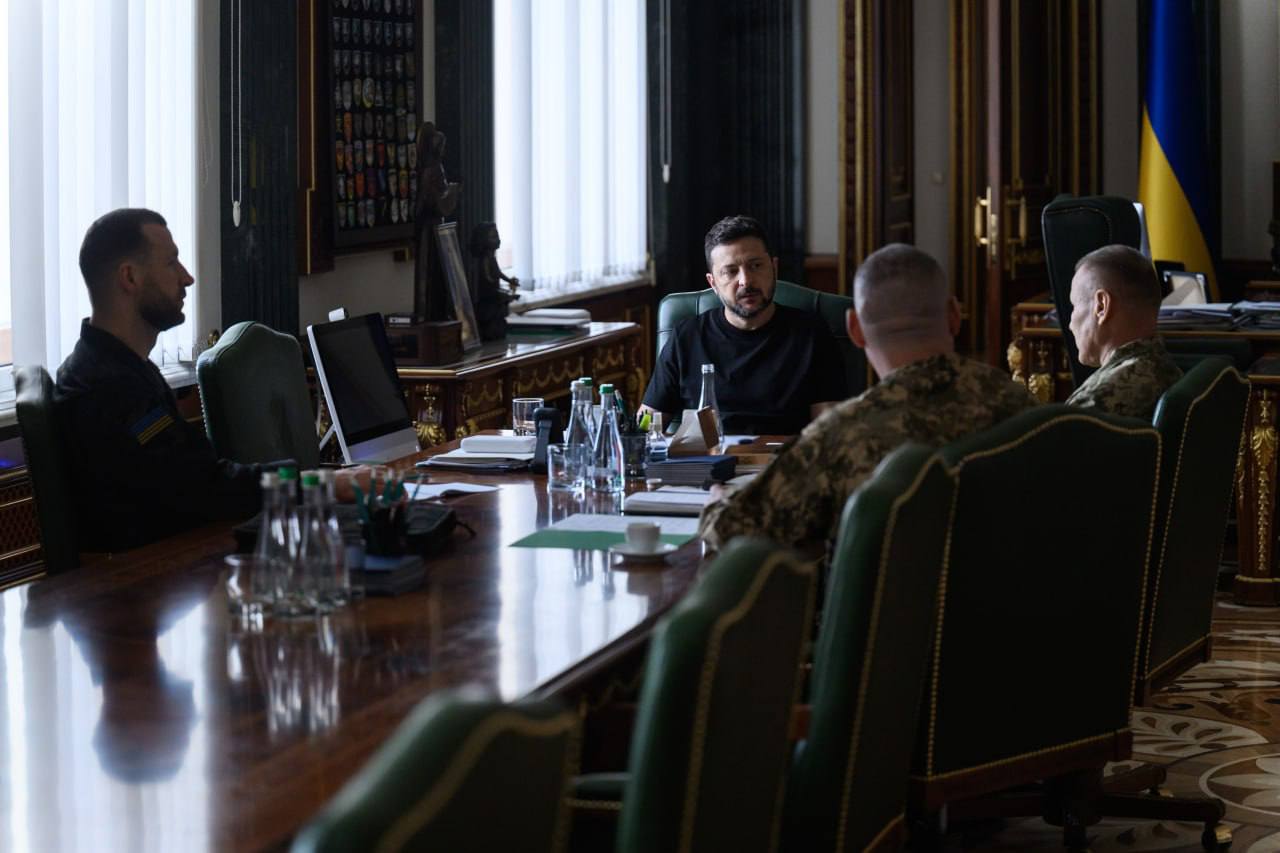
President Volodymyr Zelenskyy, together with Yevhen Khmara and Pavlo Palisa, held consultations with the commanders of eight army corps. The parties discussed the needs of the front line, the defence of border areas, countering Russian drones, strengthening air defence on the front line, the defence of Kherson and Nikopol, and preparations along the Chernihiv–Kyiv axis.
Briefly about the main points
- Zelenskyy heard reports from the commanders of eight army corps.
- The defence of Kherson, Nikopol and the communities in the Dnipropetrovsk region was analysed separately.
- Countering drones and strengthening frontline air defence have been identified as priorities.
- Commanders reported on Russian activity and possible countermeasures.
- Following consultations, the High Command discussed funding and contracts to supply the troops.
Meetings with commanders took place across eight corps
Zelenskyy reported that he had spoken with the commanders of the 9th, 12th, 14th, 15th, 16th, 18th and 21st Corps, and the 30th Marine Corps. They reported on the situation in their respective sectors, the activities of the Russian army, its plans, and the Ukrainian forces’ capabilities to counter them.
According to the president, the discussion centred on priority issues needs of the frontline, the defence of border areas and the commanders’ views on the details of the defence strategy. The necessary decisions for the continuation of the corps-level reform were also identified.
The protection of frontline towns from UAVs was identified as a priority
During the consultations, the defence of Kherson and the towns and communities of the Dnipropetrovsk region, in particular Nikopol, were discussed separately. Mr Zelenskyy identified countering Russian drones, protecting the population and additional supplies as the key issues.
This focus reflects the severity of the drone threat in the Kherson region. The regional military administration reported that in May, Russian forces deployed 17,813 FPV drones and unmanned aerial vehicles carrying payloads across the region; according to the regional military administration, 98% of these targets were neutralised or destroyed. In July, the authorities also reported drone strikes on civilian targets and transport in Kherson.
Defences in the north are being prepared on the basis of intelligence reports
A presentation was given on preparations for various possible scenarios regarding the Chernihiv–Kyiv route. Zelenskyy attributed this to intelligence reports and, in his words, Russia’s search for further ways to prolong and escalate the war.
The High Command had previously analysed intelligence regarding possible Russian plans for offensive operations from the north. In June, the «North» military group reported that defensive lines were being reinforced in the border communities of the Chernihiv region.
Enquiries regarding the hulls have been moved to the contract discussions
On 20 July, following a series of consultations with commanders, Zelenskyy chaired a special meeting of the General Staff attended by military personnel, defence contractors, and representatives of the Ministry of Defence, the Ministry of Finance and the security services. The participants emphasised the need to resolve delays in supply and outstanding procurement issues.
Following the meeting, discussions centred on additional funding and contracts for UAVs, ground-based robotic systems, long-range artillery munitions and other equipment. It was also agreed that there would be regular direct communication between the military branches, manufacturers and government bodies, coordinated by the Ministry of Defence and the National Security and Defence Council.
The High Command also examined product defects reported by combat units. The sequence of consultations and the subsequent meeting indicates an attempt to link the units’ requirements not only to the volume of procurement, but also to the speed of delivery and the refinement of the equipment.