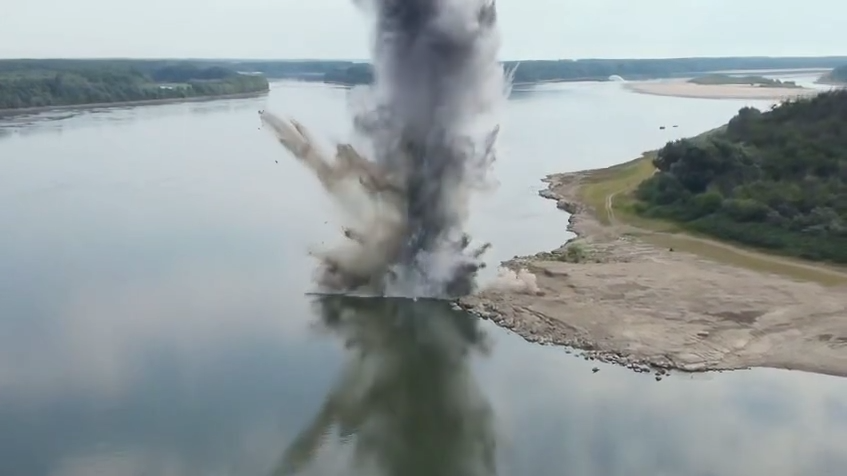
On 3 August, the Romanian military blew up the Pirjoaia rock on the Danube for the second time in order to divert the flow into the Old Danube branch, which supplies water to the Cernavodă nuclear power station. The Romanian Water Resources Administration reported the successful destruction of a significant amount of rock. Experts now plan to sink four barges to form a guide dam.
Briefly about the main points
- On 3 August, the military successfully blew up the Pyrzhoaya rock face.
- The barges will be used to construct a guide dyke on the Danube.
- The aim of the works is to increase the water inflow to the Cernavodă Nuclear Power Station.
- The forecast for 7 August is for a flow lower than the August 2003 minimum.
- The Cernavodă Nuclear Power Station generates around one-fifth of Romania’s electricity.
Demolition and construction of the guide dam
Blasting operations began on 2 August with a test underwater explosion. On that occasion, only a small fragment of rock was successfully detached, but the following day the military carried out a further operation, which the Romanian Water Resources Administration described as successful. At the same time, the Lower Danube Administration is continuing dredging work on the section between the Old Danube and the Bala branch.
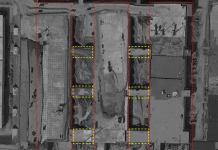
Two of the four barges have already arrived at the site; the other two were due to arrive on 3 August. They will be loaded with rock debris and positioned at designated points. With the involvement of Navrom, the University of the Lower Danube and AFDJ, experts are to determine the method for sinking the barges; the operation is expected to be completed by the morning of 5 August.
The flooded barges are intended to form a guide dam that will direct more water towards the Cernavodă area. Acting Defence Minister Radu Miruce stated that, due to a difference in water levels of around four metres, approximately 85% of the flow is heading towards the Bala estuary, whilst around 15% is flowing towards Cernavoda. According to him, the current intervention is an emergency measure.
Critically low runoff and risks to the power system
On 3 August, the Danube’s flow rate at the Romanian border stood at 1,500 cubic metres per second — approximately three times lower than the long-term averages for July and August. This is also a quarter lower than during the same period in 2025. Hydrologists predict that on 7 August, the flow rate could fall below 1,400 cubic metres per second — the lowest level recorded in August 2003.
Water level In the Chernavoda area, the water level stood at minus 218 centimetres and, without intervention, could fall to minus 233 centimetres by 9 August. The aim of the works is to raise it by 10–12 centimetres. According to the forecast, rainfall in Austria may lead to a slight increase in runoff, but its effects will reach Chernavoda in approximately 12 days.
According to preliminary calculations cited by Miruce, without any measures being taken, the power station could have entered the shutdown procedure on Wednesday or Thursday. One power unit at Cernavodă has already been shut down this week, reducing domestic electricity generation by 10% at a time of high consumption due to the heatwave. The country’s only nuclear power station accounts for around 20% of its electricity generation, so keeping the second unit operational is crucial for maintaining the generation balance.
A project that had not been implemented previously
Miruce said that there had previously been a project to raise the bed of the Bala branch and deepen the Old Danube, which could have balanced the distribution of water. According to him, the project has been blocked at the Ministry of Transport since April 2024. The current works could simultaneously facilitate navigation and facilitate future dredging of the Old Danube.