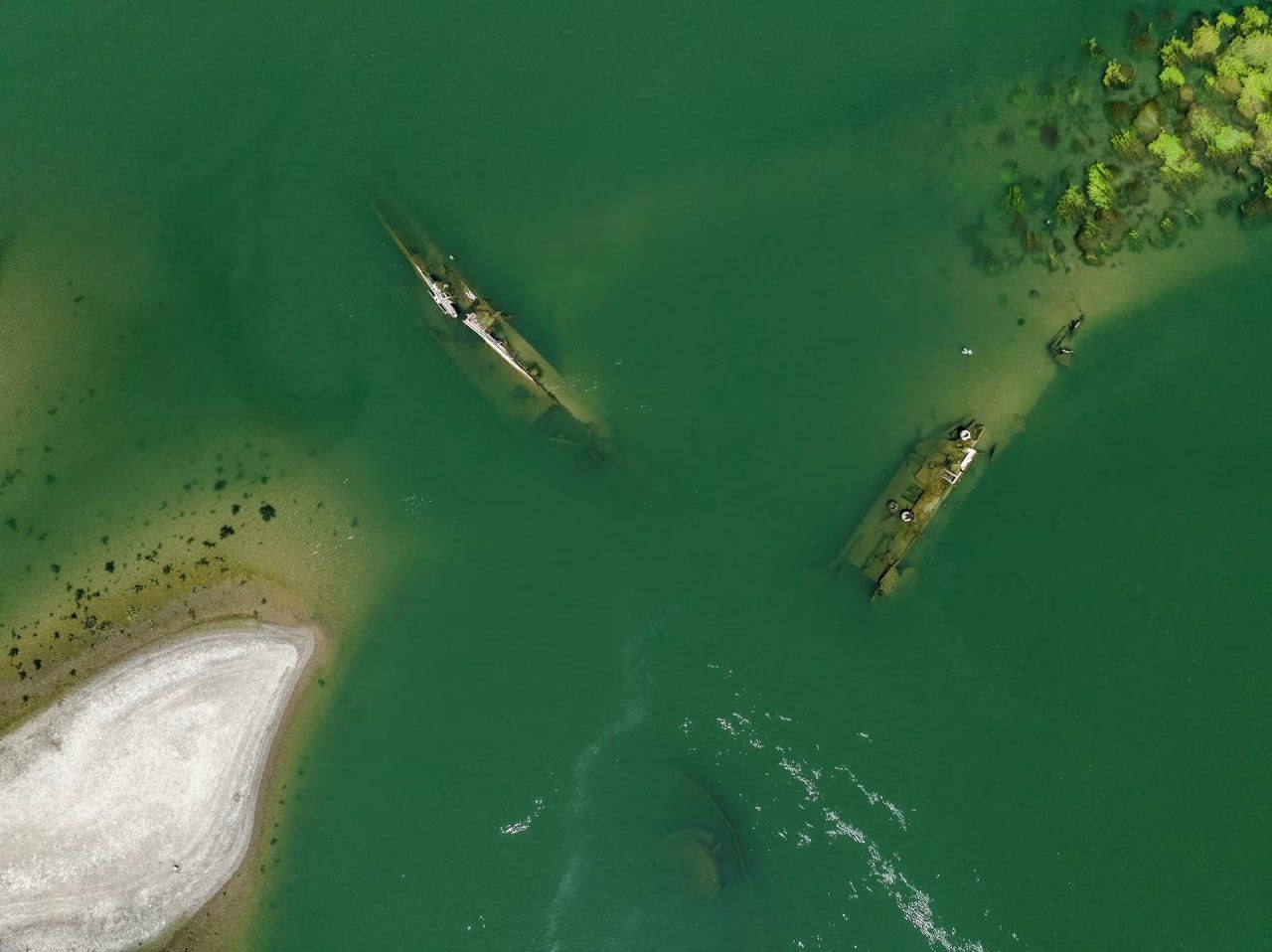
A prolonged heatwave and drought have caused water levels in the Danube near Prahovo in Serbia to fall to critical levels, exposing the hulls of Kriegsmarine vessels that sank during the German retreat in 1944. There may be around 200 sunken vessels in this section of the river — warships, barges, tugs and cargo ships — which pose obstacles to navigation.
Briefly about the main points
- The shallowing of the Danube has exposed the Kriegsmarine vessels that were sunk in 1944.
- The harbour near Prahovo can accommodate around 200 vessels.
- Sunken vessels result in annual losses to the shipping industry of around 5 million euros.
- The EU has provided 16 million euros to clear the hazardous area.
- Before the vessel is raised, it is inspected by divers and bomb disposal experts for unexploded ordnance.
The breakwaters narrow the fairway
The sunken flotilla lies downstream of the port of Prahovo, near the Đerdap Gorge. The low water level has made the hulls more visible, whilst at the same time exacerbating the problem of vessel passage in this section of the Danube.
According to Serbian estimates, delays to shipping caused by debris cost around €5 million each year. The Western Balkans Investment Fund links the removal of this obstacle to safer navigation and improved regional connectivity. This is the project sponsor’s expectation, not a guaranteed economic outcome.
The lifting of the hulls begins with demining
The European Union has allocated a grant of 16 million euros for the dredging of the river channel. The project is underway: the Serbian Waterways Directorate announced that work would begin on removing the 21 most hazardous vessels in August 2024. The current WBIF project sheet specifies 29 June 2028 as the completion date.
The operation requires a phased approach, as there may still be unexploded ordnance on parts of the hulls. In June 2026, the Serbian Mine Action Centre reported that a depth charge had been removed from the T-20 vessel; it was transported ashore and destroyed by a controlled detonation.
Before being raised, the hulls are inspected by divers and bomb disposal experts. Hulls that are too large or damaged are not removed from the river, but are buried deeper into the riverbed to a depth that is safe for the fairway.
The drought is exacerbating a local problem on the Danube
The situation near Prahovo is unfolding against a backdrop of water stress in the Danube basin. In mid-July, the Copernicus European Drought Observatory estimated that drought conditions across most of Europe as consistently critical, whilst the Associated Press reported at the end of the month that the Danube had reached record low levels in Central Europe.
For Prahovo, this presents a twofold challenge: as the water recedes, it simultaneously exposes historical wrecks and increases their impact on the shipping route. At the same time, the danger posed by explosive remnants means that the clearance operation cannot be reduced to a simple mechanical removal of all the wrecks.