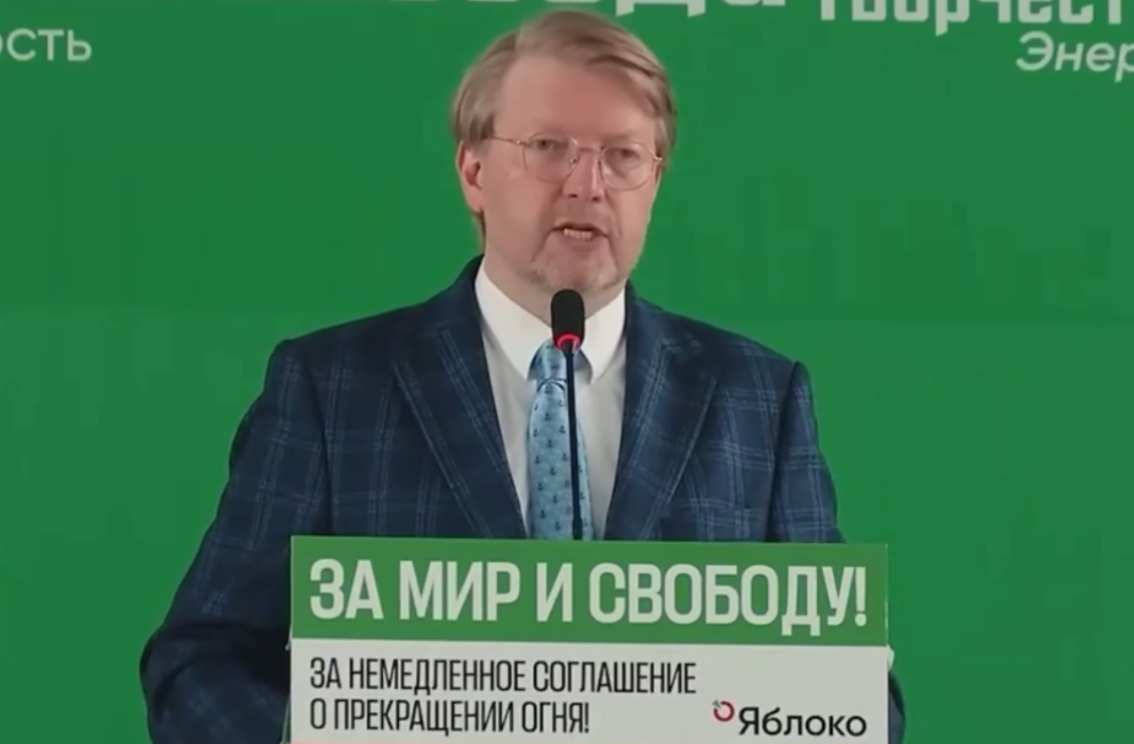
The Central Election Commission of the Russian Federation has registered the «Yabloko» party’s federal list for the State Duma elections. Voting will take place on 18–20 September 2026. The party has become the only political force admitted to the nationwide elections that openly calls for an end to the war against Ukraine. Following the registration of the list, interest in «Yabloko» surged online. Its Telegram channel overtook those of the Russian Federation’s parliamentary parties, whilst search interest in the party’s name exceeded that of Putin’s «United Russia».
Briefly about the main points
- The Central Election Commission of the Russian Federation has registered the «Yabloko» list comprising 269 candidates.
- Voting in the State Duma elections will take place from 18 to 20 September.
- The party is calling for a ceasefire and the start of negotiations.
- Mykola Rybakov, leader of the «Yabluko» party, has lost his right to stand for election.
- The party’s deputy leader, Maxim Kruglov, has been sentenced to seven years in a penal colony.
- The «Yabloko» Telegram channel has become the largest among Russian political parties’ channels.
- The party’s poll ratings remain below the 5% threshold for entering parliament.
«Yabluko» is standing in the elections on an anti-war platform
On 29 July, the Central Electoral Commission of the Russian Federation registered the «Yabloko» federal list, comprising 269 candidates. The party’s election manifesto bears the slogan «For peace and freedom! For a life without fear!». It contains calls for the conclusion of an agreement on ceasefire, a shift towards diplomacy and the prevention of nuclear war.
Founded in 1993, the party has traditionally championed democracy, human rights and the rule of law. It does not recognise Russia’s annexation of Crimea as legitimate and proposes that the peninsula’s future status be determined through an internationally recognised process once the war has ended.
The human rights organisation Amnesty International referred to «Apple»the last organised political force in Russia that consistently calls for peace and opposes human rights violations.". Amnesty International
The party leader was removed from office and his deputy was imprisoned
Leader of «Yabluko» Mykola Rybakov He is barred from standing for election. A Russian court fined him for publishing an obituary featuring a photograph Alexei Navalny, having deemed the image to be an alleged display of «extremist symbols».
Rybakov emphasised that the photograph of Navalny is not included in the official list of prohibited materials. However, the court ruling stripped the politician of his right to stand for election for one year. In July 2026, the Supreme Court of the Russian Federation upheld the ruling.
The persecution of the party’s deputy leader has become even harsher Maxima Kruglova. In June, he was sentenced to seven years« imprisonment in a case concerning so-called »fake news’ about the Russian army. The case stemmed from posts made in 2022 regarding civilian casualties in Ukraine, Bucha and Mariupol. Kruglov did not admit guilt.
Regional politicians from the party are also coming under pressure. In some regions, electoral commissions have refused to register «Yabluko’s» candidate lists, and administrative and criminal proceedings have been brought against its representatives.
Yabluko’s online audience has grown rapidly
Between 21 and 27 July, the number of mentions of the party on social media rose from 2,056 to 4,730, whilst posts about it received over 11.5 million views. According to monitoring data from «Election Atlas», audience reach and engagement also roughly doubled.
In early August, «Yabloko» overtook «United Russia» in search interest on Google Trends for the first time in a year. The party’s Telegram channel, which until recently had around 25,000 subscribers, had approximately 107,000 on 6 August, and by 7 August the public counter was already showing over 136,000.
At the same time, these figures should be treated with caution. After the channel rose to first place, the party itself reported a mass influx of bot subscriptions, which it claimed was intended to undermine organic growth. Therefore, the number of subscribers cannot be directly equated with the number of future voters.
Social media does not yet guarantee a seat in the State Duma
According to the VTsIOM’s average July figures, «United Russia» was supported by 34% of those surveyed, the Communist Party of the Russian Federation (CPRF) by 11%, «New People» by 10%, the Liberal Democratic Party of Russia (LDPR) by 9%, and «Fair Russia» by 5%. Non-parliamentary parties together were supported by around 9% of respondents.
In the spring, Yabloko’s support rating was estimated at around 3%, whilst a five per cent threshold must be cleared to secure seats via party lists. At the same time, 30% of Russians aged 18–24 and 19.5% of respondents aged 25–34 said they might support the party. This refers specifically to potential willingness, rather than a definitive intention to vote.
A number of Russian opposition politicians, including Yulia Navalnaya, Ivan Zhdanov and Lyubov Sobol, have called for support for «Yabloko». However, the party has distanced itself from overseas campaigns, fearing that contacts with organisations designated as «undesirable» in Russia could be used as grounds for revoking the registration of its electoral list.
The sharp rise in online interest indicates that there is a demand within Russian society for an end to the war. However, this does not yet predict the outcome of the vote — particularly given the repression of the Kremlin’s opponents, censorship, a controlled information environment and limited opportunities for independent observation.