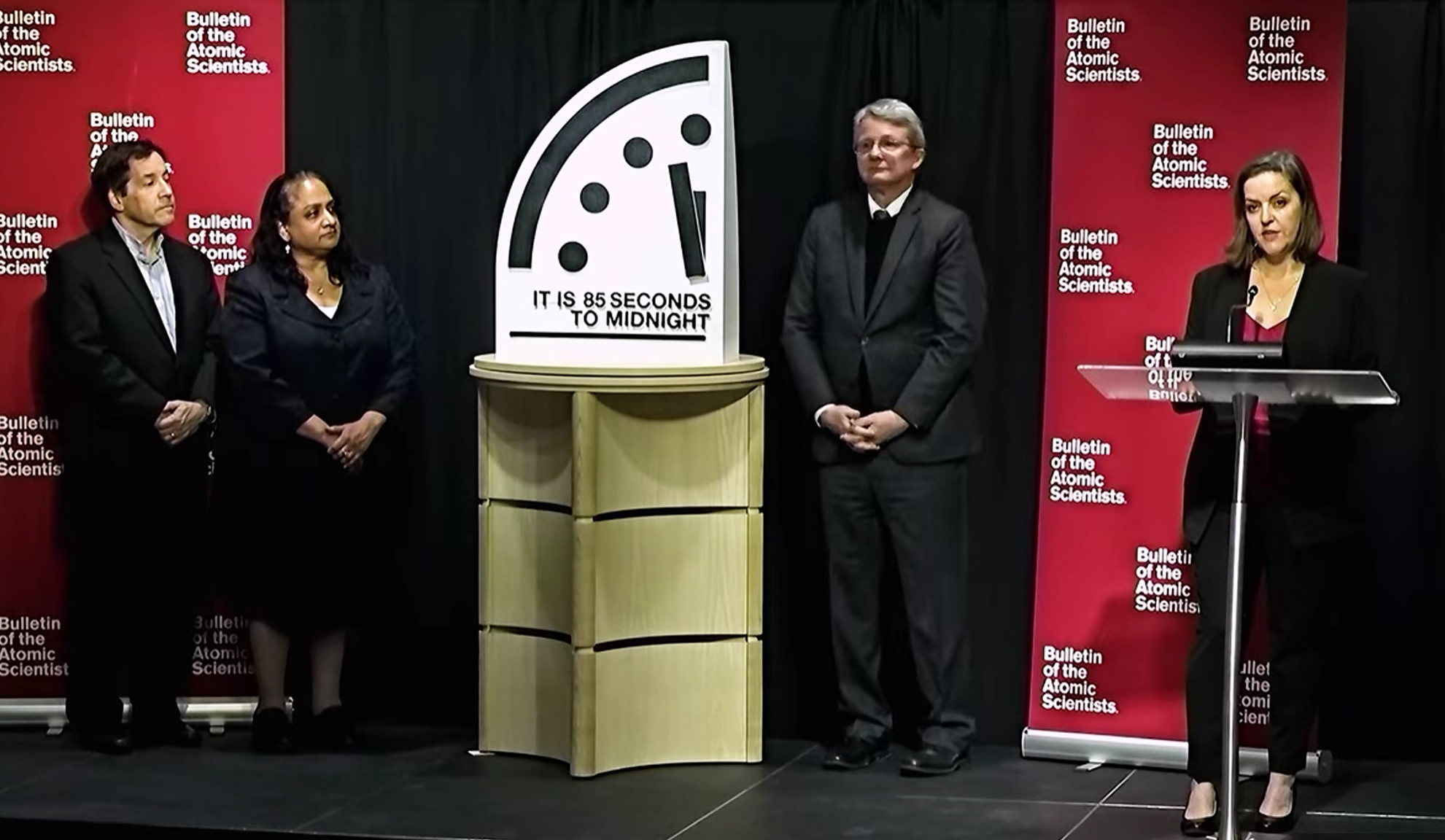
The Doomsday Clock has been set to a record 85 seconds to «midnight» — the closest it has ever been in the history of this symbolic indicator. The Bulletin of the Atomic Scientists attributed the decision to a combination of global risks, particularly nuclear threats. The US and Russia, which together possess approximately 86% of the world’s nuclear arsenal, are now without a valid agreement on strategic arms control.
Briefly about the main points
- The 85-second mark was the lowest in the history of the Doomsday Clock.
- New START has expired, removing the limits and inspections.
- China’s nuclear arsenal already exceeds 600 warheads.
- In South Korea, the majority of those surveyed support the country having its own nuclear weapons.
- Japan is discussing deterrence, but remains committed to its non-nuclear principles.
The termination of New START has reduced transparency between the US and Russia
The New START Treaty expired on 5 February 2026. For the first time since 1972, Washington and Moscow do not have a valid agreement limiting strategic weapons.
The document set limits on deployed strategic warheads and delivery systems, and also provided for inspections and verification mechanisms. Their loss does not mean an automatic build-up of arsenals, but it does make the situation less predictable.
China is expanding its arsenal, whilst nuclear debates are intensifying across Asia
According to SIPRI estimates, China has up to 620 nuclear warheads and continues to expand its capabilities. The US administration has stated that any future arms control system must take China into account, rather than being limited to a bilateral agreement with Russia.
In South Korea, support for the development of a national nuclear arsenal has reached around 70% in opinion polls, although this is not government policy. In Japan, political debate has intensified, but the authorities have reaffirmed their commitment to the three non-nuclear principles. The combination of the loss of treaty constraints, growing arsenals and regional discussions may increase the risk of miscalculation and escalation, but does not predict an inevitable nuclear war.