Ukraine plans to order four SAMP/T NG systems, and France will transfer two existing SAMP/T systems whilst these are being manufactured. Paris and Rome have also authorised the licensed production of Aster 30 interceptor missiles in Ukraine. On 26 August, the Italian newspaper La Repubblica reported that preparations were underway for an additional batch of missiles to be ready by October.
Briefly about the main points
- Deliveries of the new SAMP/T NG are scheduled to begin in 2027.
- France will temporarily provide Ukraine with two systems from its own forces.
- Italy is preparing Aster 30 missiles as part of a new aid package.
- Local production of missiles is scheduled to begin by the end of 2026.
- A SAMP/T NG battery can carry up to 48 missiles ready for launch.
The new batteries will be funded through a European loan
The Franco-Ukrainian declaration provides for Kyiv to order four SAMP/T NG. The plan is to fund these through the European ‘Ukraine Support Loan’ mechanism. The batteries are expected to be delivered in stages from 2027, and Ukraine must return the systems provided by France for the transitional period once it has received the new ones.
France plans to deploy the Ground Fire 300 radar in Ukraine by the end of 2026. The programme is also set to include five GM400 radars and one Kronos radar. According to La Repubblica’s estimates, the total cost of the programme could be close to €3 billion, with European lending mechanisms set to be the main source of funding.
Italy is preparing the missiles and the classified part of the 13th package
Italy plans to transfer additional Aster 30 systems from its military stocks by October 2026. La Repubblica reports that the classified part of the 13th military aid package is to include air defence systems, Aster missiles and radar systems. Recently, Rome has publicly emphasised humanitarian aid and generators.
Since the summer of 2025, deliveries of Aster 30 missiles to Ukraine have effectively ceased: France and Italy have scaled back deliveries due to their own minimal stocks. Production of these missiles has now been ramped up, and Paris and Rome have agreed to speed up the delivery of the agreed quantity of munitions. Ukraine is already operating two SAMP/T batteries; according to an Italian publication, one of them was provided in full by Italy.
Contracts for the localisation of missiles are expected in September
According to an official statement by France and Ukraine, the launch of licensed production of the Aster 30 is planned for as soon as possible, but no later than the end of 2026. La Repubblica specifies that the agreement covers, in particular, the advanced Aster 30 B1NT variant. Kyiv expects to finalise the necessary contracts in September.
Having our own production line could gradually reduce our reliance on stocks interceptor missiles from partners. For long-range air defence systems to operate effectively, it is not only the number of batteries that matters, but also the availability of ammunition, the stockpiles of which in France and Italy had previously become a constraint on new transfers.
SAMP/T NG is designed for air defence and missile defence
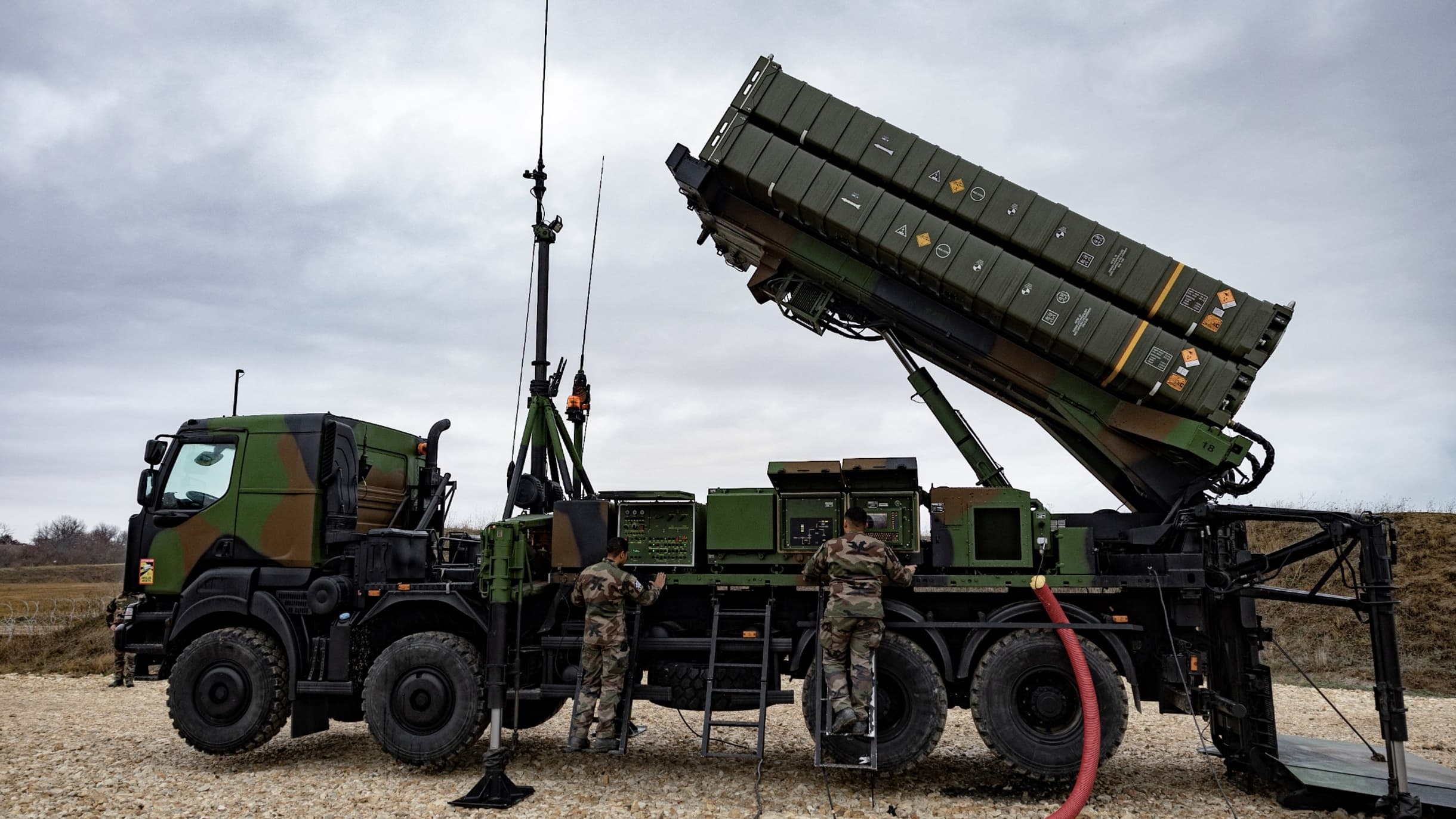
The SAMP/T NG is a new-generation joint Franco-Italian system being developed by the Eurosam consortium, established by MBDA and Thales. The system is designed to protect cities, military installations, infrastructure and troop formations. The manufacturer claims the system is capable of countering aeroplanes, helicopters, attack drones, cruise missiles, anti-radar missiles and tactical ballistic missiles.
A full battery can comprise up to six launchers, each carrying eight missiles. This provides up to 48 interceptors ready for launch. The system provides all-round coverage, and the claimed engagement range with the new Aster 30 B1NT exceeds 150 km. The French Ground Fire 300 has a detection range of up to 400 km; the Italian configuration can utilise Leonardo’s Kronos Grand Mobile High Power radar.
In July 2025, Eurosam announced that tests of the B1NT had confirmed the interception of targets at ranges of around 150 km and at higher altitudes than the previous version. The missile has been fitted with a Ka-band homing head, new electronics and interception algorithms. The manufacturer positions it as a countermeasure against short- and medium-range tactical ballistic missiles, manoeuvrable high-speed targets and some hypersonic threats. However, this does not guarantee the interception of any specific missile under all conditions.