
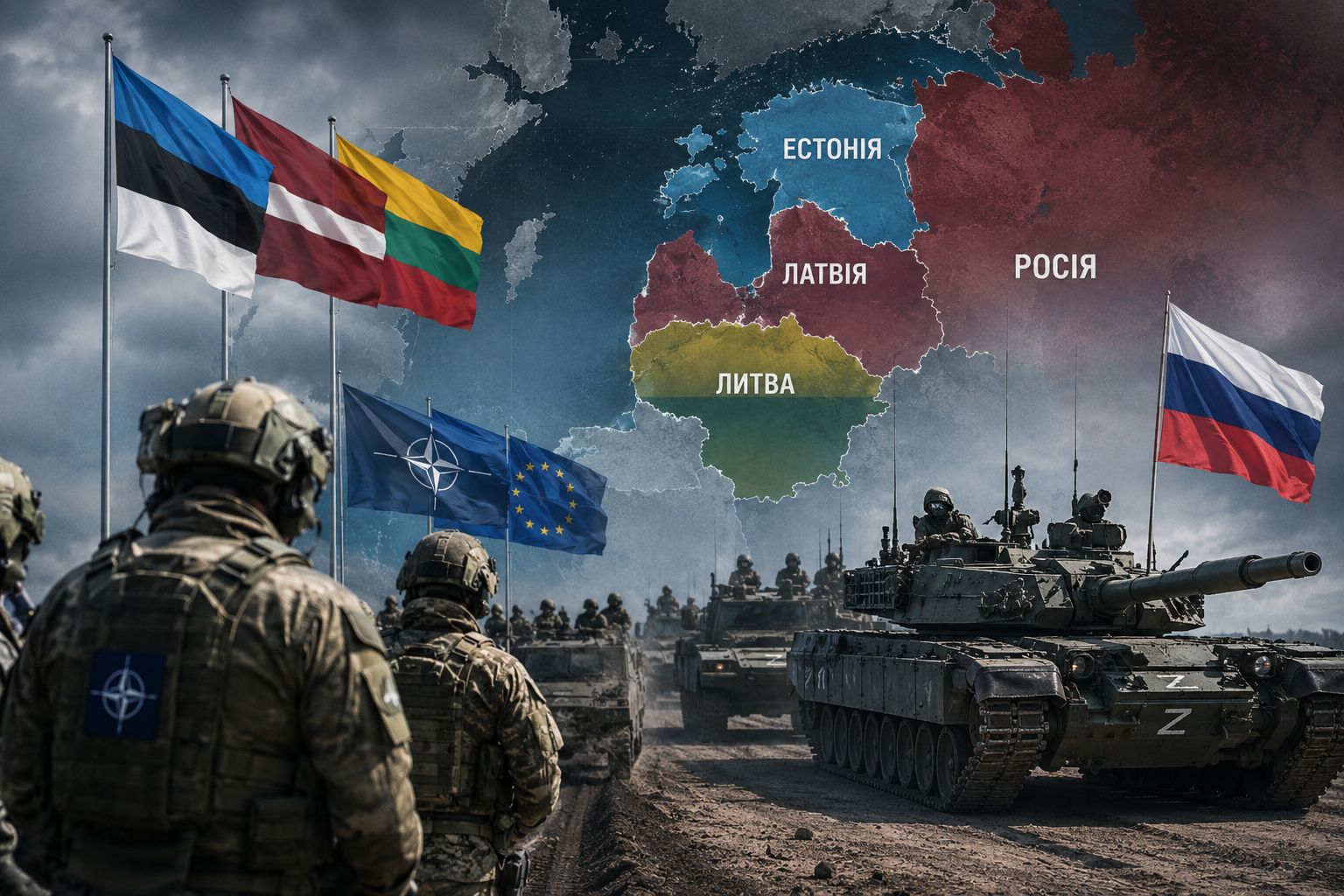
CIA Director John Ratcliffe’s rare and unannounced visit to Moscow has been interpreted in a far more alarming light than the White House initially sought to suggest. According to The Wall Street Journal, CBS News and Politico, the head of US intelligence flew to the Russian capital to to personally convey a warning to the Kremlin: Russia must not attack NATO countries, particularly Estonia, Latvia and Lithuania.
Behind this diplomatic signal lie new assessments by US intelligence. In Washington, it is thought that Vladimir Putin may attempt, in the coming years, to «a »limited attack’ on one of the allies, to test whether the Alliance is genuinely prepared to fulfil Article 5 and fight for a small country on its eastern flank. This does not necessarily mean a large-scale invasion on the scale of the one in Ukraine: the scenarios under consideration include cyber-attacks, hybrid operations and a small-scale ground invasion.
That’s not all does not mean that the Kremlin has already decided to go to war with NATO. There is no public evidence of such an order. However, the very fact that Washington sent the Director of the CIA to Moscow to convey the warning suggests that the US takes this risk far more seriously than mere political rhetoric.
Why did Retcliffe fly to Moscow in person?
John Ratcliffe arrived in Moscow 25 August. The visit had not been announced in advance. The Kremlin subsequently confirmed that the CIA director had held talks with representatives of the Russian security services, but stated that there had been no face-to-face meeting with Putin There were none. At the same time, the Russian President was briefed on the outcome of the discussions.
Politico reported that the talks were primarily aimed at to warn Russia against escalating tensions with the Baltic states. Russian support for Iran was a separate issue. The Wall Street Journal linked Retcliffe’s mission to a new US intelligence assessment regarding Moscow’s possible attempt to test NATO’s unity.
President of the United States Donald Trump publicly described the trip as «semi-routine» and denied that it was specifically linked to fears of a Russian attack on NATO.
But this raises an obvious contradiction. CBS News, the WSJ and Politico, citing various sources, report that Russia has issued a specific warning regarding the Alliance. The CIA has not officially commented on the purpose of the trip.
In the context of intelligence diplomacy, the format itself is important. When it is sufficient to convey a message via the embassy, by telephone or through lower-ranking intelligence service representatives, Director of the CIA He himself does not fly on a military aircraft to the capital of a country which is, in fact, on its worst terms with Washington in decades.
The last time something like this happened was before the invasion of Ukraine
This visit has a particularly troubling historical parallel.
The previous known visit by the current CIA Director to Moscow took place in November 2021, rather than in the autumn of 2022. At that time, the US President Joe Biden dismissed the Director of the CIA William Burns to Russia after US intelligence received information that Moscow was preparing a major invasion of Ukraine.
Burns informed the Russian leadership that the US was aware of the build-up of troops and warned of the consequences of a full-scale war. This did not deter the Kremlin: on 24 February 2022, Russia launched its invasion.
In November 2022, Burns also met with the head of the Russian Foreign Intelligence Service Sergei Naryshkin, but this meeting did take place in Ankara, rather than Moscow, and concerned, above all, the risk of nuclear escalation.
Of course, historical parallels do not mean that events will necessarily repeat themselves. But it explains why Retcliffe’s current trip has attracted so much attention: US presidents have previously used the Director of the CIA as a personal envoy when it was necessary to convey a warning to the Kremlin regarding an extremely dangerous military scenario.
What exactly might Russia be planning?
The most important aspect of the American assessment lies in the word «limited».
For the Kremlin to launch a conventional, large-scale invasion of the Baltic states would amount to a direct attack on NATO. This creates the risk of war not only with the armed forces of Estonia, Latvia or Lithuania, but with the entire Alliance, including the US, the UK, France, Germany and Poland.
From the point of view of political logic, a far more dangerous scenario is one in which Russia attempts to to seize a small area or deliberately create an ambiguous crisis, banking on a split within NATO.
According to media reports, US intelligence officials are considering a range of possibilities — from a large-scale cyberattack and a hybrid operation to a small-scale ground invasion, most likely in the Baltic region. The aim of such a scenario might not be to conquer the whole of Lithuania or Estonia, but rather to test the Alliance’s guiding principle: Will all the allies really agree to risk a major war with Russia just to regain a few dozen square kilometres of territory?.
This is precisely where the Kremlin’s potentially most dangerous gamble lies.
If NATO responds decisively, Russia’s local operation could escalate into a full-scale war between two nuclear powers.
If the response is weak or divided, it will effectively undermine confidence in Article 5, upon which the entire NATO collective defence system is based.
Why the Baltic states in particular?
Geographically speaking, Estonia, Latvia and Lithuania are among the Alliance’s most challenging areas to defend.
They share borders with Russia and Belarus, and the heavily militarised Kaliningrad Oblast of the Russian Federation lies nearby. The Baltic states’ land link with the rest of NATO territory runs through the area of the Polish-Lithuanian border, known as The Suwałki Corridor.
However, the situation today is fundamentally different from what it was before 2022.
NATO already has permanent multinational battle groups in Estonia, Latvia, Lithuania and Poland. The Estonian contingent is led by the United Kingdom, the Latvian by Canada, the Lithuanian by Germany and the Polish by the United States. In Lithuania, a permanent German armoured brigade is also being deployed, with its strength set to increase to approximately 5,000 troops.
Overall, NATO currently has nine multinational formations on the eastern flank, whilst regional defence plans provide for the rapid deployment of additional troops, equipment, air defence systems and aircraft in the event of a crisis.
At its July 2026 summit, the Alliance itself reaffirmed once again that an attack on one member would be regarded as an attack on all.
In other words, for Moscow, a Baltic operation would not be a «second Ukraine», but would involve a completely different level of risk.
However, not all intelligence agencies consider an attack to be inevitable
It is important to distinguish between forecast risk.
The Wall Street Journal does not report that US intelligence has pinpointed the date of a Russian invasion or obtained a Kremlin-approved plan to seize the Baltic states. It refers to an assessment that Putin might give it a go a limited operation against one of its allies in the coming years.
What is more, the assessments of European intelligence agencies differ.
Earlier this year, the Estonian foreign intelligence service assessed that Russia has no plans to launch a military attack on NATO within the next two years, in particular thanks to a significant strengthening of the Alliance’s own defences. Politicians in Estonia and Latvia have also warned against statements about an inevitable invasion, which could cause unfounded panic.
So, the picture is more complex: the US sees the risk as serious enough to issue a direct warning to Moscow, but there is no public consensus that war is now inevitable.
600,000 Russians after the election: for Ukraine or a new war?
Against this backdrop, new information from the Main Intelligence Directorate and the Foreign Intelligence Service of Ukraine takes on particular significance.
On 27 August, the Ukrainian security services reported that the Russian General Staff had already drawn up a plan an additional mobilisation of 600,000 people in 2026–2027 — around 300,000 each year.
According to Ukrainian intelligence, Putin is most likely to take a decision following the elections to the State Duma of the Russian Federation, scheduled for 18–20 September. Russia is already putting in place the legislative and administrative framework for the new conscription drive, tightening up military registration and broadening the categories of people who can be sent up for military service.
However, there is one crucial detail here.
Main Intelligence Directorate and Foreign Intelligence Service did not state that these 600,000 were intended for an attack on the Baltic states. According to their information, the top priority is to replenish Russian units already fighting against Ukraine, as well as new formations. The reason is the huge losses and a decline in the rate of recruitment of contract soldiers.
At the same time, such a mobilisation has broader strategic significance. If the Kremlin manages to both make up for its losses in Ukraine and form new units, Russia will have greater reserves with which to exert pressure on other fronts.
It is therefore logical to regard mobilisation as a component in the restoration of the Russian Federation’s overall military capability, but there is as yet no evidence that it is being carried out specifically as part of a separate Baltic operation.
Dugin is already putting forward the formula «Ukraine in exchange for de-escalation»
Against this backdrop, a statement by a Russian ultra-nationalist ideologue proved particularly telling Alexandra Dugina, who is often described as a Kremlin-aligned advocate of expansionist policies.
Following reports on the content of Retcliffe’s negotiations, he wrote: «If you want us not to escalate the situation, hand Ukraine over to us, and we won’t».
Dugin does not hold a position that would allow him to shape or officially announce Russia’s foreign policy. Therefore, his remarks cannot be interpreted as the Kremlin’s published plan.
But this rhetoric is interesting in another sense: it effectively sets out the possible logic behind escalatory blackmail — the threat of extending the conflict beyond Ukraine’s borders in exchange for concessions from the West regarding Ukraine itself.
Could Putin attack the Baltic states to force the West to sacrifice Ukraine?
In theory, such a scenario is possible.
Russia might have reckoned that the prospect of a direct war between NATO and Russia would frighten European capitals to such an extent that they would start putting pressure on Kyiv to accept Russia’s terms.
In such a scenario, Moscow’s aim would not be to conquer half of Europe. It would be enough to create a crisis that would force Western governments to choose between: either the risk of a direct war between Russia and NATO, or a deal with Moscow at Ukraine’s expense.
It is precisely a small, swift and deliberately limited operation that best fits this logic, rather than a large-scale offensive.
The Kremlin might attempt to seize a small piece of territory, whilst claiming that it does not seek war with NATO as a whole, and offer to negotiate whilst discussions are taking place within the Alliance regarding the scale of the response.
But this is an extremely risky strategy, even for Moscow.
NATO already has troops from other allies stationed directly on Baltic territory. Therefore, even a small-scale invasion would almost inevitably put British, German, Canadian or other military personnel at risk of losing their lives from the very first hours of the conflict. This makes it considerably more difficult to portray an attack as a local dispute between Russia and a small Baltic state.
In such a scenario, Ukraine becomes even more important to NATO
There is also the opposite effect.
If the Kremlin’s aim is indeed to force the West to abandon Ukraine by threatening the Baltic states, such a strategy could have exactly the opposite effect.
For NATO, a strong Ukraine effectively keeps a significant part of the Russian army far from the Baltic states’ borders. The Russian troops, equipment, missiles, aircraft and financial resources that Moscow is spending on the war against Ukraine cannot be fully deployed against Lithuania, Latvia or Estonia at the same time.
That is why NATO In its current strategy, it explicitly links Ukraine’s security to that of the Alliance and states that support for Kyiv will continue. At the summit in Ankara, the allies agreed on €70 billion in military aid for Ukraine for 2026 and confirmed their intention to maintain a comparable level in 2027.
From this point of view, Ukraine’s concession, in the face of the threat of a Russian attack on the Baltic states, might not have reduced, but rather increase the future risk to NATO, as Moscow would then be able to redeploy the freed-up forces to the west.
Is a major war really on the horizon?
Taken together, the signals paint a worrying picture.
US intelligence is reviewing its risk assessments. The CIA Director is making a rare personal visit to Moscow. NATO is bolstering its eastern flank. Russia is considering a new mobilisation of hundreds of thousands of people. Kremlin ideologues are openly using threats of wider escalation in connection with Ukraine.
But it does not follow from this that A major war between Russia and NATO has either already been decided or is inevitable.
On the contrary, Retcliffe’s visit itself can be interpreted as part of a strategy of deterrence: Washington is demonstrating to Moscow that it can foresee potential scenarios and is attempting to convince the Kremlin that a limited attack will not go unanswered.
This is the key difference between the situation in 2021 and the current one. Before the invasion of Ukraine, Russia could expect to be at war with a state that was not formally a member of NATO. An attack on Estonia, Latvia or Lithuania would entail a deliberate risk of confrontation with a military bloc possessing nuclear weapons and significantly greater combined economic and military resources.
That is precisely why the most dangerous scenario is not Russian tank columns marching openly across Europe. American intelligence considers a small-scale operation, a provocation or a hybrid attack – calculated on the assumption that the West will not want to escalate it into a Third World War – to be a far more realistic risk.
And it is precisely this calculation that Washington now appears to be trying to undermine, even before the Kremlin decides to put it to the test.



From all over the world, we stand ready to defend Ukraine and the whole of Europe against Russian aggression. Glory to Ukraine. Glory to the heroes! From Auckland Oblast, New Zealand 🇳🇿 🇺🇦🔱🫡