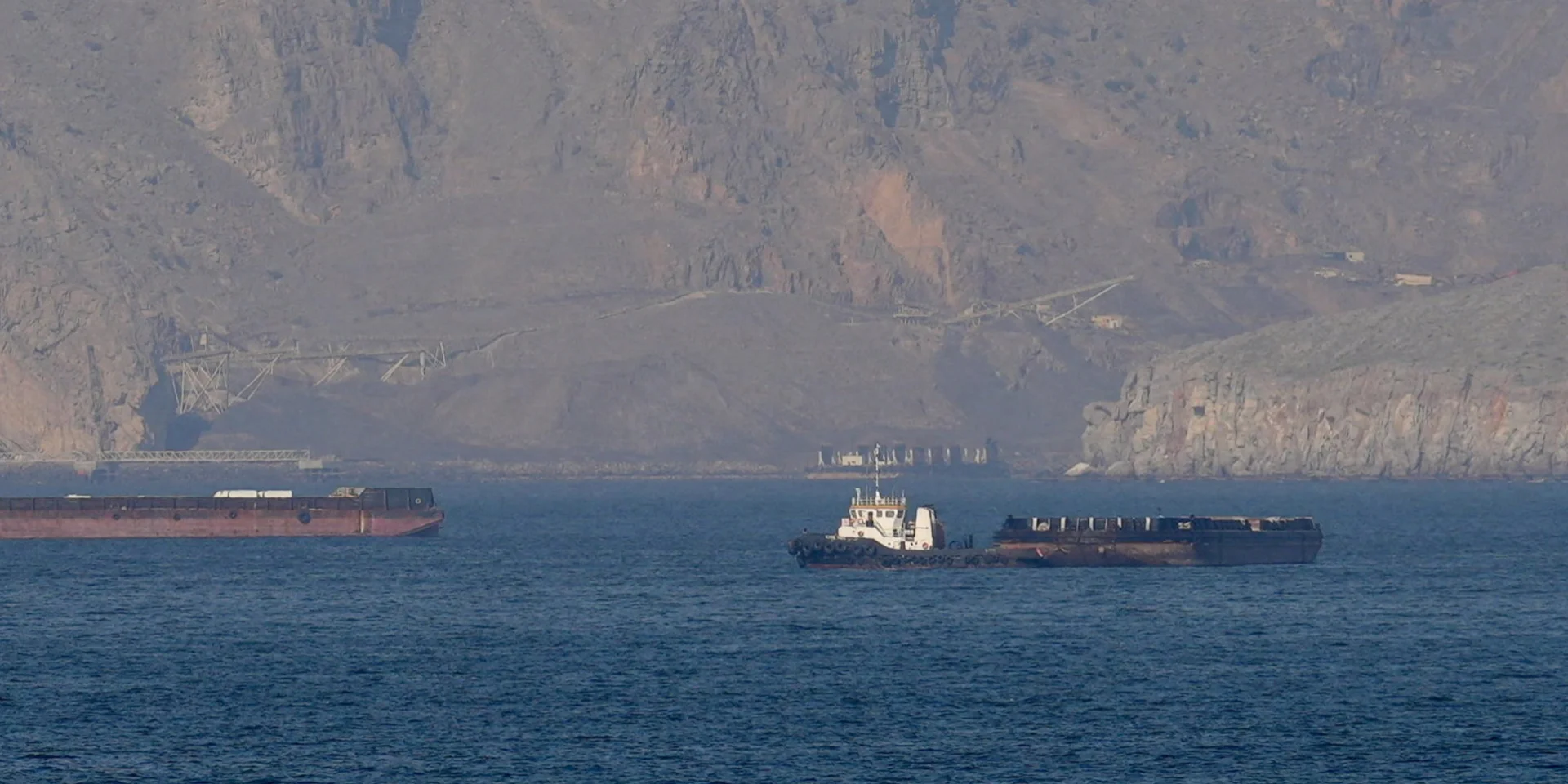
The Strait of Hormuz is a narrow sea passage between Iran and Oman, connecting the Persian Gulf with the Gulf of Oman and the Arabian Sea. It is one of the world’s most important energy routes: under normal conditions, around a fifth of global oil consumption and a significant proportion of global liquefied natural gas supplies pass through it. That is precisely why any escalation of tensions around the strait can quickly affect the price of Brent crude, the cost of maritime transport, gas and, ultimately, fuel prices for consumers.
Where is the Strait of Hormuz?
The Strait of Hormuz is situated at the mouth of the Persian Gulf. Its northern shore is controlled by Iran, whilst the southern shore runs along the coasts of Oman and the United Arab Emirates.
Oil tankers use this corridor to sail from ports in Saudi Arabia, Iraq, Kuwait, the UAE, Qatar and Iran out into the Indian Ocean, and from there on to Asia, Europe and other markets.
At its narrowest point, the strait is about 34 km, however, the navigation lanes are considerably narrower: a corridor approximately 3.2 km wide is used for traffic in each direction, with a buffer zone situated between them.
It is precisely this geographical location that makes Hormuz the so-called chokepoint — a critical bottleneck in global trade.
How much oil passes through the Strait of Hormuz?
According to the US Energy Information Administration, in the first half of 2025, an average of 20.9 million barrels of crude oil and petroleum products per day.
This corresponded to approximately 20% of global consumption of liquid petroleum products and more than a quarter of all the oil transported by sea.
These volumes can fluctuate sharply during wars, sanctions or restrictions on shipping. It is therefore more accurate, when assessing the role of the Strait of Hormuz, to look not at the figures for a specific day of crisis, but at its normal throughput in the global energy sector.
It is precisely for this reason that news of possible restrictions on shipping is taken into account almost immediately by oil traders.
Here at UkrMedia, we have already reported in detail on how the escalation surrounding Iran and the Strait of Hormuz has affected the oil market: The US has launched strikes against Iran: Tehran’s reaction and oil prices.
Why the Strait of Hormuz is important not just for oil
Another resource passes through the Strait of Hormuz, on which the global economy is becoming increasingly dependent — liquefied natural gas, or LNG.
In 2024, around 20% of total global LNG trade. The main supplier was Qatar — one of the world’s largest exporters of liquefied natural gas.
Geography is particularly important for Qatar: its main LNG terminals are located within the Persian Gulf, so tankers must pass through the Strait of Hormuz before reaching the global market.
In 2024, approximately 83% of LNG passing through the strait was bound for Asia. China, India and South Korea together accounted for more than half of this volume.
Therefore, a major disruption to shipping through the Strait of Hormuz could simultaneously drive up both oil and gas.
Which countries are most dependent on the Strait of Hormuz?
Asia is the most dependent.
In the first half of 2025, around 89% of crude oil and condensate, …which passed through the Strait of Hormuz were bound for Asian markets. China, India, Japan and South Korea together received around 74% of these shipments.
The escalation in the Strait area is therefore particularly sensitive for the major Asian economies.
The US is now far less dependent on this route than it was a few decades ago: the rise in US production has drastically reduced oil imports from the Persian Gulf. However, this does not mean that American consumers are immune to a crisis.
Oil is traded on the global market. If millions of barrels disappear from it, the price of crude rises worldwide, not just in the countries that physically purchase oil via the Strait of Hormuz.
That is precisely why statements by American politicians regarding petrol prices often draw attention back to this strait. For example, UkrMedia reported on a statement by Donald Trump, who compared the impact of the situation around the Strait of Hormuz with the problems facing the oil refining industry: Trump on petrol prices, oil refineries and the Strait of Hormuz.
What would happen if the Strait of Hormuz were blocked?
A complete halt to shipping would mean that a significant proportion of oil exports from the Persian Gulf would be unable to reach the global market quickly.
The consequences would depend on the duration of the blockade, but the mechanism would be broadly the same: traders price in the risk of a shortage — the price of oil rises; insurance companies raise premiums for tankers — delivery costs increase; countries begin to draw on their reserves — the market becomes even more volatile; an LNG shortage puts further pressure on gas prices.
It is particularly important that It is impossible to completely replace the Strait of Hormuz with pipelines.
Saudi Arabia and the UAE have pipelines that allow some of their oil to bypass the strait, but their available capacity is significantly lower than that of normal maritime traffic. According to EIA estimates, these countries’ alternative routes could provide around 4.7 million barrels per day additional throughput — compared with the approximately 20 million barrels that would normally pass through the Strait of Hormuz.
That is precisely why a complete, prolonged closure of the route would be an event of global significance.
In 2026, UkrMedia had already been monitoring actual disruptions and the resumption of traffic along this route: Iran and Oman discussed a temporary corridor through the Strait of Hormuz.
Why do oil prices react even before the market actually closes?
For Brent prices to rise, it is not necessary to wait until tankers physically stop passing through the strait.
Oil is traded via futures contracts, and the market assesses future risks. If traders perceive an increased likelihood of war, a blockade, the laying of mines or attacks on ships, this may be immediately factored into the price geopolitical risk premium.
In addition, shipowners may alter their routes, insurance companies may review their premiums, and buyers may try to secure additional supplies in advance.
That is precisely why a single statement from Iran, the US or a major shipping company can sometimes cause oil prices to fluctuate even before there is any actual change in export volumes.
Once the situation stabilises and the market sees that supplies are resuming, the effect may work in the opposite direction. This was the case, for example, when, against the backdrop of a resumption of exports through the strait, OPEC+ decided to increase production: OPEC+ has increased oil production as exports resume.
Could Iran close the Strait of Hormuz on its own?
Iran controls the northern shore of the strait and has significant military capabilities in the region. Tehran has repeatedly used the threat of restricting shipping as a means of exerting political and military pressure.
However, a prolonged total lockdown is a far more difficult task than simply announcing one.
Iran’s own exports also pass through the strait. Furthermore, the restrictions on shipping affect China, India and Iran’s other major trading partners.
Therefore, even at times of greatest tension, it is important to distinguish between a political threat, a temporary disruption to traffic and the de facto long-term closure of the maritime route.
This is precisely what one should bear in mind when reading reports about the «closure of the Strait of Hormuz». Here is one such example: Iran has announced the closure of the Strait of Hormuz following US strikes.
How the Strait of Hormuz affects petrol and diesel prices
The connection isn’t instant, but it’s fairly direct.
The rise in global crude oil prices is driving up costs for oil refineries. At the same time, petroleum products themselves — petrol, diesel and aviation fuel — may become more expensive.
Added to this are transport costs, tanker insurance, exchange rates, taxes and the situation in the specific regional market.
Therefore, a blockade of the Strait of Hormuz does not mean that fuel prices at petrol stations will automatically rise by a certain percentage. However, a prolonged reduction in supplies through the strait exerts strong fundamental pressure on prices.
Why the Strait of Hormuz will remain important
The world is gradually making the transition to renewable energy, electric vehicles and other energy sources, but the global economy still consumes vast quantities of oil and gas.
The Persian Gulf remains one of the main centres for their extraction.
And as long as the majority of these products reach the global market via the narrow maritime corridor between Iran and Oman, the Strait of Hormuz will remain one of the places where a local military or political crisis could escalate into a global economic problem.
That is precisely why, whenever Iran, the US, oil tankers, attacks or threats of a blockade reappear in the news, the markets look first and foremost at one spot on the map — the Strait of Hormuz.
Short answers
What is the Strait of Hormuz?
A strait between Iran and Oman, which connects the Persian Gulf with the open ocean.
How much oil passes through the Strait of Hormuz?
Before the major disruptions, around 20–21 million barrels of oil and petroleum products passed through the route each day — roughly one-fifth of global consumption.
Why can’t we just go round it?
There are pipelines running through Saudi Arabia and the UAE, but their capacity is insufficient to replace the entire maritime flow through the strait.
Does gas pass through the Strait of Hormuz?
Yes. Under normal circumstances, around one-fifth of global LNG trade passes through the strait, primarily from Qatar.
Who is most dependent on the strait?
First and foremost, Asian countries — China, India, Japan and South Korea.