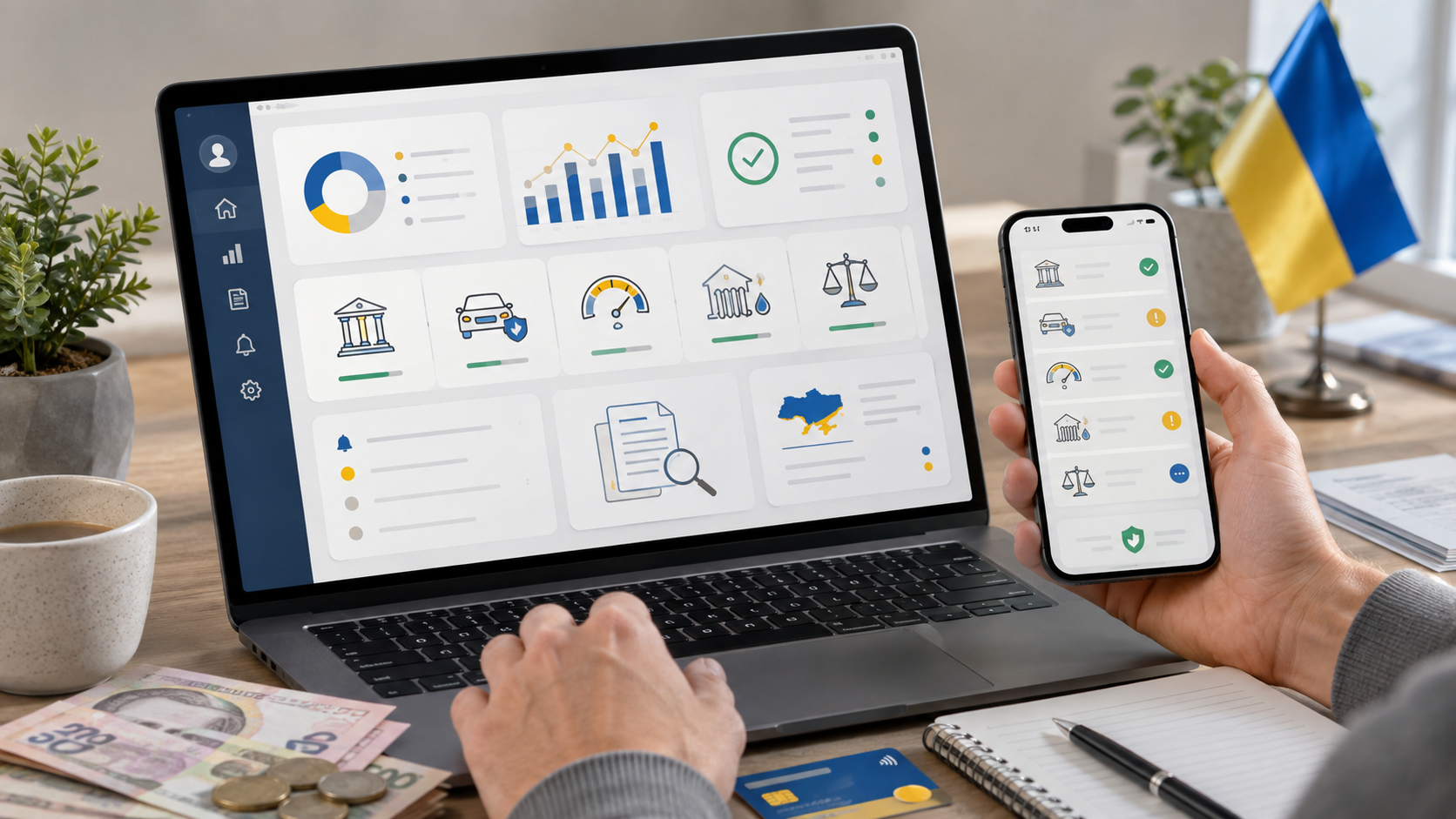
A person may have outstanding debts without realising it: an old fine, unpaid tax, a loan, enforcement proceedings or a utility bill. There is no single service in Ukraine that shows absolutely all of a person’s debts. Let’s take a look at where to check for different types of debt online and what to do if you discover a debt you weren’t previously aware of.
Briefly about the main points
– There is no single register of all debts in Ukraine.
– Enforcement proceedings are checked via the Ministry of Justice and «Diyu».
– Tax arrears can be viewed in the State Tax Service’s Online Portal.
– You can check traffic fines via the Ministry of the Interior’s online services.
– It is worth checking loans via your credit history and the NBU register.
– Utility bills are checked at the suppliers’ offices.
Is it possible to check all outstanding debts in one place?
No. That’s the main thing you need to know before the check.
The Unified Register of Debtors is not a register of all the debts incurred by Ukrainian citizens. If a person has an overdue loan, an unpaid gas bill or a tax liability, this does not necessarily mean that their surname will automatically appear in the Ministry of Justice’s register.
The Unified Register of Debtors is primarily linked to enforcement of decisions. By law, this is a component of the Automated Enforcement Proceedings System, which contains information on debtors’ outstanding financial obligations.
Therefore, for a thorough check, it is best to use several services:
| What we check | Where to look |
|---|---|
| Enforcement proceedings | Ministry of Justice, ASVP, «Dія» |
| Taxes | The State Tax Service’s online portal, «My Tax» |
| Traffic fines | Ministry of the Interior, Driver’s Hub, «Diya» |
| Loans | Credit Reference Bureau, NBU Credit Register |
| Utility bills | Supplier’s personal account |
| Child maintenance | Unified Register of Debtors / Enforcement Service |
1. How to check if you are listed in the Unified Register of Debtors
It is best to start with The Ministry of Justice’s Unified Register of Debtors.
This is a public service: anyone can check the details of an individual or a legal entity. For individuals, the register contains, amongst other things, their full name, date of birth, enforcement case number and information about the authority or enforcement officer responsible for enforcement.
The Ministry of Justice’s Unified Register of Debtors
An important point to note: The register does not show the exact amount of the debt and all the documents in the case. First and foremost, it confirms that enforcement proceedings are pending against the individual. The Ministry of Justice emphasises separately that the Unified Register of Debtors and the Automated Enforcement Proceedings System are not one and the same resource.
If the search turns up nothing, this does not guarantee that there are no debts at all. For example, the debt may not yet have reached the stage of enforcement.
2. How to find out the details of enforcement proceedings
If enforcement proceedings have already been brought against you, further information can be found at Automated Enforcement Proceedings System — AEPS.
It sets out:
- enforcement documents;
- the details of the debtor and the creditor;
- information about a public or private enforcement agent;
- resolutions;
- details of the freezing of funds and property;
- enforcement measures taken;
- status of the decision’s implementation.
The parties to enforcement proceedings have full access to the documents relating to a specific case. For this purpose, in particular, the following may be used access ID, as specified in the order to commence proceedings.
There’s also a simpler option — an app «Action». In the «Enforcement Proceedings» section, you can view an open case and pay the outstanding amount online. As of August 2026, this feature is operational.
3. How to check your tax liability
A separate category — taxes.
It is not worth looking for them solely in the Ministry of Justice’s register. Individuals can obtain the most up-to-date information about their own financial dealings with the state budget via The State Tax Service’s online portal.
Once you have logged in, you need to open the section «Status of payments to the budget». It shows charges, payments, penalties, overpayments and tax arrears for individual payments. The State Tax Service confirmed that this feature was operational in August 2026.
You can log in to the private area using, for example, a digital signature, BankID or Diya.Sign.
State Tax Service Online Portal
The second option is a mobile app «My Tax». The State Tax Service states that, in the «My Details» section, individuals can view the status of their payments to the State Budget and information regarding any tax arrears.
This is particularly worth checking for owners of property, land and cars, as well as business owners and people who pay certain taxes themselves.
4. How to check for traffic fines
There are specific government services for motorists.
Fines for breaching the Highway Code, recorded by automatic cameras, can be checked on the Ministry of the Interior’s official website.
To search, enter vehicle registration number and one more piece of information — for example, details from a driving licence, vehicle registration certificate or court order.
You can also view and pay for administrative offences via Driver’s cabin.
Traffic fines are also available on «Dii». In 2026, the Ministry of Digital Transformation further expanded the service’s functionality, notably by integrating the payment of fines into Dii.AI.
At the same time, the Ministry of the Interior has issued a warning about fraudulent messages concerning allegedly unpaid fines. In June 2026, the Ministry urged the public to verify information only through official channels and not to enter bank details on pages containing suspicious messages.
5. How to check whether you have any outstanding loans or arrears
If the main question is «Is there a loan in my name that I’m not aware of?», the Unified Register of Debtors is not enough.
This needs to be checked credit history.
Under Ukrainian law, a person has the right to to obtain information about your credit history free of charge once per calendar year at a credit reference agency. Free access is also provided in the event that a lender refuses to enter into a credit agreement.
For example, the Ukrainian Credit Bureau confirms that you can obtain your own credit report free of charge once a year.
Your credit history shows details of any loans you have taken out and your repayment record.
It’s a good idea to do this even if you’re certain you haven’t borrowed anything. If an entry has appeared in your history an unfamiliar loan, you should contact the lender and the credit reference agency immediately to dispute the information.
The law expressly provides for a person’s right to submit a complaint to the bureau if they disagree with the information in their credit history.
6. What does the NBU Credit Register show?
There is another useful government tool — The National Bank of Ukraine’s Credit Register.
However, it should not be confused with a credit reference agency.
As of 2026, the NBU’s Credit Register contains information on a debtor’s credit transactions if the total amount of their liabilities is 50,000 hryvnias or more. An individual may obtain information about themselves and request that it be amended or deleted in the event of an error.
It is therefore advisable to use the following to check loans both mechanisms:
credit reference agency — for credit history;
The NBU Credit Register — for information entered into the state register in accordance with established criteria.
7. How to check your utility bills
The situation with utility bills is simpler, but less centralised.
There is no single national portal that shows all your water, gas, heating and electricity bills across Ukraine at the same time.
You should therefore check this directly in the suppliers’ personal accounts:
- electricity;
- gas;
- water supply;
- heat supply;
- the building manager or the owners’ association.
If the debt has already been recovered through the courts and enforcement proceedings have been initiated, the information may also appear in the enforcement systems.
This leads to an important conclusion: The fact that a person is not listed in the Unified Register of Debtors does not mean that they have no outstanding utility bills.
Why might there be a debt, yet it does not appear in the register?
This is one of the most common mistakes made when carrying out a self-assessment.
For example, a person checks the Unified Register of Debtors, cannot find their surname and concludes: «I have no debts».
In fact, she may have:
credit card arrears;
an outstanding utility bill;
tax liability;
a recent fine;
another debt in respect of which enforcement proceedings have not yet been initiated.
The Ministry of Justice itself explains that the Unified Register contains only a limited amount of information relating to enforcement proceedings, whilst the ASVP has a more extensive database.
In other words You need to check the specific type of debt you are interested in.
What to do if you discover an unknown debt
The worst thing you can do is to transfer money straight away using the details provided in an SMS, a messaging app or on a random website.
First, check the information via an official government service or organisation.
If this is enforcement proceedings, find out the case number and the enforcement officer’s contact details.
If you have a tax debt, view the details of the assessment in the State Tax Service’s Online Portal.
If you’ve been fined, check the decision via the Ministry of the Interior.
If you have a loan — obtain your credit history and contact the financial institution that provided the information.
If the debt is not yours or the amount is incorrect, You shouldn’t just pay it to «get it out of the way». First, you need to find out the reason for the debt and demand that the error be rectified.
How to check if you have any debts in 10 minutes
For a basic check, simply follow this route:
- Find yourself in The Unified Register of Debtors.
- Check «Enforcement Proceedings» in Action.
- Go to State Tax Service Online Portal.
- Motorists – please check fines imposed by the Ministry of the Interior.
- Get credit history.
- Check if necessary The NBU Credit Register.
- View suppliers’ personal accounts utilities.
This does not guarantee that every possible financial claim against an individual will be found in one place, but it does allow you to check the main categories of debt that Ukrainians most commonly face.
Is it possible to check another person’s debts?
Partly.
The Unified Register of Debtors is public, so anyone can check whether a person is listed in it.
However, tax information, a full credit history, banking liabilities and personal data relating to enforcement proceedings are not accessible to third parties.
That is why services that promise to show, based on a telephone number or full name, «all a person’s loans and debts», should be treated with caution.
How often should you check your debts?
For most people, it is sufficient to carry out a general check a few times a year, as well as before any important financial or property transactions.
It is a good idea to check your credit history at least once a year — especially as the law allows you to do so free of charge once per calendar year.
The check doesn’t take long, but it can help you spot an old fine, an incorrect charge or even a loan you never applied for, in good time.