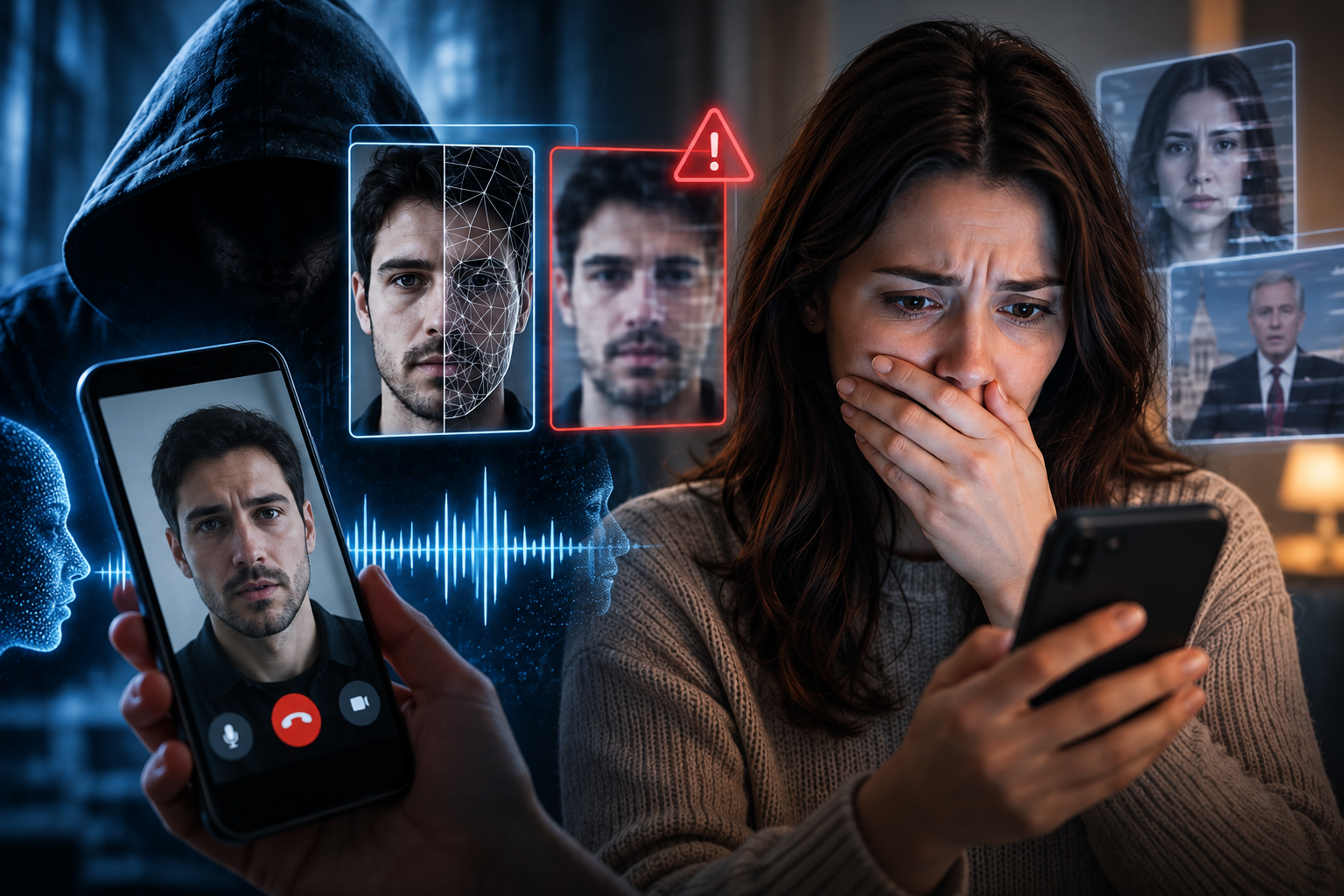
Artificial intelligence has radically transformed online fraud. Criminals are using voice cloning, deepfake videos, AI-generated images, automated chatbots and synthetic personas, …to impersonate other people more convincingly and scale up their attacks. In March 2026, INTERPOL warned of the «industrialisation of fraud»: it estimated that AI-enhanced schemes could be 4.5 times more profitable rather than traditional ones. Ready-made kits for creating digital doubles, complete with video avatars, voice clones and other synthetic data, are already being offered on darknet markets.
- Fraudsters can clone a voice from a short audio recording.
- It is no longer always possible to spot a deepfake video just by looking at it.
- The main sign of a scam is an urgent request for money or personal details.
- Don’t rely on a voice or video alone: verify the person through another channel.
- Agree on a secret word with your loved ones for emergencies.
What is AI fraud and why has it become more dangerous?
AI fraud — is the use of generative artificial intelligence to deceive people: the creation of fake voices, photographs, videos, documents, messages or even entirely fictional digital personas.
In the past, a fraudster had to convincingly impersonate another person. Now, part of the work is done by AI: generates well-written messages in the required language, mimics a voice, creates photographs and helps to maintain long-term communication with the victim.
INTERPOL notes that generative AI has significantly lowered the barrier to entry for criminals. Deepfake technology and automated models are already being used for large-scale social engineering and the creation of synthetic identities.
The scale of the problem is growing rapidly. During the international operation ‘First Light 2026’, which targeted social engineering schemes, law enforcement agencies from 97 countries arrested 5,811 people and seized assets amounting to $293 million.
How fraudsters clone a voice
One of the most dangerous scenarios is — voice cloning, or voice cloning.
Fraudsters find people’s voice recordings on TikTok, Instagram, YouTube, Telegram, a podcast or another open-access source, after which they upload it to a text-to-speech system.
According to INTERPOL, modern criminal services are capable of creating convincing digital clones using approximately 10 seconds of audio, obtained from public sources.
After that, the victim may receive a phone call from a «son», «daughter», «friend», «boss» or someone else they know.
A typical scenario goes like this:
«Mum, I’ve been in a car crash. I can’t talk for long. Please transfer the money straight away.».
Or:
«It’s the director. I’m in a meeting at the moment. Please pay the bill straight away; I’ll explain everything later.».
The FTC warns that fraudsters may use even short snippets of voice recordings from content published online. That is why A familiar voice is no longer proof that a real person is calling you.
How to spot a fake voice
The quality of voice clones is constantly improving, so it is no longer enough to look solely for a robotic tone or a strange accent.
First and foremost, you should pay attention to the behaviour of the person you are talking to.
You should be on your guard if a person:
- calls for immediate action;
- asks that nobody should ring;
- insists on confidentiality;
- asks you to transfer money to an unfamiliar account;
- demands cryptocurrency or gift vouchers;
- refuses to answer personal questions;
- does not allow you to end the call and ring back.
Namely. the urgency of the situation and the victim’s isolation are typical features of scam tactics. The FTC advises against trusting even a very familiar voice, and recommends ending the call and phoning the person yourself using a number you already know.
The simplest check
If a relative calls you and asks for money:
1. Put the receiver down.
2. Dial their normal number yourself.
3. Send a message via the messaging app you used previously.
4. Give another family member a ring.
Do not use any number or link sent by a suspicious person.
How to spot a deepfake video
Deepfake — is a synthetic or AI-altered video in which a person’s face, facial expressions, voice or even their entire body can be replaced.
In the past, such videos often featured strange-looking eyes, distorted fingers or unnatural lip movements. In modern models, many of these flaws are now virtually imperceptible.
The FBI advises people to look out for possible anomalies: unnatural movements, strange shadows, issues with accessories, out-of-sync audio, delays during video calls, or an unusual manner of speaking. At the same time, the Bureau itself warns that AI-generated content has become so high-quality that it is often It is difficult to determine this with any certainty by visual inspection alone.
So the rule is simple:
Do not try to verify the authenticity of a video based solely on its appearance. Check the source.
If, for example, a business associate messages you on Telegram and sends a video message asking you to transfer €5,000 — call them on a number you already know or get in touch by other means.
The most common AI schemes
«A relative is in trouble»
One of the most emotionally charged scams. An AI voice clone reports an accident, arrest, hospitalisation or other emergency and asks you to send money urgently.
«The manager is requesting a transfer»
The fraudster pretends to be a director or a colleague.
AI makes it possible to forge not only messages, but also voice and video calls. Such attacks are particularly dangerous for accountants and finance departments.
Investment scams
Criminals create fake videos featuring celebrities, businesspeople or financial experts who purportedly recommend a cryptocurrency, an exchange or an investment platform.
Romance scam
The fraudster maintains a romantic relationship for months using AI-generated photos, translation tools and automatically generated messages.
Deepfake even allows you to make short video calls, which makes the fictional character seem much more convincing.
Fraud committed in the name of the police or public authorities
A person is informed of a criminal case, tax debt or a «suspicious transaction».
The police warn that criminals are also using phone number spoofing: The victim’s screen may display the actual number of the police or a government agency.
Therefore, even a correct Caller ID does not guarantee that the call is genuine.
A secret word can protect your family
One of the simplest ways to combat voice deepfakes is to agree with your closest friends and family on family password.
For example, choose a word that:
- is not linked to your names;
- was not used on social media;
- is not the name of a pet;
- Only family members know this.
If a «relative» calls with an urgent request, ask them to give a code word.
For particularly sensitive situations, you can use a security question, the answer to which cannot be found on Facebook, Instagram or other public sources.
The main thing is — Do not post the code word online.
How to assess someone in 30 seconds
If you receive a suspicious call, video or message, follow the three-check rule.
The first one is a different channel.
Call the person yourself or message them via an account you already know.
The second is a separate question.
Ask about a fact that only you and the person you’re talking to know.
Third — a pause.
Do not carry out any financial transactions within a few minutes of receiving an unexpected request.
Fraud often works not because the deepfake is perfect, but because the victim don’t give you time to think.
Things you should never do
Please do not send codes from text messages or authentication apps.
Do not disclose your bank card’s CVV.
Do not install remote access programmes at the request of strangers.
Don’t transfer money just because the person on the video call looks familiar.
Do not click on the «verify account» link in the message you have received.
Do not buy cryptocurrency or gift cards based on instructions from someone who is creating a false sense of urgency.
The FTC specifically warns that being asked to pay for something using a gift card is a classic sign of fraud.
What to do if you have already transferred the money
Speed is important here.
First and foremost Please contact your bank or payment service provider immediately and please let us know about a fraudulent transaction. If the transfer has not yet been completed, it can sometimes be stopped.
After that:
- block any compromised cards;
- change your passwords for your email and important accounts;
- close all unknown active sessions;
- enable two-factor authentication;
- Save screenshots, your phone number, your crypto wallet address and any correspondence;
- Please report this to the police.
It is also important to be wary of a second case of fraud. In 2026, the FTC issued a warning about so-called «recovery scams»: after an initial loss, the victim receives a phone call from people promising to ‘refund’ the money they had paid in advance. This may be the next stage of the same criminal scheme.
Is there a service that can detect deepfakes with 100% accuracy?
No. There are systems for analysing synthetic content, digital watermarks and technologies for verifying the origin of media files. However, No detector should be regarded as conclusive proof.
AI models are constantly being improved, and various methods of compressing, editing and re-uploading videos can affect how the detectors work.
That is precisely why the safest approach is to check not only the file, but the person, the source and the circumstances of the enquiry.
If a video has supposedly been sent by a friend, the most reliable way to check is not to analyse the pixels, but to ring that friend directly.
How to protect yourself from AI scams
For most people, completely removing their voice and photographs from the internet is unrealistic. However, it is possible to significantly reduce the risk.
Limit the visibility of your personal profiles and do not post unnecessary information about relatives, travel itineraries, documents or finances.
Use a variety of strong passwords and two-factor authentication.
Teach elderly family members this rule: no urgent transfers following a single phone call.
Companies should establish a separate procedure for verifying large payments. For example, a transfer exceeding a specified amount must be verified via a second, independent channel.
This is important because criminals are increasingly using AI to automate phishing, social engineering and the creation of synthetic identities. In August 2026, INTERPOL reported that AI had already been linked to 55% cybercrimes recorded in the African countries surveyed, which illustrates the scale of the rapid spread of such tools.
The golden rule: don’t rely solely on what you see and hear
The era in which a photograph, a voice message or a video call automatically confirmed a person’s identity is coming to an end.
A modern deepfake can look convincing, whilst a voice clone can sound almost identical to the original.
Therefore, the most important defence against AI fraud is — independent audit. If you are suddenly asked for money, passwords or confidential information, stop and contact the person by another means.
Just a few minutes of verification can distinguish a genuine emergency from a well-crafted AI hoax.
Frequently Asked Questions
Is it possible to clone a voice from a recording on social media?
Yes. INTERPOL has reported on tools capable of creating convincing voice clones even from short audio clips obtained from public sources.
How can I tell if it’s an AI calling me?
There is no single tell-tale sign. Things to watch out for include a sense of urgency, demands for money, secrecy, a reluctance to answer personal questions, and requests not to ring back.
Can you trust a video call?
Not entirely. Deepfake technology can also be used during video calls. When making financial or other important decisions, verify the person’s identity via an independent channel.
What should you do if a relative calls and asks for money?
End the call and ring your relative back yourself using the number you have. If they do not answer, get in touch with other family members.
Would a family code word help?
Yes, it’s simply an extra layer of verification. The code word should only be known to close friends and must not appear in public profiles.