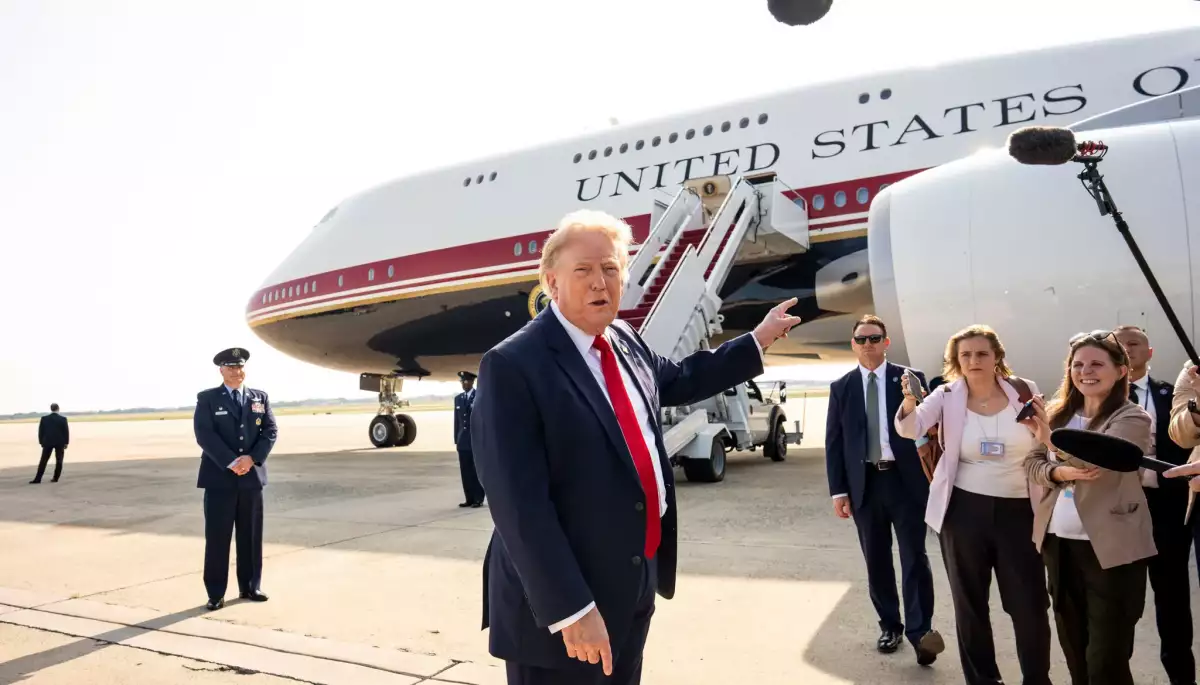
President of the United States Donald Trump has threatened the European Union with new trade restrictions, should Washington regard the possible granting of «associate member» status to Canada by the EU as a hostile move. The US President stated that, in such a case, he might impose «very serious tariffs» or restrict trade with Europe in certain sectors. At the same time, he left open the possibility of not taking such measures if he is convinced that the initiative is not directed against the US.
- Trump has threatened the EU with new tariffs.
- The reason is a possible rapprochement between Canada and the European Union.
- The US President has also raised the possibility of trade restrictions.
- Canada could become the EU’s first «associate member».
Trump spoke of a «hostile act»
Commenting on the European Commission’s proposal, Trump told journalists that Canada’s potential new status could be viewed by Washington as a «hostile act». He described the very idea as «ridiculous» and once again criticised Canada as a US trading partner.
«If I regard this as a hostile act, I will impose very heavy tariffs,» Trump said.
The US President also raised the possibility of halting trade with Europe in certain sectors. At the same time, he clarified that much would depend on the motives of Brussels and Ottawa: if their actions were, in his words, «well-intentioned», he would not see a problem with this.
Von der Leyen has proposed a new status for Canada
The reason for Trump’s reaction was statement President of the European Commission Ursula von der Leyen during the annual State of the European Union address.
She suggested «open the door» to Canada as the EU’s first associate member and to take relations between the parties to a new level. The initiative aims to deepen cooperation in the fields of defence, technology, energy, artificial intelligence and critical raw materials.
However, it does not currently have that status does not exist in the treaties of the European Union. Brussels will effectively have to create a new framework and define exactly what rights and obligations it will entail. The idea will also need to be discussed with the EU Member States and Canada.
The European Commission denies that it is anti-US
Following Trump’s remarks, the European Commission emphasised that the partnership with Canada could be strengthened is not directed against any third country. In Brussels, the initiative is explained as a desire to strengthen cooperation between close partners against a backdrop of geopolitical and economic instability.
French Minister for European Affairs Benjamin Addad He also stated that the European Union should take decisions on external partnerships independently, rather than under pressure from other states.
Canada is seeking to diversify its ties
Prime Minister of Canada Mark Carney In recent months, it has been actively developing economic and defence ties with Europe against the backdrop of trade tensions with the US. Canada has already joined the European SAFE programme on defence procurement and is discussing new joint projects with the EU in the fields of energy, AI and digital trade.
At the same time, there is no question as yet of full membership Canada’s accession to the EU. The format proposed by von der Leyen is intended to be a distinct model of partnership, the details of which have yet to be worked out.
Further discussions are expected to take place during Canadian-European talks, in particular following Carney’s address to the European Parliament.