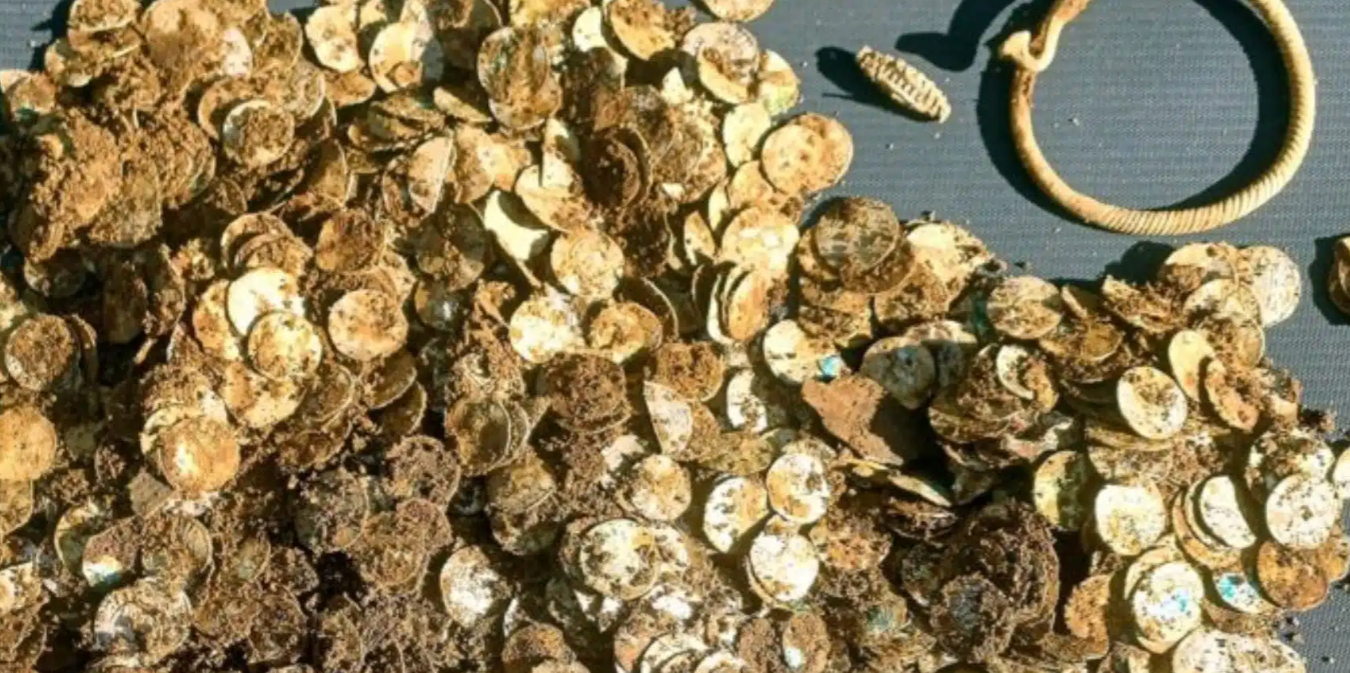
In Finland, a metal detector has helped uncover the country’s largest known Late Iron Age coin hoard, which is thought to date from the Viking Age. Kalle Lappinen found thousands of silver coins near Süsmä, weighing a total of around 4.5 kg. Archaeologists are still determining the exact age, number and origin of the coins.
A metal detector led to a record-breaking find
An amateur treasure hunter with a metal detector Kalle Lappinen discovered the treasure on 3 September 2026 near the village of Syüsmä in the Päijät-Häme region. The site was surveyed by archaeologists the very next day. The work was carried out under the supervision of Esko Tikkanen from the museums in Lahti, which are responsible for safeguarding the archaeological heritage in this area.
The museum has named the find the largest known Late Iron Age hoard of coins in Finland. Yle describes it as the largest known Viking-era silver hoard in the country.
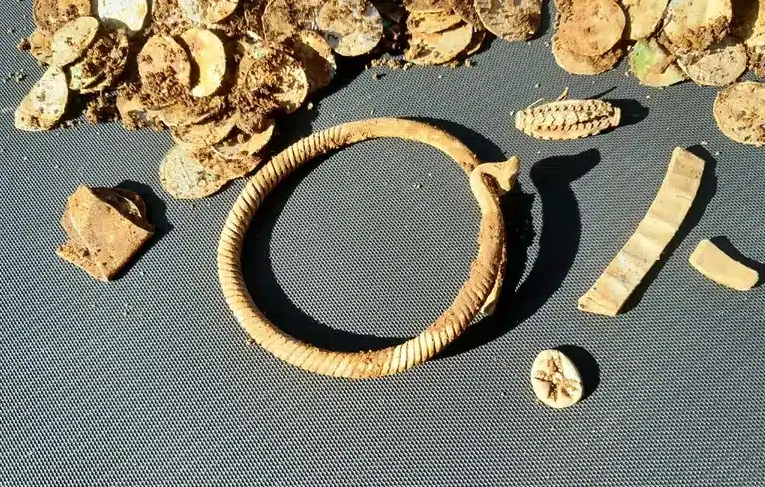
The silver was hidden in two containers made of birch bark
The discovery turned out to be more than just one hiding place. The coins and other items were divided amongst two containers of birch bark, buried at a depth of approximately 45 cm amongst the stones. The distance between the hiding places was about 12 metres. The total weight of the coins found was approximately 4.5 kg.
Archaeologists have not yet specified the exact number. Coins they still need to be cleaned, separated from one another, counted and examined. It is already clear that we are talking about thousands of coins. Precise dating has not yet been finalised, so it is too early to draw any definitive conclusions about when the hoard was buried or the origin of all the coins.
What else was found along with the coins?
As well as coins, archaeologists recovered a fragment of silver coinage, a silver bracelet, a silver plate and a silver bead.
Of particular interest are the remains of birch bark in which the objects were wrapped. Organic materials usually deteriorate much more quickly than metal, so they can provide archaeologists with additional information about how the hoard was stored.
Researchers also need to determine exactly where the coins were minted and via which trade routes the silver might have reached this part of Finland.
The previous record had stood for over 130 years
Prior to this, the find from Nousiainen, made as far back as 1895. It contained approximately 1,700 coins and other items with a total weight of approximately 2.2 kg. The new find from Syusmy is more than twice as heavy as that one.
Overall, 2026 proved to be a year rich in major Viking Age discoveries in Northern Europe. In Norway, near Rena, archaeologists and metal detectorists uncovered the Mørstad hoard — over 2,900 coins, making it the largest known Viking hoard in the country.
In Rebild, Denmark, a homeowner discovered whilst fitting out his terrace that 18.5 kg of silver — around 700 artefacts and fragments dating from the 10th century. Danish museums have described it as the largest known Viking-era silver hoard in the country.
Gotland still holds the world record
The Swedish History Museum describes the world’s greatest Viking treasure as Spillings’ Hoard, found on the island of Gotland in 1999. The find comprised approximately 76 kg of silver and bronze, including around 67 kg of silver. The hoard contained thousands of coins and other items.
The Finnish find is considerably smaller than the Spillings find, but it has already set a record for archaeology in Finland.