In Nepal, on the morning of 3 November, two tourist helicopters collided in mid-air whilst landing near Everest Base Camp. A 47-year-old Indian national was killed in the crash, whilst three others, including both pilots, were injured. The collision took place in full view of tourists and staff at the landing site. The moment of the crash was captured on video.
- On 3 November, two helicopters collided near Everest Base Camp in Nepal.
- A 47-year-old tourist from India has died, and three other people have been injured.
- Among those injured were a New Zealand national and the pilots of both helicopters.
- The collision occurred during landing and was captured on video.
The helicopters collided whilst landing at the same time
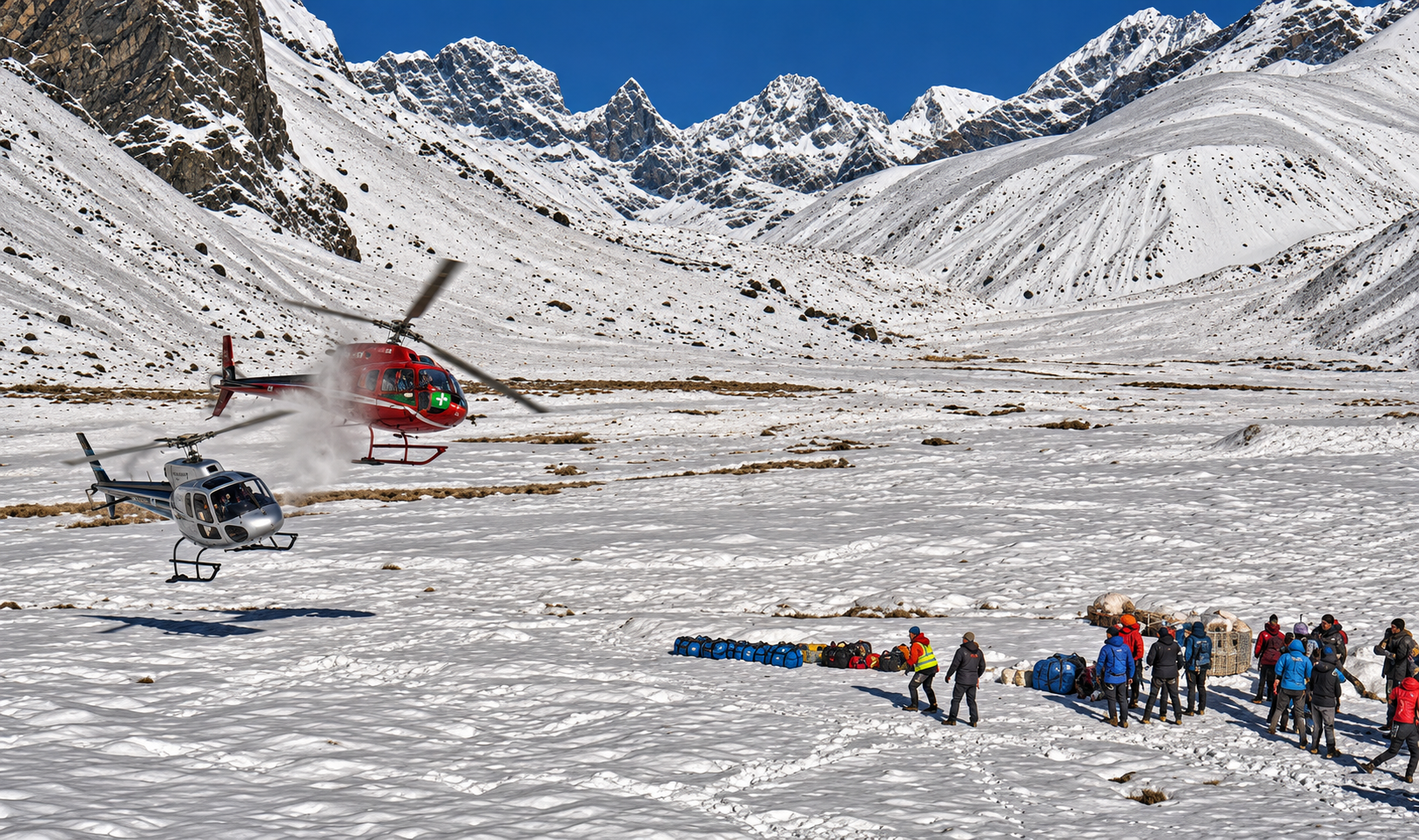
The accident occurred at approximately 08:11 local time at the helipad in the village of Feriche, in the Solukhumbu district. The village is situated at an altitude of over 4,200 metres above sea level on a popular route to Everest Base Camp.
Two Airbus AS350 helicopters collided, which are owned by the private airlines Fishtail Air and Air Dynasty.
According to the Civil Aviation Authority of Nepal, a Fishtail Air helicopter with registration number 9N-AJR arrived from Gorakshap. On board were two foreign tourists who had been evacuated from the area Everest.
The second helicopter, Air Dynasty 9N-AOD, took off from Lukla Airport and was carrying cargo.
Both aircraft were approaching to land almost simultaneously from opposite directions. A few metres above the ground, their rotors collided, after which the helicopters lost control and crashed onto the snow-covered landing pad.
The moment of the accident was caught on video
The footage released shows two helicopters approaching the same landing pad. One of them hovers at a low altitude, whilst the other approaches for landing from the opposite direction.
In an instant, the propeller blades collide. Following the collision, both aircraft change direction abruptly and crash to the ground.
At this moment, a group of tourists and ground crew are near the site. People start to run away, trying to avoid the wreckage of the damaged helicopters.
The video was shared by international news agencies and local media. Aviation investigators are looking into the reasons why the pilots began their approach at the same time.
A tourist from India has died; both pilots were injured
According to the Solukhumb District Police, the deceased was a 47-year-old Vasant Kumar Balaramudu, a resident of the Indian city of Chennai. He was on board a Fishtail Air helicopter and died at the scene of the crash.
Among the injured is a 49-year-old New Zealand citizen of Indian origin Shailesh Krishna Patel, who was travelling in the same helicopter.
The pilots of both aircraft were also injured — Rabindra Prajapati with Fishtail Air and Prajal K. S. from Air Dynasty.
Patel and Prajapati were evacuated by another helicopter to Nepal Mediciti Hospital near Kathmandu. The co-pilot is receiving medical treatment in Lukla. According to the local police, his condition is stable.
The body of the deceased tourist was also taken to Lukla for further procedures.
The Nepalese aviation authorities have launched an investigation
The Civil Aviation Authority of Nepal (CAAN) has announced that it has launched an investigation into the circumstances of the collision.
Director-General of the agency Mukesh Dangol The Kathmandu Post reported that preliminary findings suggest there may have been communication problems between the pilots.
The airfield at Feriche is located outside the coverage area of the Lukla Airport control tower. Under these circumstances, crews must coordinate their actions independently via radio communication.
However, the exact cause of the disaster has not yet been established.
The mountainous region around Everest is one of the most challenging areas for aviation operations in Nepal. Helicopters are used here to transport tourists, deliver cargo and carry out evacuations mountaineers, who have been injured or are unable to descend unaided due to illness or exhaustion.
At high altitudes, flights are made more difficult by thin air, changeable weather and a limited number of suitable landing sites. Following recent snowfalls in the region, tourist traffic has picked up again, leading to an increase in the number of helicopter flights.