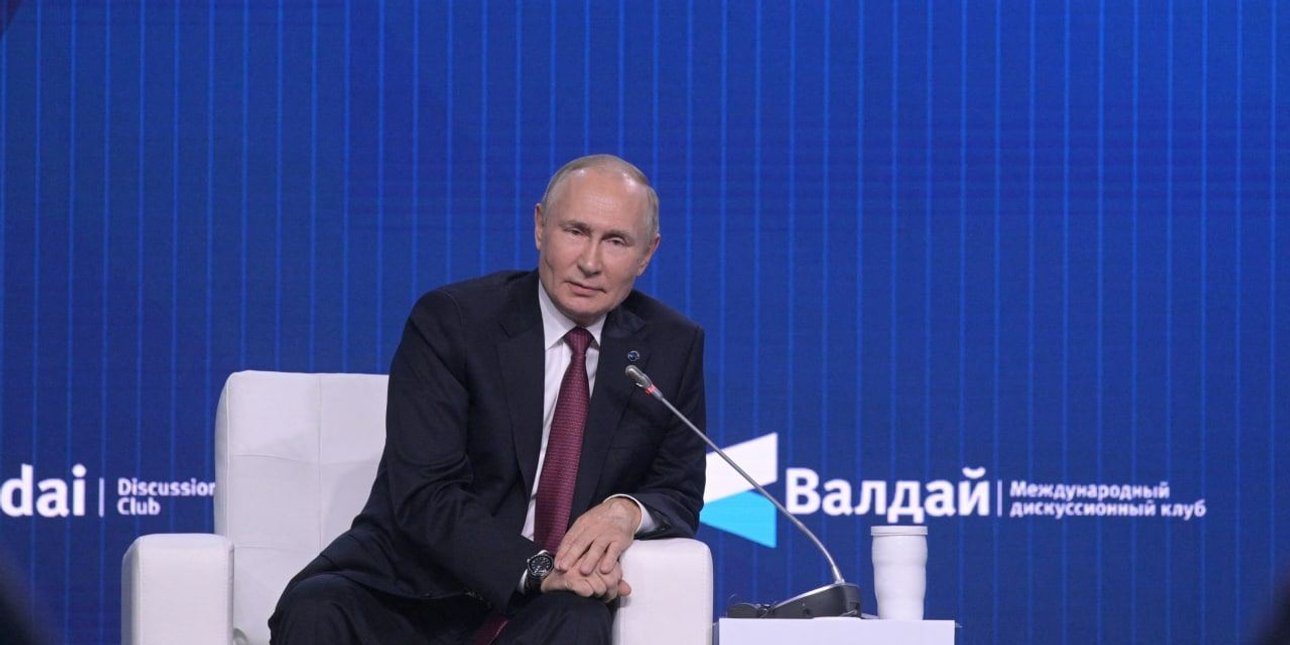
During his speech at a meeting of the Valdai Club on 1 October, Russian President Vladimir Putin continued a series of statements on relations with the West, the war against Ukraine and the situation in the Baltic region. He described NATO exercises in the Baltic Sea and attempts to detain Russian vessels as acts of escalation, and also stated that in the event of a direct attack on Russia, Moscow would consider using «all available weapons».
- Putin stated that Russia would use «all available means» in the event of a direct attack on its territory.
- He described NATO exercises in the Baltic Sea and actions taken against Russian vessels as signs of escalation.
- The President of the Russian Federation has given assurances that Moscow has no plans to attack NATO countries in the future.
- Putin denied that the Russian letter regarding Kaliningrad made any direct reference to nuclear weapons.
Putin has spoken of a direct conflict with NATO
One of the most hard-hitting parts of the speech concerned a possible direct confrontation between Russia and NATO. Putin stated that Moscow regards Western military exercises in the Baltic Sea, as well as attempts to restrict the movement of Russian vessels, as escalatory measures.
According to him, if it comes to a direct attack on Russian territory, the Russian leadership will inevitably be faced with the question of whether to deploy its entire arsenal. At the same time, he claimed that Russian weapons systems possess capabilities which, in his assessment, are not currently available to other states.
NATO’s activities in the Baltic region is described as defensive. The Secretary-General of the Alliance Mark Rütte On 30 September, he stated that NATO poses no threat to Russian territory and is prepared to defend every allied region in the event of an attack. He also stated that, at present, the Alliance does not regard Russian warnings as a sign of an imminent nuclear strike.
The dispute over Kaliningrad and nuclear weapons
Putin also touched upon the Russian diplomatic note concerning the Kaliningrad region. He stated that the letter from the Russian Foreign Ministry allegedly referred to the use of «all means», but without any direct mention of nuclear weapons.
This version differs from the information provided by Reuters. On 30 September, the agency reported that it had seen the text of a Russian diplomatic note sent to NATO. According to Reuters, the document explicitly stated that in the event of an attempt to isolate Kaliningrad Russia is prepared to deploy its entire arsenal, including nuclear weapons. The note also referred to the possibility of strikes against decision-making centres in NATO countries.
Rutte confirmed that communications had indeed taken place between Moscow and the Alliance, but declined to disclose the exact wording of the Russian document publicly. At the same time, he directly called on Moscow to cease its nuclear threats.
«We have no intention of attacking either in 2029 or in 2050»
Alongside warnings about the possibility of deploying Russia’s entire arsenal, Putin stated that Moscow had no intention of attacking European countries or NATO. He dismissed suggestions of possible Russian aggression against the Alliance in the coming decades.
This is not the first time the Kremlin has made such statements. NATO, for its part, officially describes Russia as the most significant and direct threat to the security of its allies, but emphasises that the Alliance itself is not seeking confrontation with Moscow.
At present, NATO’s leadership is also stating that it sees no signs of Russia preparing for an imminent large-scale attack on Alliance territory. Rutte emphasised that, in the event of major preparations, such actions would show clear military and logistical signs.
Putin has once again referred to the bombing of Yugoslavia
The President of the Russian Federation also referred back to the events of 1999, stating that, in his view, it was NATO’s military operation against the Federal Republic of Yugoslavia that marked the beginning of an era of «impunity and unchecked power on the part of the West».
Operation Allied Force It actually began on 24 March 1999 and lasted 78 days. NATO justified it on the grounds that it was necessary to halt the humanitarian catastrophe and violence in Kosovo following the collapse of diplomatic negotiations. The question of the legality of launching the campaign without a separate mandate from the UN Security Council remains a subject of debate in international law. Following the cessation of hostilities, the Security Council adopted Resolution 1244, which authorised an international civilian and security presence in Kosovo.
In his speech, Putin used Yugoslavia as an example to support a broader argument that the West had, in effect, created the rules itself, which are now leading to international instability.
What Putin said about Yanukovych and 2014
Putin also stated that the former President of Ukraine Viktor Yanukovych He supported Ukraine’s rapprochement with the European Union but opposed accession to NATO, after which he was allegedly «removed from power».
The first part of the statement has a factual basis: during Yanukovych’s presidency, Ukraine did indeed declare its commitment to European integration, whilst at the same time, in 2010, it abandoned its course towards NATO membership and reaffirmed its non-aligned status. At the end of 2013, Yanukovych backed out of the planned signing of the Association Agreement with the EU following significant political and economic pressure from Russia, which served as the immediate trigger for the start of the Euromaidan protests.
However, the claim that he was removed precisely because of his stance on NATO does not reflect the full sequence of events. On 22 February 2014, the Verkhovna Rada declared that Yanukovych had abdicated his constitutional powers and called a snap presidential election. By that time, he had left Kyiv and soon found himself in Russia.
Putin claimed that Ukraine had «lost its statehood»
Another part of the speech was devoted to Ukraine. Putin claimed that the country is allegedly incapable of «existing independently» and is «losing the elements of statehood». This is a political assessment by the Russian president, not an established fact.
Ukraine remains an internationally recognised sovereign state, a member of the United Nations and a candidate for membership of the European Union. At the same time, due to the full-scale war, the country is indeed heavily dependent on international military and financial aid.
Putin stated separately that Moscow’s concern is not so much the supply of Western weapons to Ukraine as the direct involvement, in his view, of Western states in the planning and execution of strikes on Russian territory.
He said that the Russian Federation was monitoring which companies and countries were supplying weapons, but added that this did not mean an automatic decision to attack such production facilities.
Western countries and the war in Ukraine
Putin continued to portray the war as part of a wider confrontation between Russia and the West. Earlier in the same speech, he claimed that Moscow had allegedly been forced to «defend itself with arms».
This interpretation contradicts the internationally recognised chronology of the war. Russia annexed Crimea in 2014 and, on 24 February 2022, launched a full-scale invasion of Ukraine. In March 2022, the UN General Assembly condemned Russia’s aggression and demanded the withdrawal of Russian troops. NATO and also defines the war as unprovoked Russian aggression
Putin went on to say that he had no regrets about the attempts to improve relations with Western countries in the 2000s. According to him, the Russian leadership later came to the conclusion that Moscow would not be able to integrate fully into the Western system.
Rhetoric that speaks of both deterrence and the threat of escalation
Putin’s speech at the «Valdai» Forum» He combined two parallel arguments. On the one hand, he insisted that Russia had no intention of attacking NATO countries and was not interested in a direct war with Europe. On the other hand, he repeatedly emphasised his readiness to use all available means in the event of a direct conflict.
This is taking place against a backdrop of rising tensions in the Baltic region. Russia is warning NATO about Kaliningrad, the Alliance is conducting military exercises and strengthening its eastern flank, and both sides are increasingly speaking of the risk of a mistake or uncontrolled escalation. Reuters notes that the current rhetoric surrounding Kaliningrad has become one of the most serious episodes of nuclear posturing between Moscow and NATO in recent times.
At the same time, NATO has not announced any change to its nuclear readiness level in response to the latest Russian statements, whilst Rutte has called for the immediate threat not to be exaggerated and for defence preparations and support for Ukraine to continue.