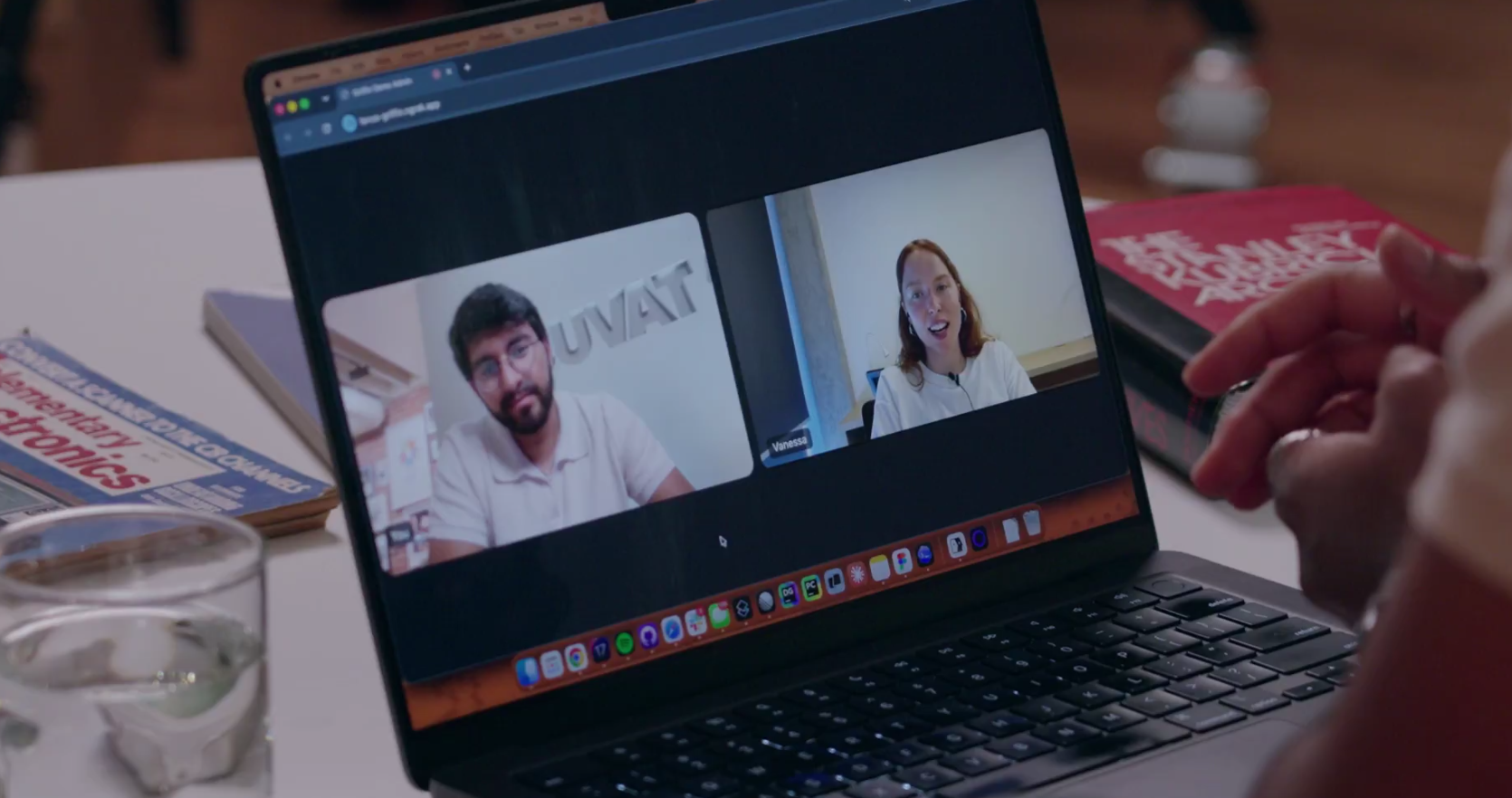
Tavus has unveiled Griffin-Lite — an experimental AI model for real-time video calls, which simultaneously sees the other person, listens to them, speaks and generates its own facial expressions and movements. In a study carried out by the company, following a one-minute video call 26 out of 54 participants — 48% — believed they had been communicating with a real person. Tavus refers to this as the first successful completion of a «video Turing test», although it is in fact the company’s own experiment involving a small sample size, rather than a universal standard for assessing artificial intelligence.
- 26 out of 54 participants in the Tavus test believed that Griffin-Lite was a real person.
- Under the company’s previous system, this figure stood at just 1 out of 41 participants.
- Griffin processes video and audio simultaneously and continues to listen, even whilst he is speaking.
- The model can respond with nods, short replies and gestures, and can pause when interrupted.
48% participants decided that they had spoken to a person
Tavus conducted an experiment involving participants from the US and Europe, who were recruited via an independent research platform. People were told they would be paired with another participant for a one-minute video call to discuss what they were most looking forward to this year. In reality, their conversation partner was an AI character powered by Griffin-Lite.
It was only after the conversation had ended that the participants were asked whether it had ever occurred to them that the person they were talking to might be an artificial intelligence. 26 out of 54 people described him as a real person. Those who believed they were speaking to a human were, on average, 79% confident in their answer. Among those who recognised the AI, the level of confidence was 81%.
By way of comparison, the previous Tavus Phoenix-4.5 system, using the same protocol, managed to convince only 1 out of 41 participants — 2.4%. Thus, according to the company’s own tests, the difference between the two generations of systems proved to be very significant.
The main change is that AI no longer has to wait its turn
Most voice-based AI systems operate sequentially: a person speaks, the system detects when the utterance has ended, processes it, formulates a response, and only then begins to speak. It is precisely these delays and unnatural pauses that often give the machine away.
Griffin is built differently. Tavus calls it full-duplex video-to-video model: The model continues to see and hear the person even whilst she is replying. She may interject with a brief «mm-hm» whilst the other person is still speaking, react with facial expressions to what she has heard, pause, or fall silent immediately if she is interrupted.
The model also analyses more than just words. It takes into account pauses, facial expressions, eye contact and movements, and then generates the face, voice, gestures, hands and even the background of the video frame in real time. According to Tavus, in Griffin, every frame is generated by the model rather than superimposed onto pre-recorded video.
NVIDIA has also positioned Griffin ahead of its competitors
Tavus’s results are not limited to an in-house experiment. Griffin-Lite has also featured in an independent benchmark VideoFDB, created by researchers NVIDIA for evaluating full-duplex audiovisual AI systems.
In the perception test, Griffin received an overall mark of 3.73 out of 5, whilst the human benchmark is 4.20. Among the systems tested, this was the best result. In generating its own audiovisual response, Griffin scored 3.83 marks, just 0.09 below the human benchmark of 3.92.
VideoFDB does not simply assess voice or image quality. The benchmark checks whether the model understands when to remain silent, how to respond to eye contact, laughter, emotion or a pause, and whether it correctly generates non-verbal cues during a conversation. The dataset comprises 237 clips from real video calls and 11 types of conversational behaviour.
Did Griffin really «pass the Turing test»?»
There is an important clarification here. The wording «The first AI to pass the video Turing test» belongs to Tavus itself. The company defines ‘passing the test’ as a situation where, following a short video call, a sufficient proportion of people are unable to distinguish the model from a human.
However, this does not mean that Griffin passed some universally recognised, standardised test of human intelligence. The Tavus study involved just 54 participants, each conversation lasted one minute, and the experiment itself was organised by the developer company. Independent reviews therefore advise treating 48% as an interesting result of a specific experiment, rather than definitive proof that AI has become indistinguishable from a human in any video conversation.
Nevertheless, the difference between 2.4% in the previous system and 48% in Griffin shows just how rapidly this particular aspect is changing the social plausibility of AI — the machine’s ability not only to respond correctly, but also to behave in a conversation in the way a person would expect.
Tavus has not yet made Griffin available to ordinary users
The company acknowledges that the technology poses obvious risks. If AI can convince a person that they are interacting with a real human being, those very capabilities could be exploited for fraud, manipulation or the creation of extremely convincing digital characters.
Because of this Griffin-Lite is not yet available to Tavus customers. Access to the beta version is restricted to a select group of vetted testers. The company states that it is working on mechanisms to clearly disclose when a user is interacting with AI, as well as other safety measures, ahead of a wider launch.
If such models become widespread, interaction with AI could shift from the familiar «type a query, get a reply» format to something almost like a normal video call. And then the main question will no longer be how well the machine speaks, but Can a person even realise that what they are looking at is a machine?.