
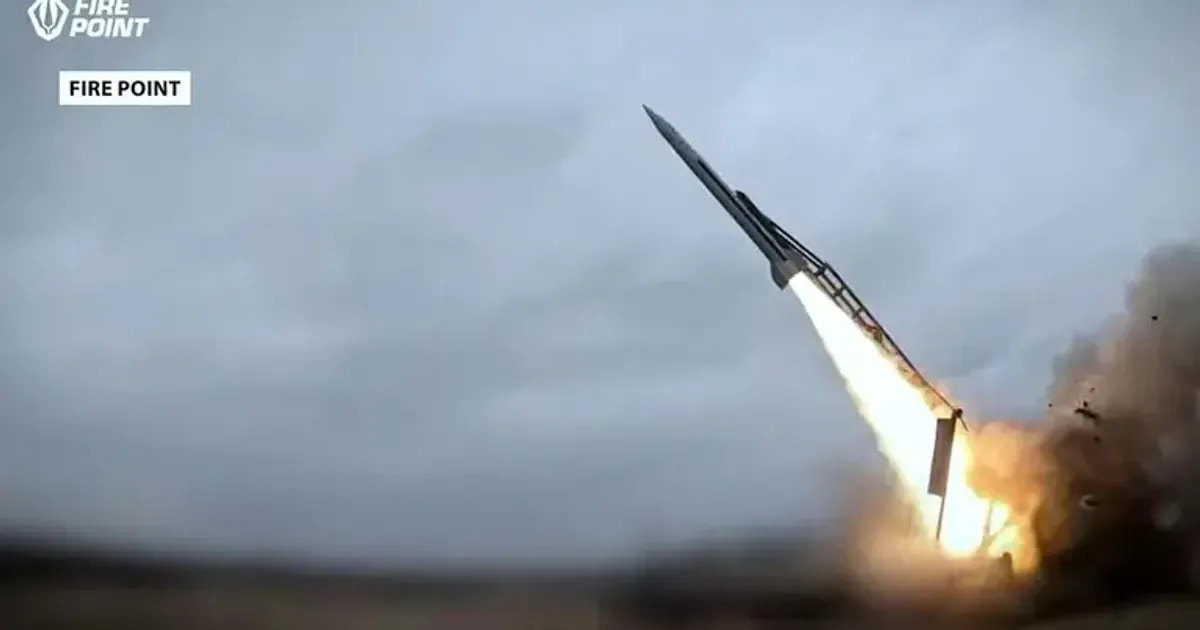
The Ukrainian company Fire Point has taken the FP-7 from its public unveiling and flight tests to its first confirmed combat deployment. On 1 October 2026, President Volodymyr Zelenskyy announced that the tactical ballistic missile had been used in combat for the first time, without disclosing the target or the strike area. The FP-7 is designed as a relatively compact, ground-based, short-range ballistic system: according to the latest information on the Ukrainian version of the manufacturer’s website, it is capable of delivering up to 200 kg of payload over a distance of up to 250 km, to build up speed to 1,500 m/s and reach a height of around 60 km.
- The FP-7 is a Ukrainian tactical ballistic missile manufactured by Fire Point.
- The manufacturer currently claims a range of up to 250 km and a payload of up to 200 kg.
- The maximum stated speed is around 1,500 m/s, and the accuracy is around 14 metres.
- The rocket is launched from the ground and is powered by a solid-fuelled propulsion system.
- On 1 October 2026, Ukraine confirmed the first combat use of the FP-7.
Key features of the FP-7
Fire Point positions itself as FP-7 as a ballistic missile for engaging ground targets at tactical and operational-tactical ranges. The manufacturer’s current Ukrainian website states the range up to 250 km, payload up to 200 kg, maximum speed 1,500 m/s, with a stated accuracy of approximately 14 metres, flight altitude up to 60 km and the maximum flight time to 300 seconds.
| Parameter. | Specified specifications |
|---|---|
| Type | tactical ballistic missile |
| Range | up to 250 km |
| Combat load | up to 200 kg |
| Maximum speed | up to 1,500 m/s |
| Claimed accuracy | about 14 m |
| Maximum height | up to 60 km |
| Maximum flight time | up to 300 s |
| Launch | ground-based |
How the FP-7 ballistic diagram works
Unlike a winged missile, which flies a significant portion of its route within the atmosphere using continuous thrust and aerodynamic control, the FP-7 switches to a ballistic trajectory after acceleration. For much of the flight, the missile travels by inertia, climbing to a height of tens of kilometres and then moving towards the target along the descending portion of its trajectory.
Stated speed 1,500 m/s This corresponds to approximately 5,400 km/h. Care must be taken when converting this directly to a Mach number, as the speed of sound varies significantly depending on altitude and temperature. In public documents, the FP-7 is often described as a system of approximately Mach 4–5.
Its high speed and ballistic trajectory make it more difficult to intercept than slower, long-range UAVs. However, it cannot be concluded from open-source data that the FP-7 is «invulnerable» to modern missile defence systems.
Solid-fuelled engine and ground launch
Published test data indicate that the FP-7 uses solid-fuelled rocket engine. For the military, this offers significant operational advantages: the missile does not require a lengthy refuelling procedure immediately prior to launch and can be kept in a state of high readiness. Fire Point has also announced its own Ukrainian developments in the field of solid rocket propellant and composite casings.
Launch takes place from a ground-based platform. The manufacturer emphasises the system’s mobility and relatively simple architecture. In publicly available videos, the FP-7 is launched from an inclined launch structure, and the engine ignites as the rocket rolls off the launch rail.
This distinguishes the FP-7 from more complex vertical launch systems, but the exact composition of the production launch system and its combat configuration have not been officially disclosed.
It is based on a familiar aerodynamic configuration
One of the most interesting aspects of the FP-7 is the origin of its aerodynamic design. Representatives Fire Point It was said that the design of the missile drew on the experience gained from Soviet anti-aircraft missiles of the S-300/S-400, in particular the 48N6 design. This is not simply a matter of retrofitting an old anti-aircraft missile, but of utilising a tried-and-tested aerodynamic concept with different electronics, control systems, materials and a different combat role.
According to Fire Point, the modern FP-7 shares only a limited number of components with the Soviet-era base design. The casing is made from modern composite materials, and the guidance system was designed specifically for strike missions.
The approach itself is typical of military engineering: rather than developing all aerodynamic solutions from scratch, the manufacturer takes a familiar and well-researched shape and adapts it to modern components.
Navigation and a stated accuracy of 14 metres
Fire Point states For FP-7, the accuracy is approximately 14 metres. In earlier reports, the company also mentioned inertial navigation. There is currently no independent confirmation of the 14-metre accuracy in real combat conditions.
For a ballistic missile of this class, accuracy is a critically important parameter. A 150–200-kilogram warhead is significantly smaller than that of heavier operational-tactical missiles, so high accuracy must compensate for the lower warhead mass when striking compact targets.
At the same time, Fire Point does not disclose the full guidance architecture of the FP-7, which is standard practice for a combat system. Therefore, any claims regarding specific satellite, optical or other correction channels remain mere speculation without confirmation from the manufacturer.
From testing to its first combat deployment
The FP-7 was unveiled alongside the larger FP-9 in 2025. The first public videos of flight tests appeared at the end of February 2026. By August, according to Fire Point’s Chief Executive, Iryna Terekh, the company had conducted approximately 15 test runs, whilst the missile was undergoing procedures relating to codification and military trials.
1 October Volodymyr Zelenskyy reported about The first combat deployment of the FP-7. The launch site, target, range and outcome of the strike have not been officially disclosed. This is a significant limitation: whilst the fact of a live launch has been confirmed, it is not yet possible to assess the system’s actual accuracy, reliability and effectiveness based on publicly available data.
FP-7 and ATACMS — how similar are they?
Fire Point and some media outlets describe the FP-7 as a more economical alternative to the American version ATACMS, but one should not equate the two.
Both systems belong to the class of ground-based short-range ballistic systems, but ATACMS — a mature, mass-produced platform comprising several generations of missiles, various warheads and many years of combat experience. The FP-7 is a considerably newer Ukrainian system, which is only just coming into operational use.
Its potential benefit for Ukraine lies, first and foremost, in in-house production. The domestically produced missile is not as dependent on foreign stocks of ready-made munitions as an imported system, and production can be scaled to meet Ukrainian requirements.
It remains to be seen whether the FP-7 can be produced in truly large quantities. It is mass production, cost and the consistency of its performance that will determine its actual role far more than a single successful launch.
The FP-7 could form the basis of an interceptor missile
The FP-7 technology has another area of development. Fire Point is working on FP-7.x — a variant of the missile intended for use as an interceptor in the European-Ukrainian project missile defence Freyja.
The idea is to use the high-speed FP-7 missile platform as the basis for a more cost-effective means of countering ballistic threats. The Financial Times reported that Fire Point, together with its European partners, is working on integrating the missile with the radar and command components of the future system.
The FP-7, a powerhouse, and the promising FP-7.x — not the same rocket. An interceptor requires different guidance systems, sensors and operational algorithms; therefore, the performance characteristics of the FP-7 strike missile cannot be automatically applied to the future air defence/missile defence system.
What else remains unknown
Following its first combat deployment, the FP-7 can no longer be described as purely an experimental project. However, several key pieces of data are still missing before the system can be fully assessed.
The actual production performance of the Fire Point, the actual cost per missile, the reliability of the claimed accuracy, the composition of the warhead, the final production range, and whether the 250 km/200 kg specifications apply to the upgraded version remain unknown.
That is precisely why FP-7 is now more accurately described as a Ukrainian tactical ballistic system that has completed the transition from testing to operational use, but its full potential will only become apparent once production has been scaled up and practical experience has been gained.